
THE MYSTERIES OF MITHRA
by Franz Cumont
translated from the second revised French edition by Thomas J. McCormack
Chicago, Open Court
[1903]
PREFACE TO THE FRENCH EDITION
THE present work, in which we purpose to treat of the origin and history
of the Mithraic religion, does not pretend to offer a picture of the downfall
of paganism. We shall not attempt, even in a general way, to seek for the causes
which explain the establishment of the Oriental religions in Italy; nor shall
we endeavour to show how their doctrines, which were far more active as fermenting
agents than the theories of the philosophers, decomposed the national beliefs
on which the Roman state and the entire life of antiquity rested, and how the
destruct on of the edifice which they had disintegrated was ultimately accomplished
by Christianity.
We shall not undertake to trace here the various phases of the battle waged
between idolatry and the growing Church; this vast subject, which we hope some
day to approach, lies beyond the scope of the present work. We are concerned
here with one epoch only of this decisive revolution, it being our purpose to
show with all the distinctness in our power how and why a certain Mazdean sect
failed under the Cars to become the dominant religion of the empire.
The civilization of the Greeks had never succeeded in establishing itself
among the Persians, and the Romans were no more successful in subjecting the
Parthians to their sway. The significant fact which dominates the entire history
of Hither Asia is that the Iranian world and the Gro-Latin world remained
forever unamenable to reciprocal assimilation, forever sundered as much by a
mutual repulsion, deep and instinctive, as by their hereditary hostility.
Nevertheless, the religion of the Magi, which was the highest blossom of
the genius of Iran, exercised a deep influence on Occidental culture at three
different periods. In the first place, Parseeism had made a very distinct impression
on Judaism in its formative stage, and several of its cardinal doctrines were
disseminated by Jewish colonists throughout the entire basin of the Mediterranean,
and subsequently even forced themselves on orthodox Catholicism.
The influence of Mazdaism on European thought was still more direct, when
Asia Minor was conquered by the Romans. Here, from time immemorial, colonies
of Magi who had migrated from Babylon lived in obscurity, and, welding together
their traditional beliefs and the doctrines of the Grecian thinkers, had elaborated
little by little in these barbaric regions a religion original despite its complexity.
At the beginning of our era, we see this religion suddenly emerging from
the darkness, and pressing forward, rapidly and simultaneously, into the valleys
of the Danube and the Rhine, and even into the heart of Italy. The nations of
the Occident felt vividly the superiority of the Mazdean faith over their ancient
national creeds, and the populace thronged to the altars of the exotic god.
But the progress of the conquering religion was checked when it came in contact
with Christianity.
The two adversaries discovered with amazement, but with no inkling of their
origin, the similarities which united them; and they severally accused the Spirit
of Deception of having endeavored to caricature the sacredness of their religious
rites. The conflict between the two was inevitable,–a ferocious and implacable
duel: for the stake was the dominion of the world. No one has told the tale
of its changing fortunes, and our imagination alone is left to picture the forgotten
dramas that agitated the souls of the multitudes when they were called upon
to choose between Ormadz and the Trinity.
We know the result of the battle only: Mithraism was vanquished, as without
doubt it should have been. The defeat which it suffered was not due entirely
to the superiority of the evangelical ethics, nor to that of the apostolic doctrine
regarding the teaching of the Mysteries; it perished, not only because it was
encumbered with the onerous heritage of a superannuated past, but also because
its liturgy and its theology had retained too much of its Asiatic coloring to
be accepted by the Latin spirit without repugnance. For a converse reason, the
same battle, waged in the same epoch in Persia between these same two rivals,
was without success, if not without honor, for the Christians; and in the realms
of the Sassanids, Zoroastrianism never once was in serious danger of being overthrown.
The defeat of Mithraism did not, however, utterly annihilate its power. It
had prepared the minds of the Occident for the reception of a new faith, which,
like itself, came also from the banks of the Euphrates, and which resumed hostilities
with entirely different tactics. Manichsm appeared as its successor and continuator.
This was the final assault made by Persia on the Occident,–an assault more
sanguinary than the preceding, but one which was ultimately destined to be repulsed
by the powerful resistance offered to it by the Christian empire.
* * * * *
The foregoing rapid sketch will, I hope, give some idea of the great importance
which the history of Mithraism possesses. A branch torn from the ancient Mazdean
trunk, it has preserved in many respects the characteristics of the ancient
worship of the Iranian tribes; and it will enable us by comparison to understand
the extent, so much disputed, of the Avestan reformation. Again, if it has not
inspired, it has at least contributed to give precise form to, certain doctrines
of the Church, as the ideas relative to the powers of hell and to the end of
the world. And thus both its rise and its decadence combine in explaining to
us the formation of two great religions. In the heyday of its vigor, it exercised
no less remarkable an influence on the society and government of Rome.
Never, perhaps, not even in the epoch of the Mussulman invasion, was Europe
in greater danger of being Asiaticized than in the third century of our era,
and there was a moment in this period when Carism was apparently on the point
of being transformed into a Caliphate.
The resemblances which the court of Diocletian bore to that of Chosroes have
been frequently emphasized. It was the worship of the sun, and in particular
the Mazdean theories, that disseminated the ideas upon which the deified sovereigns
of the West endeavored to rear their monarchical absolutism. The rapid spread
of the Persian Mysteries among all classes of the population served admirably
the political ambitions of the emperors. A sudden inundation of Iranian and
Semitic conceptions swept over the Occident, threatening to submerge everything
that the genius of Greece and Rome had so laboriously erected, and when the
flood subsided it left behind in the conscience of the people a deep sediment
of Oriental beliefs, which have never been completely obliterated.
I believe I have said sufficient to show that the subject of which I am about
to treat is deserving of exhaustive and profound study. Although my investigations
have carried me, on many sides, much farther than I had at the outset intended
to go, I still do not regret the years of labor and of travel which they have
caused me. The work which I have undertaken could not have been other than difficult.
On the one hand, we do not know to what precise degree the Avesta and the
other sacred books of the Parsees represent the ideas of the Mazdeans of the
Occident; on the other, these books constitute the sole material in our possession
for interpreting the great mass of figured monuments which have gradually been
collected. The inscriptions by themselves are always a sure guide, but their
contents are upon the whole very meager. Our predicament is somewhat similar
to that in which we should find ourselves if we were called upon to write the
history of the Church of the Middle Ages with no other sources at our command
than the Hebrew Bible and the sculptured dris of Roman and Gothic portals.
For this reason, our explanations of the Mithraic imagery will frequently
possess nothing more than a greater or less degree of probability. I make no
pretension to having reached in all cases a rigorously exact decipherment of
these hieroglyphics, and 1 am anxious to ascribe to my opinions nothing but
the value of the arguments which support them. 1 hope nevertheless to have established
with certainty the general signification of the sacred images which adorned
the Mithraic crypts. On the details of their recondite symbolism it is difficult
to throw much light. We are frequently forced to take refuge here in the ars
nesciendi.
The following pages reproduce the “Conclusions” printed at the end of the
first volume of my large work, Textes et monuments figur relatifs aux mystes
de Mithra (Brussels: H. Lamertin). 1 Stripped of the
notes and references which there served to establish them, they are confined
to epitomizing and co-ordinating the sum-total of the knowledge we possess concerning
the origin and the characteristic features of the Mithraic religion. They will
furnish, in fact, all the material necessary for readers desirous of general
information on this subject.
To impart the same solidity to all the various portions of the edifice we
have been reconstructing has been impossible. The uncertainties and discontinuity
of the tradition do not permit this. Persons desirous of examining the stability
of the foundations upon which my expositions rest, should consult the critical
discussions of the “Introduction” to my larger work, the purpose of which is
to ascertain the meaning and value of the written documents, and especially
of the figured monuments, there described.
During the long period in which this work has been in preparation I have
been frequently obliged to resort to that community of interest and sentiment
which unites men of science throughout the world, and I may say I have rarely
appealed to it in vain. The courtesy of devoted friends, several of whom are
now no more, has often anticipated the expression of my wishes, and has spontaneously
placed at my disposal things which I could scarcely have dared to request. I
have endeavored in my large work to make due acknowledgment to each one of them.
It would not be fitting to give in this place a mere mechanical list of the
names of my collaborators, and by bestowing upon them commonplace thanks to
appear in the light of cancelling the indebtedness which I owe them. But it
is with a feeling of profound gratitude that I recall to mind the services which
have been lavished upon me, and that, having now reached the end of my task,
after more than ten years, I still think of all who have aided me in completing
it.
The first edition of the present work appeared in 1900, and a second was
called for not long afterwards. Few changes have been made. We have added a
few notes, made a few references to recent articles, and adorned the pages with
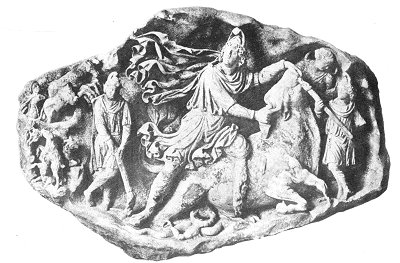
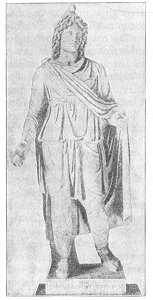
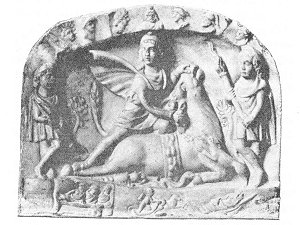
a considerable number of illustrations. 2 The most important
addition is the chapter on Mithraic sculpture, which, in view of the extensive
researches now being made as to the Oriental origins of Roman art, cannot fail
to be of interest.
We have also to thank the many critics who have so kindly reviewed our Mysteries
of Mithra, and have generously acknowledged that our reconstruction of this
vanished creed rests upon an objective and complete interpretation of the sources.
In a matter which is still so obscure, it was inevitable that certain divergences
of opinion should have come to light, and our conclusions, at times bold, may,
in certain points, have appeared to some erroneous. We have had regard for these
expressions of doubt in our revision. If we have not always felt obliged to
modify our opinion, it is not because we have not weighed the arguments of our
critics, but because in so small a volume as the present, from which all discussions
must be excluded, we had not the space to substantiate our conclusions. It is
a delicate matter, we grant, to publish a text without the notes which support,
explain, and modify it; but we trust that the reader will not feel too keenly
this inevitable omission.
FRANZ CUMONT.
GHENT, May 1st, 1902.
Footnotes
1 Large octavo, 931
pages, 507 illustrations and 9 photogravure plates. This work, which is a monument
of scholarship and industry, is a complete descriptive and critical collection
of all the Mithraic texts, inscriptions, references, and monuments that have
been recovered from antiquity.
2 The illustrations
of the French edition numbered twenty-two. The present English edition contains
more than double that number.


Leave A Comment