
Aelius Spartianus
The Life of Hadrian
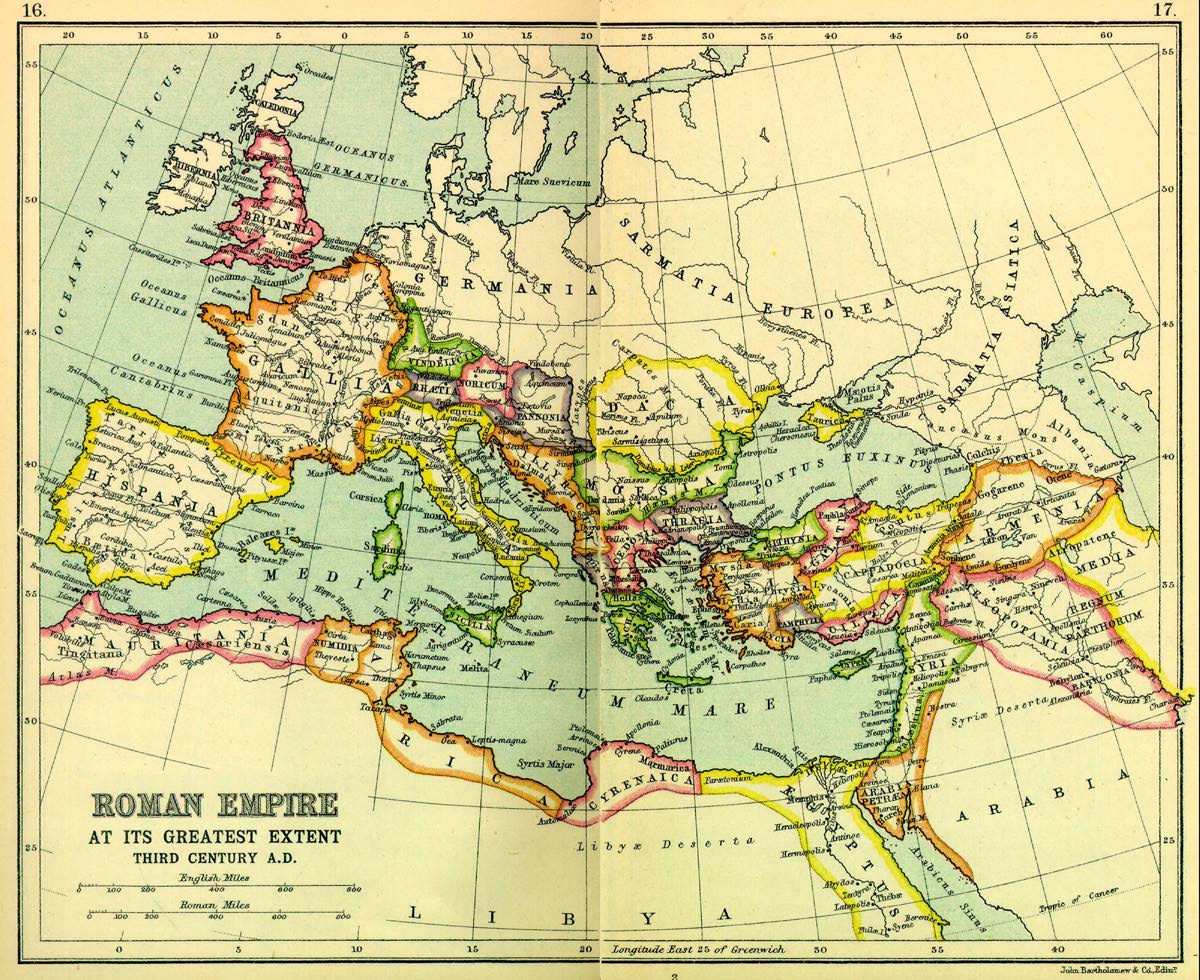
Under Hadrian (r. 117-138 CE.) the Roman Empire reached its acme of prosperity.
The Emperor, himself a man of remarkable and varied genius, although not always
of just and even temperament, seemed anxious to conceal the real despotism of
his government by the enlightened use of his power. No new conquests were made,
but many internal reforms were executed. Hadrian also was a great traveler, and
spent much of his reign going up and down his vast empire, heaping benefits upon
the communities with which he sojourned.
In many places where he visited the frontiers, which were not separated from
the Barbarians by rivers, Hadrian raised a kind of wall, by driving into the ground
great piles. He set up a king over the Germans, and he quenched the seditious
movements of the Moors, for which deed the Senate ordered thanksgivings to the
Gods. A single interview was sufficient for Hadrian to stop a war with the Parthians
that seemed to threaten. Then he sailed by way of Asia and the Islands to Achaia;
and after the example of Hercules and Philip he was admitted to the Eleusinian
mysteries. He bestowed many benefits upon the Athenians and presided at their
games. It was noticed in Achaia, that though many persons with swords assisted
at the religious ceremonies, nevertheless none of the suite of Hadrian came armed.
He passed next into Sicily, where he ascended Mt. Aetna to see the sun rise, which
seems there to form a bow of variegated colors. Next he went to Rome, and thence
to Africa, where he heaped benefactions upon the province. Never did a Prince
traverse over the Empire with such celerity!
After that, returning from Africa to Rome, he went quickly again to the East,
and passing by way of Athens, he dedicated the public works which he had formerly
commenced there; such as a temple to Jupiter the Olympian, and an altar upon which
he bestowed his own name. In Cappadocia he took some slaves which he intended
for camp service. He proffered his friendship to the princes and kings of the
region, and he did the same to Chosroes, king of Parthia, to whom he returned
the latter’s daughter, who had been made captive by Trajan.
While traversing the provinces he punished according to their crimes the various
governors and procurators; and did so with such severity that he seemed to actually
stimulate their accusers. After having crossed Arabia, the Emperor came to Pelusium,
where he erected a splendid monument to Pompey. While sailing on the Nile he lost
his beloved favorite Antino, whom he mourned as over a woman. There are various
stories about this young man. Some say he sacrificed himself to save Hadrian’s
life; others give widely differing accounts as to the Emperor’s liking for him.
The Greeks, with their sovereign’s consent accorded the memory of Antino divine
honors.
This ruler loved poetry, and cultivated carefully all branches of literature.
He understood likewise arithmetic, geometry, and painting. He danced and sang
extremely well, his bent for sensuous pleasure being extreme. He made many verses
for his favorites, and wrote love poems. He handled weapons with much skill, and
was a master of the military art. He also devoted some little time to the exercises
of gladiators. Now severe, now merry, now voluptuous, now self-contained, now
cruel, now merciful, this Emperor seemed never the same. He enriched his friends
liberally, but finally growing suspicious of some put them to death or ruined
them.
He enjoyed literary and philosophical discussions, but it was not safe to defeat
him in them. Favorinus (a famous philosopher and orator), when his friends blamed
him for surrendering to Hadrian’s criticism as to his use of a word when he had
good authority on his side, laughed and replied, “You can never persuade me, good
friends, that the commander of thirty legions is not the best-qualified critic
in the world!”
When he sat as judge he was aided not merely by his friends and his courtiers,
but by many famous Jurisconsulti, all approved by the Senate. He enacted among
other things that no one should destroy houses in one city to transport the materials
to another city. He awarded to children of proscribed persons, a twelfth part
of their father’s estate. He did not admit accusations tor the crime of lese-majest
He refused the bequests of persons whom he had not known, and did not accept those
of personal acquaintances, if they had children. He enacted that whoever found
a treasure on his own land should keep it. If one found treasure on the property
of some one else, he could keep half—the rest went to the proprietor.
He took away the right of masters to kill their slaves, requiring that if the
slaves deserved it, they should be condemned to death by the regular judges. He
abolished the special dungeons for slaves and freedmen. Also, hereafter, not all
the slaves of a master who was murdered in his home by a slave were to suffer
death as formerly, but only those within reach of his outcries.
Hadrian had also a most agreeable style of conversation, even towards persons
of decidedly humble rank. He hated those who seemed to envy him this natural pleasure,
under pretext of causing “the Majesty of the Throne” to be respected. At the Museum
of Alexandria he proposed many questions to the professors there, and satisfied
himself as to the facts. He had a remarkable memory, and great talents (for oratory),
preparing his own orations and responses without aid of a secretary. He had a
great faculty for remembering names without prompting; it was enough to have met
persons once, he could then even aid the nomenclators if they made a mistake.
He remembered all the old veterans whom he had pensioned off. He wrote, dictated,
heard others, and conversed with his friends; and all at the same time!
Source:
From: William Stearns Davis, ed., Readings in Ancient History: Illustrative
Extracts from the Sources, 2 Vols. (Boston: Allyn and Bacon, 1912-13), Vol. II:
Rome and the West, pp.??
Scanned by: J. S. Arkenberg, Dept. of History, Cal. State Fullerton. Prof.
Arkenberg has modernized the text.
Emperor Hadrian
I. The original home of the family of the Emperor Hadrian was Picenum, the
later, Spain; for Hadrian himself relates in his autobiography that his forefathers
came from Hadria, but settled in Italica in the time of the Scipios. The father
of Hadrian was Aelius Hadrianus, surnamed Afer, a cousin of the Emperor Trajan;
his mother was Domitia Paulina, a native of Cadiz; his sister was Paulina, the
wife of Servianus, his wife was Sabina, and his great-grandfather’s grandfather
was Marullinus, the first of his family to be a Roman senator.
Hadrian was born on the ninth day before the Kalends of February in the seventh
consulship of Vespasian and the fifth of Titus. Bereft of his father at the age
of ten, he became the ward of Ulpius Trajanus, his cousin, then of praetorian
rank, but afterwards emperor, and of Caelius Attianus, a knight. He then grew
rather deeply devoted to Greek studies, to which his natural tastes inclined so
much that some called him “Greekling.”
II. He returned to his native city in his fifteenth year and at once entered
military service, but was so fond of hunting that he incurred criticism for it,
and for this reason Trajan recalled him from Italica. Thenceforth he was treated
by Trajan as his own son, and not long afterwards was made one of the ten judges
of the inheritance-court, and, later, tribune of the Second Legion, the Adjutrix.
After this, when Domitian’s principate was drawing to a close, he was transferred
to the province of Lower Moesia. There, it is said, he heard from an astrologer
the same prediction of his future power which had been made, as he already knew,
by his great-uncle, Aelius Hadrianus, a master of astrology. When Trajan was adopted
by Nerva, Hadrian was sent to convey to him the army’s congratulations and was
at once transferred to Upper Germany. When Nerva died, he wished to be the first
to bring the news to Trajan, but as he was hastening to meet him he was detained
by his brother-in-law, Servianus, the same man who had revealed Hadrian’s extravagance
and indebtedness and thus stirred Trajan’s anger against him. He was further delayed
by the fact that his travelling-carriage had been designedly broken, but he nevertheless
proceeded on foot and anticipated Servianus’ personal messenger. And now he became
a favourite of Trajan’s, and yet, owing to the activity of the guardians of certain
boys whom Trajan loved ardently, he was not free from . . . which Gallus fostered.
Indeed, at this time he was even anxious about the Emperor’s attitude towards
him, and consulted the Vergilian oracle. This was the lot given out:
But who is yonder man, by olive wreath / Distinguished, who the sacred
vessel bears? / I see a hoary head and beard. Behold / The Roman King whose laws
shall establish Rome / Anew, from tiny Cures’ humble land / Called to a mighty
realm. Then shall arise …
Others, however, declare that this prophecy came to him from the Sybilline
Verses. Moreover, he received a further intimation of his subsequent power, in
a response which issued from the temple of Jupiter at Nicephorium and has been
quoted by Apollonius of Syria, the Platonist. Finally, through the good offices
of Sura, he was instantly restored to a friendship with Trajan that was closer
than ever, and he took to wife the daughter of the Emperor’s sister — a marriage
advocated by Plotina, but, according to Marius Maximus, little desired by Trajan
himself.
III. He held the quaestorship in the fourth consulship of Trajan and in the
first of Articuleius, and while holding this office he read a speech of the Emperor’s
to the senate and provoked a laugh by his somewhat provincial accent. He thereupon
gave attention to the study of Latin until he attained the utmost proficiency
and fluency. After his quaestorship he served as curator of the acts of the senate,
and later accompanied Trajan in the Dacian war on terms of considerable intimacy,
seeing, indeed, that falling in with Trajan’s habits, as he says himself, he partook
freely of wine, and for this was very richly rewarded by the Emperor. He was made
tribune of the plebs in the second consulship of Candidus and Quadratus, and he
claimed that he received an omen of continuous tribunician power during this magistracy,
because he lost the heavy cloak which is worn by the tribunes of the plebs in
rainy weather, but never by the emperors. And down to this day the emperors do
not wear cloaks when they appear in public before civilians. In the second Dacian
war, Trajan appointed him to the command of the First Legion, the Minervia, and
took him with him to the war; and in this campaign his many remarkable deeds won
great renown. Because of this he was presented with a diamond which Trajan himself
had received from Nerva, and by this gift he was encouraged in his hopes of succeeding
to the throne. He held the praetorship in the second consulship of Suburanus and
Servianus, and again received from Trajan two million sesterces with which to
give games. Next he was sent as praetorian legate to Lower Pannonia, where he
held the Samartians in check, maintained discipline among the soldiers, and restrained
the procurators, who were overstepping too freely the bounds of their power. In
return for these services he was made consul. While he was holding this office
he learned from Sura that he was to be adopted by Trajan, and thereupon he ceased
to be an object of contempt and neglect to Trajan’s friends. Indeed, after Sura’s
death Trajan’s friendship for him increased, principally on account of the speeches
which he composed for the Emperor.
IV. He enjoyed, too, the favour of Plotina, and it was due to her interest
that later, at the time of the campaign against Parthia, he was appointed legate
to the Emperor. At this same time he enjoyed, besides, the friendship of Sosius
Papus and Platorius Nepos, both of the senatorial order, and also of Attianus,
his former guardian, of Livianus, and of Turbo, all of equestrian rank. And when
Palma and Celsus, always his enemies, on whom he later took vengeance, fell under
suspicion of aspiring to the throne, his adoption seemed assured; and it was taken
wholly for granted when, through Plotina’s favour, he was appointed consul for
the second time. That he was bribing Trajan’s freedmen and courting his favourites
all the while that he was in close attendance at court, was told and generally
believed.
On the fifth day before the Ides of August, while he was governor of Syria,
he learned of his adoption by Trajan, and he later gave orders to celebrate this
day as the anniversary of his adoption. On the third day before the Ides of August
he received the news of Trajan’s death, and this day he appointed as the anniversary
of his accession.
There was, to be sure, a widely prevailing belief that Trajan, with the approval
of many of his friends, had planned to appoint as his successor not Hadrian but
Neratius Priscus, even to the extent of once saying to Priscus: “I entrust the
provinces to your care in case anything happens to me.” And, indeed, many aver
that Trajan had purposed to follow the example of Alexander of Macedonia and die
without naming a successor. Again, many others declare that he had meant to send
an address to the senate, requesting this body, in case aught befell him, to appoint
a ruler for the Roman Empire, and merely appending the names of some from among
whom the senate might choose the best. And the statement has even been made that
it was not until Trajan’s death that Hadrian was declared adopted, and then only
by means of a trick of Plotina’s; for she smuggled in someone who impersonated
the Emperor and spoke in a feeble voice.
V. On taking possession of the imperial power Hadrian at once resumed the policy
of the early emperors, and devoted his attention to maintaining peace throughout
the world. For the nations which Trajan had conquered began to revolt; the Moors,
moreover, began to make attacks, and the Sarmatians to wage war, the Britons could
not be kept under Roman sway, Egypt was thrown into disorder by riots, and finally
Libya and Palestine showed the spirit of rebellion. Whereupon he relinquished
all the conquests east of the Euphrates and the Tigris, following, as he used
to say, the example of Cato, who urged that the Macedonians, because they could
not be held as subjects, should be declared free and independent. And Parthamasiris,
appointed king of the Parthians by Trajan, he assigned as ruler to the neighbouring
tribes, because he saw that the man was held in little esteem by the Parthians.
Moreover, he showed at the outset such a wish to be lenient, that although
Attianus advised him by letter in the first few days of his rule to put to death
Baebius Macer, the prefect of the city, in case he opposed his elevation to power,
also Laberius Maximus, then in exile on an island under suspicion of designs on
the throne, and likewise Crassus Frugi, he nevertheless refused to harm them.
Later on, however, his procurator, though without an order from Hadrian, had Crassus
killed when he tried to leave the island, on the ground that he was planning a
revolt. He gave a double donative to the soldiers in order to ensure a favourable
beginning to his principate. He deprived Lusius Quietus of the command of the
Moorish tribesmen, who were serving under him, and then dismissed him from the
army, because he had fallen under the suspicion of having designs on the throne;
and he appointed Marcius Turbo, after his reduction of Judaea, to quell the insurrection
in Mauretania.
After taking these measures he set out from Antioch to view the remains of
Trajan, which were being escorted by Attianus, Plotina, and Matidia. He received
them formally and sent them on to Rome by ship, and at once returned to Antioch;
he then appointed Catilius Severus governor of Syria, and proceeded to Rome by
way of Illyricum.
VI. Despatching to the senate a carefully worded letter, he asked for divine
honours for Trajan. This request he obtained by a unanimous vote; indeed, the
senate voluntarily voted Trajan many more honours than Hadrian had requested.
In this letter to the senate he apologized because he had not left it the right
to decide regarding his accession, explaining that the unseemly haste of the troops
in acclaiming him emperor was due to the belief that the state could not be left
without an emperor. Later, when the senate offered him the triumph which was to
have been Trajan’s, he refused it for himself, and caused the effigy of the dead
Emperor to be carried in a triumphal chariot, in order that the best of emperors
might not lose even after death the honour of a triumph. Also he refused for the
present the title of Father of his Country, offered to him at the time of his
accession and again later on, giving as his reason the fact that Augustus had
not won it until late in life. Of the crown-money for his triumph he remitted
Italy’s contribution, and lessened that of the provinces, all the while setting
forth grandiloquently and in great detail the straits of the public treasury.
Then, on hearing of the incursions of the Sarmatians and Roxolani, he sent
the troops ahead and set out for Moesia. He conferred the insignia of a prefect
on Marcius Turbo after his Mauretanian campaign and appointed him to the temporary
command of Pannonia and Dacia. When the king of the Roxolani complained of the
diminution of his subsidy, he investigated his case and made peace with him.
VII. A plot to murder him while sacrificing was made by Nigrinus, with Lusius
and a number of others as accomplices, even though Hadrian had destined Nigrinus
for the succession; but Hadrian successfully evaded this plot. Because of this
conspiracy Palma was put to death at Tarracina, Celsus at Baiae, Nigrinus at Faventia,
and Lusius on his journey homeward, all by order of the senate, but contrary to
the wish of Hadrian, as he says himself in his autobiography. Whereupon Hadrian
entrusted the command in Dacia to Turbo, whom he dignified, in order to increase
his authority, with a rank analagous to that of the prefect of Egypt. He then
hastened to Rome in order to win over public opinion, which was hostile to him
because of the belief that on one single occasion he had suffered four men of
consular rank to be put to death. In order to check the rumours about himself,
he gave in person a double largess to the people, although in his absence three
aurei had already been given to each of the citizens. In the senate, too, he cleared
himself of blame for what had happened, and pledged himself never to inflict punishment
on a senator until after a vote of the senate. He established a regular imperial
post, in order to relieve the local officials of such a burden. Moreover, he used
every means of gaining popularity. He remitted to private debtors in Rome and
in Italy immense sums of money owed to the privy-purse, and in the provinces he
remitted large amounts of arrears; and he ordered the promissory notes to be burned
in the Forum of the Deified Trajan, in order that the general sense of security
might thereby be increased. He gave orders that the property of condemned persons
should not accrue to the privy-purse, and in each case deposited the whole amount
in the public treasury. He made additional appropriations for the children to
whom Trajan had allotted grants of money. He supplemented the property of senators
impoverished through no fault of their own, making the allowance in each case
proportionate to the number of children, so that it might be enough for a senatorial
career; to many, indeed, he paid punctually on the date the amount allotted for
their living. Sums of money sufficient to enable men to hold office he bestowed,
not on his friends alone, but also on many far and wide, and by his donations
he helped a number of women to sustain life. He gave gladiatorial combats for
six days in succession, and on his birthday he put into the arena a thousand wild
beasts.
VIII. The foremost members of the senate he admitted to close intimacy with
the emperor’s majesty. All circus-games decreed in his honour he refused, except
those held to celebrate his birthday. Both in meetings of the people and in the
senate he used to say that he would so administer the commonwealth that men would
know that it was not his own but the people’s. Having himself been consul three
times, he reappointed many to the consulship for the third time and men without
number to a second term; his own third consulship he held for only four months,
and during his term he often administered justice. He always attended regular
meetings of the senate if he was present in Rome or even in the neighbourhood.
In the appointment of senators he showed the utmost caution and thereby greatly
increased the dignity of the senate, and when he removed Attianus from the post
of prefect of the guard and created him a senator with consular honours, he made
it clear that he had no greater honour which he could bestow upon him. Nor did
he allow knights to try cases involving senators whether he was present at the
trial or not. For at that time it was customary for the emperor, when he tried
cases, to call to his council both senators and knights and give a verdict based
on their joint decision. Finally, he denounced those emperors who had not shown
this deference to the senators. On his brother-in-law Servianus, to whom he showed
such respect that he would advance to meet him as he came from his chamber, he
bestowed a third consulship, and that without any request or entreaty on Servianus’
part; but nevertheless he did not appoint him as his own colleague, since Servianus
had been consul twice before Hadrian, and the Emperor did not wish to have second
place.
IX. And yet, at the same time, Hadrian abandoned many provinces won by Trajan,
and also destroyed, contrary to the entreaties of all, the theatre which Trajan
had built in the Campus Martius. These measures, unpopular enough in themselves,
were still more displeasing to the public because of his pretence that all acts
which he thought would be offensive had been secretly enjoined upon him by Trajan.
Unable to endure the power of Attianus, his prefect and formerly his guardian,
he was eager to murder him. He was restrained, however, by the knowledge that
he already laboured under the odium of murdering four men of consular rank, although,
as a matter of fact, he always attributed their execution to the designs of Attianus.
And as he could not appoint a successor for Attianus except at the latter’s request,
he contrived to make him request it, and at once transferred the power to Turbo;
at the same time Similis also, the other prefect, received a successor, namely
Septicius Clarus.
After Hadrian had removed from the prefecture the very men to whom he owed
the imperial power, he departed for Campania, where he aided all the towns of
the region by gifts and benefactions and attached all the foremost men to his
train of friends. But when at Rome, he frequently attended the official functions
of the praetors and consuls, appeared at the banquets of his friends, visited
them twice or thrice a day when they were sick, even those who were merely knights
and freedmen, cheered them by words of comfort, encouraged them by words of advice,
and very often invited them to his own banquets. In short, everything that he
did was in the manner of a private citizen. On his mother-in-law he bestowed especial
honour by means of gladiatorial games and other ceremonies.
X. After this he travelled to the provinces of Gaul, and came to the relief
of all the communities with various acts of generosity; and from there he went
over into Germany. Though more desirous of peace than of war, he kept the soldiers
in training just as if war were imminent, inspired them by proofs of his own powers
of endurance, actually led a soldier’s life among the maniples, and, after the
example of Scipio Aemilianus, Metellus, and his own adoptive father Trajan, cheerfully
ate out of doors such camp-fare as bacon, cheese and vinegar. And that the troops
might submit more willingly to the increased harshness of his orders, he bestowed
gifts on many and honours on a few. For he re-established the discipline of the
camp, which since the time of Octavian had been growing slack through the laxity
of his predecessors. He regulated, too, both the duties and the expenses of the
soldiers, and now no one could get a leave of absence from camp by unfair means,
for it was not popularity with the troops but just deserts that recommended a
man for appointment as tribune. He incited others by the example of his own soldierly
spirit; he would walk as much as twenty miles fully armed; he cleared the camp
of banqueting-rooms, porticoes, grottos, and bowers, generally wore the commonest
clothing, would have no gold ornaments on his sword-belt or jewels on the clasp,
would scarcely consent to have his sword furnished with an ivory hilt, visited
the sick soldiers in their quarters, selected the sites for camps, conferred the
centurion’s wand on those only who were hardy and of good repute, appointed as
tribunes only men with full beards or of an age to give to the authority of the
tribuneship the full measure of prudence and maturity, permitted no tribune to
accept a present from a soldier, banished luxuries on every hand, and, lastly,
improved the soldiers’ arms and equipment. Furthermore, with regard to length
of military service he issued an order that no one should violate ancient usage
by being in the service at an earlier age than his strength warranted, or at a
more advanced one than common humanity permitted. He made it a point to be acquainted
with the soldiers and to know their numbers.
XI. Besides this, he strove to have an accurate knowledge of the military stores,
and the receipts from the provinces he examined with care in order to make good
any deficit that might occur in any particular instance. But more than any other
emperor he made it a point not to purchase or maintain anything that was not serviceable.
And so, having reformed the army quite in the manner of a monarch, he set out
for Britain, and there he corrected many abuses and was the first to construct
a wall, eighty miles in length, which was to separate the barbarians from the
Romans.
He removed from office Septicius Clarus, the prefect of the guard, and Suetonius
Tranquillus, the imperial secretary, and many others besides, because without
his consent they had been conducting themselves toward his wife, Sabina, in a
more informal fashion than the etiquette of the court demanded. And, as he was
himself wont to say, he would have sent away his wife too, on the ground of ill-temper
and irritability, had he been merely a private citizen. Moreover, his vigilance
was not confined to his own household but extended to those of his friends, and
by means of his private agents he even pried into all their secrets, and so skilfully
that they were never aware that the Emperor was acquainted with their private
lives until he revealed it himself. In this connection, the insertion of an incident
will not be unwelcome, showing that he found out much about his friends. The wife
of a certain man wrote to her husband, complaining that he was so preoccupied
by pleasures and baths that he would not return home to her, and Hadrian found
this out through his private agents. And so, when the husband asked for a furlough,
Hadrian reproached him with his fondness for his baths and his pleasures. Whereupon
the man exclaimed: “What, did my wife write you just what she wrote to me?” And,
indeed, as for this habit of Hadrian’s, men regard it as a most grievous fault,
and add to their criticism the statements which are current regarding the passion
for males and the adulteries with married women to which he is said to have been
addicted, adding also the charges that he did not even keep faith with his friends.
XII. After arranging matters in Britain he crossed over to Gaul, for he was
rendered anxious by the news of a riot in Alexandria, which arose on account of
Apis; for Apis had been discovered again after an interval of many years, and
was causing great dissension among the communities, each one earnestly asserting
its claim as the place best fitted to be the seat of his worship. During this
same time he reared a basilica of marvellous workmanship at Nimes in honour of
Plotina. After this he travelled to Spain and spent the winter at Tarragona, and
here he restored at his own expense the temple of Augustus. To this place, too,
he called all the inhabitants of Spain for a general meeting, and when they refused
to submit to a levy, the Italian settlers jestingly, to use the very words of
Marius Maximus, and the others very vigorously, he took measures characterized
by skill and discretion. At this same time he incurred grave danger and won great
glory; for while he was walking about in a garden at Tarragona one of the slaves
of the household rushed at him madly with a sword. But he merely laid hold on
the man, and when the servants ran to the rescue handed him over to them. Afterwards,
when it was found that the man was mad, he turned him over to the physicians for
treatment, and all this time showed not the slightest sign of alarm.
During this period and on many other occasions also, in many regions where
the barbarians are held back not by rivers but by artificial barriers, Hadrian
shut them off by means of high stakes planted deep in the ground and fastened
together in the manner of a palisade. He appointed a king for the Germans, suppressed
revolts among the Moors, and won from the senate the usual ceremonies of thanksgiving.
The war with the Parthians had not at that time advanced beyond the preparatory
stage, and Hadrian checked it by a personal conference.
XIII. After this Hadrian travelled by way of Asia and the islands to Greece,
and, following the example of Hercules and Philip, had himself initiated into
the Eleusinian mysteries. He bestowed many favours on the Athenians and sat as
president of the public games. And during this stay in Greece care was taken,
they say, that when Hadrian was present, none should come to a sacrifice armed,
whereas, as a rule, many carried knives. Afterwards he sailed to Sicily, and there
he climbed Mount Aetna to see the sunrise, which is many-hued, they say, like
a rainbow. Thence he returned to Rome, and from there he crossed over to Africa,
where he showed many acts of kindness to the provinces. Hardly any emperor ever
travelled with such speed over so much territory.
Finally, after his return to Rome from Africa, he immediately set out for the
East, journeying by way of Athens. Here he dedicated the public works which he
had begun in the city of the Athenians, such as the temple to Olympian Jupiter
and an altar to himself; and in the same way, while travelling through Asia, he
consecrated the temples called by his name. Next, he received slaves from the
Cappadocians for service in the camps. To petty rulers and kings he made offers
of friendship, and even to Osdroes, king of the Parthians. To him he also restored
his daughter, who had been captured by Trajan, and promised to return the throne
captured at the same time. And when some of the kings came to him, he treated
them in such a way that those who had refused to come regretted it. He took this
course especially on account of Pharasmanes, who had haughtily scorned his invitation.
Furthermore, as he went about the provinces he punished procurators and governors
as their actions demanded, and indeed with such severity that it was believed
that he incited those who brought the accusations.
XIV. In the course of these travels he conceived such a hatred for the people
of Antioch that he wished to separate Syria from Phoenicia, in order that Antioch
might not be called the chief city of so many communities. At this time also the
Jews began war, because they were forbidden to practise circumcision. As he was
sacrificing on Mount Casius, which he had ascended by night in order to see the
sunrise, a storm arose, and a flash of lightning descended and struck both the
victim and the attendant. He then travelled through Arabia and finally came to
Pelusium, where he rebuilt Pompey’s tomb on a more magnificent scale. During a
journey on the Nile he lost Antinous, his favourite, and for this youth he wept
like a woman. Concerning this incident there are varying rumours; for some claim
that he had devoted himself to death for Hadrian, and others — what both his
beauty and Hadrian’s sensuality suggest. But however this may be, the Greeks deified
him at Hadrian’s request, and declared that oracles were given through his agency,
but these, it is commonly asserted, were composed by Hadrian himself.
In poetry and in letters Hadrian was greatly interested. In arithmetic, geometry,
and painting he was very expert. Of his knowledge of flute-playing and singing
he even boasted openly. He ran to excess in the gratification of his desires,
and wrote much verse about the subjects of his passion. He composed love-poems
too. He was also a connoisseur of arms, had a thorough knowledge of warfare, and
knew how to use gladiatorial weapons. He was, in the same person, austere and
genial, dignified and playful, dilatory and quick to act, niggardly and generous,
deceitful and straightforward, cruel and merciful, and always in all things changeable.
XV. His friends he enriched greatly, even though they did not ask it, while
to those who did ask, he refused nothing. And yet he was always ready to listen
to whispers about his friends, and in the end he treated almost all of them as
enemies, even the closest and even those whom he had raised to the highest of
honours, such as Attianus and Nepos and Septicius Clarus. Eudaemon, for example,
who had been his accomplice in obtaining the imperial power, he reduced to poverty;
Polaenus and Marcellus he drove to suicide; Heliodorus he assailed in a most slanderous
pamphlet; Titianus he allowed to be accused as an accomplice in an attempt to
seize the empire and even to be outlawed; Ummidius Quadratus, Catilius Severus,
and Turbo he persecuted vigorously; and in order to prevent Servianus, his brother-in-law,
from surviving him, he compelled him to commit suicide, although the man was then
in his ninetieth year. And he even took vengeance on freedmen and sometimes on
soldiers. And although he was very deft at prose and at verse and very accomplished
in all the arts, yet he used to subject the teachers of these arts, as though
more learned than they, to ridicule, scorn, and humiliation. With these very professors
and philosophers he often debated by means of pamphlets or poems issued by both
sides in turn. And once Favorinus, when he had yielded to Hadrian’s criticism
of a word which he had used, raised a merry laugh among his friends. For when
they reproached him for having done wrong in yielding to Hadrian in the matter
of a word used by reputable authors, he replied: “You are urging a wrong course,
my friends, when you do not suffer me to regard as the most learned of men the
one who has thirty legions.”
XVI. So desirous of a wide-spread reputation was Hadrian that he even wrote
his own biography; this he gave to his educated freedmen, with instructions to
publish it under their own names. For indeed, Phlegon’s writings, it is said,
are Hadrian’s in reality. He wrote Catachannae, a very obscure work in imitation
of Antimachus. And when the poet Florus wrote to him:
I don’t want to be a Caesar,
Stroll about among the Britons,
Lurk about among the . . . .
And endure the Scythian winters,
he wrote back:
I don’t want to be a Florus,
Stroll about among the taverns,
Lurk about among the cook-shops,
And endure the round fat insects.
Furthermore, he loved the archaic style of writing, and he used to take part
in debates. He preferred Cato to Cicero, Ennius to Vergil, Caelius to Sallust;
and with the same self-assurance he expressed opinions about Homer and Plato.
In astrology he considered himself so proficient that on the Kalends of January
he would actually write down all that might happen to him in the whole ensuing
year, and in the year in which he died, indeed, he wrote down everything that
he was going to do, down to the very hour of his death.
However ready Hadrian might have been to criticize musicians, tragedians, comedians,
grammarians, and rhetoricians, he nevertheless bestowed both honours and riches
upon all who professed these arts, though he always tormented them with his questions.
And although he was himself responsible for the fact that many of them left his
presence with their feelings hurt, to see anyone with hurt feelings, he used to
say, he could hardly endure. He treated with the greatest friendship the philosophers
Epictetus and Heliodorus, and various grammarians, rhetoricians, musicians, geometricians
— not to mention all by name — painters and astrologers; and among them Favorinus,
many claim, was conspicuous above all the rest. Teachers who seemed unfit for
their profession he presented with riches and honours and then dismissed from
the practice of their profession.
XVII. Many whom he had regarded as enemies when a private citizen, when emperor
he merely ignored; for example, on becoming emperor, he said to one man whom he
had regarded as a mortal foe, “You have escaped.” When he himself called any to
military service, he always supplied them with horses, mules, clothing, cost of
maintenance, and indeed their whole equipment. At the Saturnalia and Sigillaria
he often surprised his friends with presents, and he gladly received gifts from
them and again gave others in return. In order to detect dishonesty in his caterers,
when he gave banquets with several tables he gave orders that platters from the
other tables, even the lowest, should be set before himself. He surpassed all
monarchs in his gifts. He often bathed in the public baths, even with the common
crowd. And a jest of his made in the bath became famous. For on a certain occasion,
seeing a veteran, whom he had known in the service, rubbing his back and the rest
of his body against the wall, he asked him why he had the marble rub him, and
when the man replied that it was because he did not own a slave, he presented
him with some slaves and the cost of their maintenance. But another time, when
he saw a number of old men rubbing themselves against the wall for the purpose
of arousing the generosity of the Emperor, he ordered them to be called out and
then to rub one another in turn. His love for the common people he loudly expressed.
So fond was he of travel, that he wished to inform himself in person about all
that he had read concerning all parts of the world. Cold and bad weather he could
bear with such endurance that he never covered his head. He showed a multitude
of favours to many kings, but from a number he even purchased peace, and by some
he was treated with scorn; to many he gave huge gifts, but none greater than to
the king of the Hiberi, for to him he gave an elephant and a band of fifty men,
in addition to magnificent presents. And having himself received huge gifts from
Pharasmanes, including some cloaks embroidered with gold, he sent into the arena
three hundred condemned criminals dressed in gold-embroidered cloaks for the purpose
of ridiculing the gifts of the king.
XVIII. When he tried cases, he had in his council not only his friends and
the members of his staff, but also jurists, in particular Juventius Celsus, Salvius
Julianus, Neratius Priscus, and others, only those, however, whom the senate had
in every instance approved. Among other decisions he ruled that in no community
should any house be demolished for the purpose of transporting any building-materials
to another city. To the child of an outlawed person he granted a twelfth of the
property. Accusations for lese majeste he did not admit. Legacies from persons
unknown to him he refused, and even those left to him by acquaintances he would
not accept if they had any children. In regard to treasure-trove, he ruled that
if anyone made a find on his own property he might keep it, if on another’s land,
he should turn over half to the proprietor thereof, if on the state’s, he should
share the find equally with the privy-purse. He forbade masters to kill their
slaves, and ordered that any who deserved it should be sentenced by the courts.
He forbade anyone to sell a slave or a maid-servant to a procurer or trainer of
gladiators without giving a reason therefor. He ordered that those who had wasted
their property, if legally responsible, should be flogged in the amphitheatre
and then let go. Houses of hard labour for slaves and free he abolished. He provided
separate baths for the sexes. He issued an order that, if a slave-owner were murdered
in his house, no slaves should be examined save those who were near enough to
have had a knowledge of the murder.
XIX. In Etruria he held a praetorship while emperor. In the Latin towns he
was dictator and aedile and duumvir, in Naples demarch, in his native city duumvir
with the powers of censor. This office he held at Hadria, too, his second native
city, as it were, and at Athens he was archon.
In almost every city he built some building and gave public games. At Athens
he exhibited in the stadium a hunt of a thousand wild beasts, but he never called
away from Rome a single wild-beast-hunter or actor. In Rome, in addition to popular
entertainments of unbounded extravagance, he gave spices to the people in honour
of his mother-in-law, and in honour of Trajan he caused essences of balsam and
saffron to be poured over the seats of the theatre. And in the theatre he presented
plays of all kinds in the ancient manner and had the court-players appear before
the public. In the Circus he had many wild beasts killed and often a whole hundred
of lions. He often gave the people exhibitions of military Pyrrhic dances, and
he frequently attended gladiatorial shows. He built public buildings in all places
and without number, but he inscribed his own name on none of them except the temple
of his father Trajan. At Rome he restored the Pantheon, the Voting-enclosure,
the Basilica of Neptune, very many temples, the Forum of Augustus, the Baths of
Agrippa, and dedicated all of them in the names of their original builders. Also
he constructed the bridge named after himself, a tomb on the bank of the Tiber,
and the temple of the Bona Dea. With the aid of the architect Decrianus he raised
the Colossus and, keeping it in an upright position, moved it away from the place
in which the Temple of Rome is now, though its weight was so vast that he had
to furnish for the work as many as twenty-four elephants. This statue he then
consecrated to the Sun, after removing the features of Nero, to whom it had previously
been dedicated, and he also planned, with the assistance of the architect Apollodorus,
to make a similar one for the Moon.
XX. Most democratic in his conversations, even with the very humble, he denounced
all who, in the belief that they were thereby maintaining the imperial dignity,
begrudged him the pleasure of such friendliness. In the Museum at Alexandria he
propounded many questions to the teachers and answered himself what he had propounded.
Marius Maximus says that he was naturally cruel and performed so many kindnesses
only because he feared that he might meet the fate which had befallen Domitian.
Though he cared nothing for inscriptions on his public works, he gave the name
of Hadrianopolis to many cities, as, for example, even to Carthage and a section
of Athens; and he also gave his name to aqueducts without number. He was the first
to appoint a pleader for the privy-purse.
Hadrian’s memory was vast and his ability was unlimited; for instance, he personally
dictated his speeches and gave opinions on all questions. He was also very witty,
and of his jests many still survive. The following one has even become famous:
When he had refused a request to a certain grey-haired man, and the man repeated
the request but this time with dyed hair, Hadrian replied, “I have already refused
this to your father.” Even without the aid of a nomenclator he could call by name
a great many people, whose names he had heard but once and then all in a crowd;
indeed, he could correct the nomenclators when they made mistakes, as they not
infrequently did, and he even knew the names of the veterans whom he had discharged
at various times. He could repeat from memory, after a rapid reading, books which
to most men were not known at all. He wrote, dictated, listened, and, incredible
as it seems, conversed with his friends, all at one and the same time. He had
as complete a knowledge of the state-budget in all its details as any careful
householder has of his own household. His horses and dogs he loved so much that
he provided burial-places for them, and in one locality he founded a town called
Hadrianotherae, because once he had hunted successfully there and killed a bear.
XXI. He always inquired into the actions of all his judges, and persisted in
his inquiries until he satisfied himself of the truth about them. He would not
allow his freedmen to be prominent in public affairs or to have any influence
over himself, and he declared that all his predecessors were to blame for the
faults of their freedmen; he also punished all his freedmen who boasted of their
influence over him. With regard to his treatment of his slaves, the following
incident, stern but almost humorous, is still related. Once when he saw one of
his slaves walk away from his presence between two senators, he sent someone to
give him a box on the ear and say to him: “Do not walk between those whose slave
you may some day be.” As an article of food he was singularly fond of tetrapharmacum,
which consisted of pheasant, sow’s udders, ham, and pastry.
During his reign there were famines, pestilence, and earthquakes. The distress
caused by all these calamities he relieved to the best of his ability, and also
he aided many communities which had been devastated by them. There was also an
overflow of the Tiber. To many communities he gave Latin citizenship, and to many
others he remitted their tribute.
There were no campaigns of importance during his reign, and the wars that he
did wage were brought to a close almost without arousing comment. The soldiers
loved him much on account of his very great interest in the army and for his great
liberality to them besides. The Parthians always regarded him as a friend because
he took away the king whom Trajan had set over them. The Armenians were permitted
to have their own king, whereas under Trajan they had had a governor, and the
Mesopotamians were relieved of the tribute which Trajan had imposed. The Albanians
and Hiberians he made his friends by lavishing gifts upon their kings, even though
they had scorned to come to him. The kings of the Bactrians sent envoys to him
to beg humbly for his friendship.
XXII. He very often assigned guardians. Discipline in civil life he maintained
as rigorously as he did in military. He ordered senators and knights to wear the
toga whenever they appeared in public except when they were returning from a banquet,
and he himself, when in Italy, always appeared thus clad. At banquets, when senators
came, he received them standing, and he always reclined at table dressed either
in a Greek cloak or in a toga. The cost of a banquet he determined on each occasion,
all with the utmost care, and he reduced the sums that might be expended to the
amounts prescribed by the ancient laws. He forbade entry into Rome of heavily
laden waggons, and he did not permit riding on horseback in cities. None but invalids
were allowed to bathe in the public baths before the eighth hour of the day. He
was the first to put knights in charge of the imperial correspondence and of the
petitions addressed to the emperor. Those men whom he saw to be poor and innocent
he enriched of his own accord, but those who had become rich through sharp practice
he actually regarded with hatred. He despised foreign cults, but native Roman
ones he observed most scrupulously; moreover, he always performed the duties of
pontifex maximus. He tried a great number of lawsuits himself both in Rome and
in the provinces, and to his council he called consuls and praetors and the foremost
of the senators. He drained the Fucine Lake. He appointed four men of consular
rank as judges for all Italy. When he went to Africa it rained on his arrival
for the first time in the space of five years, and for this he was beloved by
the Africans.
XXIII. After traversing, as he did, all parts of the world with bare head and
often in severe storms and frosts, he contracted an illness which confined him
to his bed. And becoming anxious about a successor he thought first of Servianus.
Afterwards, however, as I have said, he forced him to commit suicide; and Fuscus,
too, he put to death on the ground that, being spurred on by prophecies and omens,
he was hoping for the imperial power. Carried away by suspicion, he held in the
greatest abhorrence Platorius Nepos, whom he had formerly so loved that, once,
when he went to see him while ill and was refused admission, he nevertheless let
him go unpunished. Also he hated Terentius Gentianus, but even more vehemently,
because he saw that he was then beloved by the senate. At last, he came to hate
all those of whom he had thought in connection with the imperial power, as though
they were really about to be emperors. However, he controlled all the force of
his innate cruelty down to the time when in his Tiburtine Villa he almost met
his death through a hemorrhage. Then he threw aside all restraint and compelled
Servianus to kill himself, on the ground that he aspired to the empire, merely
because he gave a feast to the royal slaves, sat in a royal chair placed close
to his bed, and, though an old man of ninety, used to arise and go forward to
meet the guard of soldiers. He put many others to death, either openly or by treachery,
and indeed, when his wife Sabina died, the rumour arose that the Emperor had given
her poison.
Hadrian then determined to adopt Ceionius Commodus, son-in-law of Nigrinus,
the former conspirator, and this in spite of the fact that his sole recommendation
was his beauty. Accordingly, despite the opposition of all, he adopted Ceionius
Commodus Verus and called him Aelius Verus Caesar. On the occasion of the adoption
he gave games in the Circus and bestowed largess upon the populace and the soldiers.
He dignified Commodus with the office of praetor and immediately placed him in
command of the Pannonian provinces, and also conferred on him the consulship together
with money enough to meet the expenses of the office. He also appointed Commodus
to a second consulship. And when he saw that the man was diseased, he used often
to say: “We have leaned against a tottering wall and have wasted the four hundred
million sesterces which we gave to the populace and the soldiers on the adoption
of Commodus.” Moreover, because of his ill-health, Commodus could not even make
a speech in the senate thanking Hadrian for his adoption. Finally, too large a
quantity of medicine was administered to him, and thereupon his illness increased,
and he died in his sleep on the very Kalends of January. Because of the date Hadrian
forbade public mourning for him, in order that the vows for the state might be
assumed as usual.
XXIV. After the death of Aelius Verus Caesar, Hadrian was attacked by a very
severe illness, and thereupon he adopted Arrius Antoninus (who was afterwards
called Pius), imposing on him the condition that he adopt two sons, Annius Verus
and Marcus Antoninus. These were the two who afterwards ruled the empire together,
the first joint Augusti. And as for Antoninus, he was called Pius, it is said,
because he used to give his arm to his father-in-law when weakened by old age.
However, others assert that this surname was given to him because, as Hadrian
grew more cruel, he rescued many senators from the Emperor; others, again, that
it was because he bestowed great honours upon Hadrian after his death. The adoption
of Antoninus was lamented by many at that time, particularly by Catilius Severus,
the prefect of the city, who was making plans to secure the throne for himself.
When this fact became known, a successor was appointed for him and he was deprived
of his office.
But Hadrian was now seized with the utmost disgust of life and ordered a servant
to stab him with a sword. When this was disclosed and reached the ears of Antoninus,
he came to the Emperor, together with the prefects, and begged him to endure with
fortitude the hard necessity of illness, declaring furthermore that he himself
would be no better than a parricide, were he, an adopted son, to permit Hadrian
to be killed. The Emperor then became angry and ordered the betrayer of the secret
to be put to death; however, the man was saved by Antoninus. Then Hadrian immediately
drew up his will, though he did not lay aside the administration of the empire.
Once more, however, after making his will, he attempted to kill himself, but the
dagger was taken from him. He then became more violent, and he even demanded poison
from his physician, who thereupon killed himself in order that he might not have
to administer it.
XXV. About this time there came a certain woman, who said that she had been
warned in a dream to coax Hadrian to refrain from killing himself, for he was
destined to recover entirely, but that she had failed to do this and had become
blind; she had nevertheless been ordered a second time to give the same message
to Hadrian and to kiss his knees, and was assured of the recovery of her sight
if she did so. The woman then carried out the command of the dream, and reeived
her sight after she had bathed her eyes with the water in the temple from which
she had come. Also a blind old man from Pannonia came to Hadrian when he was ill
with fever, and touched him; whereupon the man received his sight, and the fever
left Hadrian. All these things, however, Marius Maximus declares were done as
a hoax.
After this Hadrian departed for Baiae, leaving Antoninus at Rome to carry on
the government. But he received no benefit there, and he thereupon sent for Antoninus,
and in his presence he died there at Baiae on the sixth day before the Ides of
July. Hated by all, he was buried at Puteoli on an estate that had belonged to
Cicero.
Just before his death, he compelled Servianus, then ninety years old, to kill
himself, as has been said before, in order that Servianus might not outlive him,
and, as he thought, become emperor. He likewise gave orders that very many others
who were guilty of slight offences should be put to death; these, however, were
spared by Antoninus. And he is said, as he lay dying, to have composed the following
lines:
O blithe little soul, thou, flitting away,
Guest and comrade of this my clay,
Whither now goest thou, to what place
Bare and ghastly and without grace?
Nor, as thy wont was, joke and play.
Such verses as these did he compose, and not many that were better, and also
some in Greek.
He lived 62 years, 5 months, 17 days. He ruled 20 years, 11 months.
XXVI. He was tall of stature and elegant in appearance; his hair was curled
on a comb, and he wore a full beard to cover up the natural blemishes on his face;
and he was very strongly built. He rode and walked a great deal and always kept
himself in training by the use of arms and the javelin. He also hunted, and he
used often to kill a lion with his own hand, but once in a hunt he broke his collar-bone
and a rib; these hunts of his he always shared with his friends. At his banquets
he always furnished, according to the occasion, tragedies, comedies, Atellan farces,
players on the sambuca, readers, or poets. His villa at Tibur was marvellously
constructed, and he actually gave to parts of it the names of provinces and places
of the greatest renown, calling them, for instance, Lyceum, Academia, Prytaneum,
Canopus, Poecile and Tempe. And in order not to omit anything, he even made a
Hades.
The premonitions of his death were as follows: On his last birthday, when he
was commending Antoninus to the gods, his bordered toga fell down without apparent
cause and bared his head. His ring, on which his portrait was carved, slipped
of its own accord from his finger. On the day before his birthday some one came
into the senate wailing; by his presence Hadrian was as disturbed as if he were
speaking about his own death, for no one could understand what he was saying.
Again, in the senate, when he meant to say, “after my son’s death,” he said, “after
mine.” Besides, he dreamed that he had asked his father for a soporific; he also
dreamed that he had been overcome by a lion.
XXVII. Much was said against him after his death, and by many persons. The
senate wished to annul his acts, and would have refrained from naming him “the
Deified” had not Antoninus requested it. Antoninus, moreover, finally built a
temple for him at Puteoli to take the place of a tomb, and he also established
a quinquennial contest and flamens and sodales and many other institutions which
appertain to the honour of one regarded as a god. It is for this reason, as has
been said before, that many think that Antoninus received the surname Pius.


Leave A Comment