
The
Wisdom of the Egyptians
The Story of the Egyptians, the Religion of the Ancient Egyptians, the Ptah-Hotep
and the Ke’gemini, the “Book of the Dead,” the Wisdom of Hermes Trismegistus,
Egyptian Magic, the Book of Thoth
Edited, and with an Introduction
By Brian Brown
New York: Brentano’s
[1923]
INTRODUCTION
IN ancient times the land that is now called Egypt was called by the people,
then inhabiting that part of Africa, “Kam,” a word that means “black” or “dark-colored”
and referred to the dark color of the muddy soil in their land. To the Hebrews this
name was known as “Kh” or “Ham” and in the Bible the Egyptians are referred to
as “Sons of Ham” or “Children of Ham.”
These people had a God called “Ptah” to whom they raised a temple–the temple
was called “He-Ka-ptah” or House of “Ka”–of “Ptah.” This name, that was in the
beginning confined to “Memphis,” gradually spread to other parts of the Nile Valley,
and by degrees the whole country became known as “HeKapath,” to other people with
whom these people had contact.
The Greeks changed the name into “Aiguptos” and the Romans changed it into “Aegyptus,”
so from these names we get the name in its present form–“Egypt,”
To what race do the Egyptians belong? On this subject Prof. James Breasted in
his “History of Egypt” writes the following:
“On the now bare and windswept desert plateau, through which the Nile has hollowed
its channel, there once dwelt a race of men. Plenteous rains, now no longer known
there, rendered it a fertile and productive region. The geological changes which
have since made the country almost rainless, denuded it of vegetation and soil,
and made it for the most part uninhabitable, took place many thousands of years
before the beginning of the Egyptian civilization, which we are to study; but the
prehistoric race, who before these changes peopled the plateau, left behind them
as the sole memorial of their existence vast numbers of rude flint implements, now
lying scattered about the surface of the present desert exposed by denudation.
“These men of the paleolithic age were the first inhabitants of whom we have
any knowledge in Egypt. They cannot be connected in any way with the historic or
prehistoric civilization of the Egyptians and they fall exclusively within the province
of the geologist and anthropologist. The forefathers of the people with whom we
shall have to deal were related to the Libyans or North Africans on the one hand,
and on the other to the peoples of eastern Africa, now known as the Galla, Somali,
Bega and other tribes.
“An invasion of the Nile Valley by Semitic Nomads of Asia, stamped its essential
character unmistakably upon the language of the African people there. The earliest
strata of the language accessible to us, betray clearly this composite origin. While
still colored by its African antecedents, the language is in structure Semitic.
It is moreover a completed product as observable in our earliest preserved examples
of it; but the fusion of the Libyans and East Africans with the Nile Valley peoples
continued far into historic times, and in the case of the Libyans may be traced
in ancient historical documents for three thousand years or more.
“The Semitic immigration from Asia, examples of which are also observable in
the historic age, occurred in an epoch that lies far below our remotest historical
horizon. We shall never be able to determine when, nor with certainty through what
channels, it took place, although the most probable route is that along which we
may observe a similar influx from the deserts of Arabia in historic times, the isthmus
of Suez, by which the Mohammedan invasion entered the country.
“While the Semitic language which they brought with them left its indelible impress
upon the old Nile Valley people, the nomadic life of the desert which the invaders
left behind them, evidently was not so persistent, and the religion of Egypt, that
element of life which always receives the stamp of its environment, shows no trace
of the desert life. The affinities observable in the language are confirmed in case
of the Libyans, by the surviving products of archaic civilization in the Nile Valley
such as some of the early pottery, which closely resembles that still made by the
Libyan Kabyles. Again the representations of the early Puntites, or Somali people,
on the Egyptian monuments, show striking resemblances to the Egyptians themselves.
The examination of the bodies exhumed from archaic burials in the Nile Valley, which
we had hoped might bring further evidence f or the settlement of the problem, has,
however, produced such diversity of opinion among the physical anthropologists,
as to render it impossible for the historian to obtain decisive results from their
researches. The conclusion once maintained by some historians, that the Egyptian
was of African negro origin is now refuted; and evidently indicated that at most
he may have been slightly tinctured with negro blood, in addition to other ethnic
elements already mentioned.”
THE EGYPTIAN RELIGION
If we were called upon to characterize the Egyptian religion in a few words,
we should call it, both as a system and as a cult, an almost monarchical polytheism
in a theocratic form. The Egyptian polytheism was not purely monarchical, for there
were several divine monarchies; and only by the somewhat arbitrary doctrine that
all the chief gods were in reality the same under different names, could the semblance
of monarchy be maintained. But this religion was undoubtedly theocratic in the strictest
sense of the word. The divinity himself reigned through his son, the absolute king,
his incarnation and representative on earth. The priesthood of Amon, strengthened
by its victory over the heretic, and by the measureless wealth which the munificence
of successful conquerors poured into its lap, had attained the most tremendous power
in the state; and when, after a long time, its members had reduced the king to weak
tools in their hands, and succeeded at last in usurping the throne itself, the theocracy
was altered in form only, but not in its essence. The place of the king highpriest
was taken by the highpriest-king. But even this change was of short duration. Against
another power no less favored by the kings of the new empire, the power of the army
(composed for the greater part of hired foreign troops), the priestly princes proved
unable to keep their ground. They had to leave the country, and in Ethiopia they
founded a new sacerdotal kingdom. Still the rule of the kings, who sprang from this
military revolution, was purely theocratic.
But this only characterizes the form of the Egyptian religion. If we search for
the leading thought, contained in all its myths and symbols, and in all its institutions
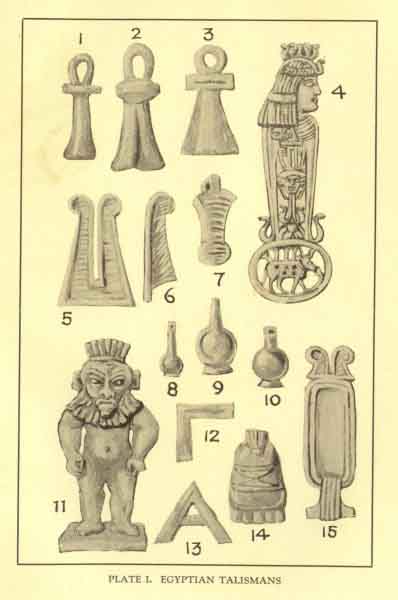
and ceremonies, it may best be comprised in the word “life.” The sign of life (ankh)
is the holiest and the most commonly used of all the symbols. The gods bear it in
their hands, hold it to the lips of their worshippers, and pour it out in streams
over the heads of their favorites. For they actually give life, now by the light
which they continually cause to triumph over the powers of darkness, again by the
regular recurrence of the fructifying waters, or by mysterious operations in the
centre of the earth. And hence they set such store on the possession of the lawful
king. He, the son of the sun, was the living pledge that these blessings should
not cease. His coronation was an agricultural festival, the beginning of the harvest;
his greatest care was to spread the waters of the Nile through canals as far as
possible over the fields. From this arose also their great fear of death and eternal
darkness, and the efforts and sacrifices which they made to secure an eternal existence,
either in the fertile land of Osiris, or as a follower of the god of light, and,
as it is put, “to obtain the crown of life.”
Entirely swayed by these ideas, the Egyptian, although his religious thinking
did not stand still, clung to the existing state of things; he did not relinquish
what was old. He may have connected different ideas with it; but the holy texts
which he muttered during the Ptolemean era were often the same as those his ancestors
had uttered at the altars and the tombs more than thirty centuries ago. The nature
of the land which bore and fed him had imprinted a peculiar stamp on his religion.
Moreover, his religion became to him more and more the only thing of supreme value.
Treasures, the fruits of his industry, and all the skill which was the product of
his remarkable civilization, he spent on the building and the decorating of his
tombs and temples. Those of Amon at Thebes gradually became the largest in the world.
His whole literature, even that which was not destined for a religious purpose,
is, with a few exceptions, saturated by a religious spirit.
Many of the virtues which we are apt to suppose a monopoly of Christian culture
appear as the ideal of these old Egyptians. Brugsch says a thousand voices from
the tombs of Egypt declare this. One inscription in upper Egypt says: “He loved
his father, he honored his mother, he loved his brethren, and never went from his
home in bad-temper. He never preferred the great man to the low one.” Another says:
“I was a wise man, my soul loved God. I was a brother to the great men and a father
to the humble ones, and never was a mischief-maker.” An inscription at Sais, on
a priest who lived in the sad days of Camybses, says, “I honored my father, I esteemed
my mother, I loved my brothers. I found graves for the unburied dead. I instructed
little children. I took care of orphans as though they were my own children. For
great misfortunes were on Egypt in my time, and on this city of Sais.”
In speaking of the ancient books of Egyptian wisdom–the “Ptah-Hotep” and the
“Ke-Gemni,” Dr. Battiscombe Gunn says: “Nor do the oldest books of any other country
approach these two in antiquity. To draw comparisons between them let us, in imagination,
place ourselves at the period at which Ptah-hotep lived, that is, about B.C. 3550,
under King Isi, and take a glance at futurity.
“The Babylonians are doubtless exercising their literary talents; but they will
leave nothing worthy the name of book to the far posterity of fifty-four centuries
hence. Thirteen centuries shall pass before Hammurabi, king of Babylon, drafts the
code of laws that will be found at that time. Only after two thousand years shall
Moses write on the origin of things, and the Vedas be arranged in their present
form. It will be two-and-a-half thousand years before the great king of Jerusalem
will set in order many proverbs and write books so much resembling, in form and
style, that of Ptah-hotep; before the source and summit of European literature will
write his world epics. For the space of years between Solomon and ourselves, great
though it seem, is not so great as that between Solomon and Ptah-hotep.”
Dr. Wallis Budge sums up the Egyptian character thus: “A good general idea of
the average Egyptian can be derived from the monuments and writings that have come
down to us. In the first place he was a very religious man. He worshipped God and
his deified ancestors, offered sacrifices and offerings to the dead, and prayed
at least twice daily, i.e., morning and evening. He believed in the resurrection
of the dead through Osiris, and in the life everlasting, and was from first to last
confident that those who had led righteous lives on earth were rewarded with happiness
and lived with Osiris in heaven, and that the wicked on earth were punished with
annihilation in the next world. His deep-seated interest in religion had a very
practical object, namely, the resurrection of his spirit-body and his soul’s future
happiness in heaven. His conscience was well developed and made him obey religious,
moral, and civil laws without question; a breach of any of these he atoned for,
not by repentance, for which there is no word in his language, but by the making
of offerings. In all religious matters he was strongly conservative, and his conservatism
led him to hold at the same time beliefs that were not only inconsistent with each
other, but sometimes flatly contradictory. In reality his religious books are filled
with obsolete beliefs, many of which were contradicted by his religious observances.
He had a keen sense of humor and was easily pleased. He loved eating and drinking,
music and dancing, festivals and processions, and display of all sorts and kinds,
and he enjoyed himself whenever an opportunity offered. Over and over again the
living are exhorted to eat and drink and enjoy themselves. His morality was of the
highest kind, and he thoroughly understood his duty towards his neighbor. He was
kindly and humane, he fed the hungry, gave drink to the thirsty, lent a boat to
the shipwrecked man, protected the widows and orphans, and fed the starving animals
of the desert. He loved his village and his home and rejoiced when he was ‘loved
by his father, praised by his mother, and beloved by his brothers and sisters.’
He was a hard worker, as the taxes wrung from him by tax-gatherers and priests in
all periods testify. He was intensely superstitious, and was easily duped by the
magician and medicine man, who provided him with spells and incantations and amulets
of all kinds. He was slow to anger and disliked military service and war. His idea
of heaven was the possession of a homestead in a fertile district, with streams
of water and luxuriant crops of wheat, barley, fruit, etc., wherein he would live
a life of leisure surrounded by all those whom he had known and loved upon earth.
He had no wish to enlarge the borders of Egypt, except for the loot which raids
brought in; he never sought to bestow the blessings of Egyptian civilization upon
other lands, and he never indulged in missionary enterprises of any kind. His religious
toleration was great. He was content to serve God and Pharaoh, and he wished above
all things to be allowed to till his land and do his own business in his own way
in peace.
“The influence of his beliefs and religion, and literature, and arts and crafts
on the civilization of other nations can hardly be overestimated. In one of the
least known periods of the world’s history he proclaimed the deathlessness of the
human soul, and his country has rightly been named the ‘land of immortality.”‘


Leave A Comment