
CHAPTER XVII
The Hebrews in Assyrian History
Revival of Assyrian Power–The Syro-Cappadocian Hittites–The
Aramn State of Damascus–Reign of Terror in Mesopotamia–Barbarities of Ashur-natsir-pal
III–Babylonia and Chald subdued–Glimpse of the Kalkhi Valley–The Hebrew
Kingdoms of Judah and Israel–Rival Monarchs and their Wars–How Judah became
subject to Damascus–Ahab and the Phnician Jezebel–Persecution of Elijah and
other Prophets–Israelites fight against Assyrians–Shalmaneser as Overlord
of Babylonia–Revolts of Jehu in Israel and Hazael in Damascus–Shalmaneser
defeats Hazael–Jehu sends Tribute to Shalmaneser–Baal Worship Supplanted by
Golden Calf Worship in Israel–Queen Athaliah of Judah–Crowning of the Boy
King Joash–Damascus supreme in Syria and Palestine–Civil War in Assyria–Triumphs
of Shamshi-Adad VII–Babylonia becomes an Assyrian Province.
IN one of the Scottish versions of the Seven Sleepers legend a shepherd enters
a cave, in which the great heroes of other days lie wrapped in magic slumber,
and blows two blasts on the horn which hangs suspended from the roof. The sleepers
open their eyes and raise themselves on their elbows. Then the shepherd hears
a warning voice which comes and goes like the wind, saying: “If the horn is
blown once again, the world will be upset altogether”. Terrified by the Voice
and the ferocious appearance of the heroes, the shepherd retreats hurriedly,
locking the door behind him; he casts the key into the sea. The story proceeds:
“If anyone should find the key and open the door, and blow but a single blast
on the horn, Finn and all the Feans would come forth. And that would be a great
day in Alban.”1
After the lapse of an obscure century the national heroes of Assyria were
awakened as if from sleep by the repeated blasts from the horn of the triumphant
thunder god amidst the northern and western mountains–Adad or Rimmon of Syria,
Teshup of Armenia, Tarku of the western Hittites. The great kings who came forth
to “upset the world” bore the familiar names, Ashur-natsir-pal, Shalmaneser,
Shamash-Adad, Ashur-dan, Adad-nirari, and Ashur-nirari. They revived and increased
the ancient glory of Assyria during its Middle Empire period.
The Syro-Cappadocian Hittites had grown once again powerful and prosperous,
but no great leader like Subbi-luliuma arose to weld the various States into
an Empire, so as to ensure the protection of the mingled peoples from the operations
of the aggressive and ambitious war-lords of Assyria. One kingdom had its capital
at Hamath and another at Carchemish on the Euphrates. The kingdom of Tabal flourished
in Cilicia (Khilakku); it included several city States like Tarsus, Tiana, and
Comana (Kammanu). Farther west was the dominion of the Thraco-Phrygian Muski.
The tribes round the shores of Lake Van had asserted themselves and extended
their sphere of influence. The State of Urartu was of growing importance, and
the Nairi tribes had spread round the south-eastern shores of Lake Van. The
northern frontier of Assyria was continually menaced by groups of independent
hill States which would have been irresistible had they operated together against
a common enemy, but were liable to be extinguished when attacked in detail.
A number of Aramn kingdoms had come into existence in Mesopotamia and throughout
Syria. The most influential of these was the State of Damascus, the king of
which was the overlord of the Hebrew kingdoms of Israel and Judah when Ashur-natsir-pal III ascended the Assyrian
throne about 885 B.C. Groups of the Aramns had acquired a high degree of culture
and become traders and artisans. Large numbers had filtered, as well, not only
into Babylonia but also Assyria and the north Syrian area of Hittite control.
Accustomed for generations to desert warfare, they were fearless warriors. Their
armies had great mobility, being composed mostly of mounted infantry, and were
not easily overpowered by the Assyrian forces of footmen and charioteers. Indeed,
it was not until cavalry was included in the standing army of Assyria that operations
against the Aramns were attended with permanent success.
Ashur-natsir-pal III1 was preceded by two vigorous Assyrian rulers, Adad-nirari III (911-890 B.C.)
and Tukulti-Ninip II (890-885 B.C.). The former had raided North Syria and apparently
penetrated as far as the Mediterranean coast. In consequence he came into conflict
with Babylonia, but he ultimately formed an alliance with that kingdom. His
son, Tukulti-Ninip, operated in southern Mesopotamia, and apparently captured
Sippar. In the north he had to drive back invading bands of the Muski. Although,
like his father, he carried out great works at Asshur, he appears to have transferred
his Court to Nineveh, a sure indication that Assyria was once again becoming
powerful in northern Mesopotamia and the regions towards Armenia.
Ashur-natsir-pal III, son of Tukulti-Ninip II, inaugurated a veritable reign
of terror in Mesopotamia and northern Syria. His methods of dealing with revolting
tribes were of a most savage character. Chiefs were skinned alive, and when
he sacked their cities, not only fighting-men but women and children were either slaughtered or burned at the stake. It is not surprising to find therefore
that, on more than one occasion, the kings of petty States made submission to
him without resistance as soon as he invaded their domains.
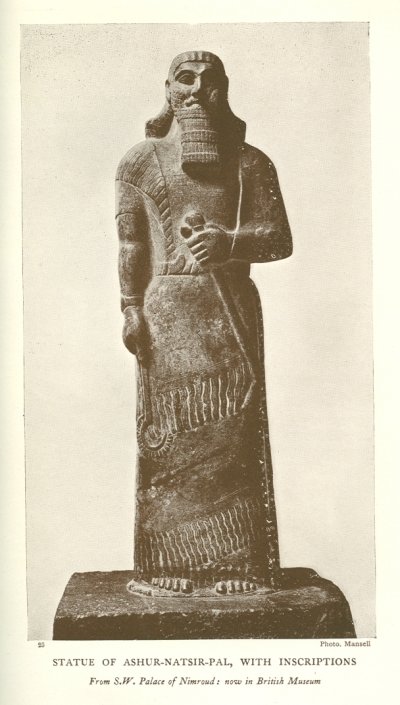
STATUE OF ASHUR-NATSIR-PAL, WITH INSCRIPTIONS
From S.W. Palace of Nimroud: now in British Museum.
Photo. Mansell
In his first year he overran the mountainous district between Lake Van and
the upper sources of the Tigris. Bubu, the rebel son of the governor of Nishtun,
who had been taken prisoner, was transported to Arbela, where he was skinned
alive. Like his father, Ashur-natsir-pal fought against the Muski, whose power
was declining. Then he turned southward from the borders of Asia Minor and dealt
with a rebellion in northern Mesopotamia.
An Aramn pretender named Akhiababa had established himself at Suru in the
region to the east of the Euphrates, enclosed by its tributaries the Khabar
and the Balikh. He had come from the neighbouring Aramn State of Bit-Adini,
and was preparing, it would appear, to form a powerful confederacy against the
Assyrians.
When Ashur-natsir-pal approached Suru, a part of its population welcomed
him. He entered the city, seized the pretender and many of his followers. These
he disposed of with characteristic barbarity. Some were skinned alive and some
impaled on stakes, while others were enclosed in a pillar which the king had
erected to remind the Aramns of his determination to brook no opposition.
Akhiababa the pretender was sent to Nineveh with a few supporters; and when
they had been flayed their skins were nailed upon the city walls.
Another revolt broke out in the Kirkhi district between the upper reaches
of the Tigris and the south-western shores of Lake Van. It was promoted by the
Nairi tribes, and even supported by some Assyrian officials. Terrible reprisals
were meted out to the rebels.
When the city of Kinabu was captured, no fewer than 3000 prisoners were burned
alive, the unfaithful governor being flayed. The city of Damdamusa was set on
fire. Then Tela was attacked. Ashur-natsir-pal’s own account of the operations
runs as follows:–
The city (of Tello) was very strong; three walls surrounded
it. The inhabitants trusted to their strong walls and numerous soldiers; they
did not come down or embrace my feet. With battle and slaughter I assaulted
and took the city. Three thousand warriors I slew in battle. Their booty and
possessions, cattle, sheep, I carried away; many captives I burned with fire.
Many of their soldiers I took alive; of some I cut off hands and limbs; of others
the noses, ears, and arms; of many soldiers I put out the eyes. I reared a column
of the living and a column of heads. I hung on high their heads on trees in
the vicinity of their city. Their boys and girls I burned up in flames. I devastated
the city, dug it up, in fire burned it; I annihilated it.1
The Assyrian war-lord afterwards forced several Nairi kings to acknowledge
him as their overlord. He was so greatly feared by the Syro-Cappadocian Hittites
that when he approached their territory they sent him tribute, yielding without
a struggle.
For several years the great conqueror engaged himself in thus subduing rebellious
tribes and extending his territory. His military headquarters were at Kalkhi,
to which city the Court had been transferred. Thither he drafted thousands of
prisoners, the great majority of whom he incorporated in the Assyrian army.
Assyrian colonies were established in various districts for strategical purposes,
and officials supplanted the petty kings in certain of the northern city States.
The Aramns of Mesopotamia gave much trouble to Ashur-natsir-pal. Although
he had laid a heavy hand on Suru, the southern tribes, the Sukhi, stirred up revolts in Mesopotamia
as the allies of the Babylonians. On one occasion Ashur-natsir-pal swept southward
through this region, and attacked a combined force of Sukhi Aramns and Babylonians.
The Babylonians were commanded by Zabdanu, brother of Nabu-aplu-iddin, king
of Babylonia, who was evidently anxious to regain control of the western trade
route. The Assyrian war-lord, however, proved to be too powerful a rival. He
achieved so complete a victory that he captured the Babylonian general and 3000
of his followers. The people of Kashshi (Babylonia) and Kaldu (Chald) were
“stricken with terror”, and had to agree to pay increased tribute.
Ashur-natsir-pal reigned for about a quarter of a century, but his wars occupied
less than half of that period. Having accumulated great booty, he engaged himself;
as soon as peace was secured throughout his empire, in rebuilding the city of
Kalkhi, where he erected a great palace and made records of his achievements.
He also extended and redecorated the royal palace at Nineveh, and devoted much
attention to the temples.
Tribute poured in from the subject States. The mountain and valley tribes
in the north furnished in abundance wine and corn, sheep and cattle and horses,
and from the Aramns of Mesopotamia and the Syro-Cappadocian Hittites came
much silver and gold, copper and lead, jewels and ivory, as well as richly decorated
furniture, armour and weapons. Artists and artisans were also provided by the
vassals of Assyria. There are traces of Phnician influence in the art of this
period.
Ashur-natsir-pal’s great palace at Kalkhi was excavated by Layard, who has
given a vivid description of the verdant plain on which the ancient city was
situated, as it appeared in spring. “Its pasture lands, known as the ‘Jaif’,
are renowned”, he wrote, “for their rich and luxuriant herbage. In times of quiet,
the studs of the Pasha and of the Turkish authorities, with the horses of the
cavalry and of the inhabitants of Mosul, are sent here to graze. . . . Flowers
of every hue enamelled the meadows; not thinly scattered over the grass as in
northern climes, but in such thick and gathering clusters that the whole plain
seemed a patchwork of many colours. The dogs, as they returned from hunting,
issued from the long grass dyed red, yellow, or blue, according to the flowers
through which they had last forced their way. . . . In the evening, after the
labour of the day, I often sat at the door of my tent, giving myself up to the
full enjoyment of that calm and repose which are imparted to the senses by such
scenes as these. . . . As the sun went down behind the low hills which separate
the river from the desert–even their rocky sides had struggled to emulate the
verdant clothing of the plain–its receding rays were gradually withdrawn, like
a transparent veil of light from the landscape. Over the pure cloudless sky
was the glow of the last light. In the distance and beyond the Zab, Keshaf,
another venerable ruin, rose indistinctly into the evening mist. Still more
distant, and still more indistinct, was a solitary hill overlooking the ancient
city of Arbela. The Kurdish mountains, whose snowy summits cherished the dying
sunbeams, yet struggled with the twilight. The bleating of sheep and lowing
of cattle, at first faint, became louder as the flocks returned from their pastures
and wandered amongst the tents. Girls hurried over the greensward to seek their
fathers’ cattle, or crouched down to milk those which had returned alone to
their well-remembered folds. Some were coming from the river bearing the replenished
pitcher on their heads or shoulders; others, no less graceful in their form,
and erect in their carriage, were carrying the heavy loads of long grass which they had cut
in the meadows.”1
Across the meadows so beautiful in March the great armies of Ashur-natsir-pal
returned with the booty of great campaigns–horses and cattle and sheep, bales
of embroidered cloth, ivory and jewels, silver and gold, the products of many
countries; while thousands of prisoners were assembled there to rear stately
buildings which ultimately fell into decay and were buried by drifting sands.
Layard excavated the emperor’s palace and dispatched to London, among other
treasures of antiquity, the sublime winged human-headed lions which guarded
the entrance, and many bas reliefs.
The Assyrian sculptures of this period lack the technical skill, the delicacy
and imagination of Sumerian and Akkadian art, but they are full of energy, dignified
and massive, and strong and lifelike. They reflect the spirit of Assyria’s greatness,
which, however, had a materialistic basis. Assyrian art found expression in
delineating the outward form rather than in striving to create a “thing of beauty”
which is “a joy for ever”.
When Ashur-natsir-pal died, he was succeeded by his son Shalmaneser III (860-825
B.C.), whose military activities extended over his whole reign. No fewer than
thirty-two expeditions were recorded on his famous black obelisk.
As Shalmaneser was the first Assyrian king who came into direct touch with
the Hebrews, it will be of interest here to review the history of the divided
kingdoms of Israel and Judah, as recorded in the Bible, because of the light
it throws on international politics and the situation which confronted Shalmaneser
in Mesopotamia and Syria in the early part of his reign.
After Solomon died, the kingdom of his son Rehoboam was restricted to Judah, Benjamin, Moab, and Edom. The “ten tribes” of Israel
had revolted and were ruled over by Jeroboam, whose capital was at Tirzah.1 “There were wars between Rehoboam and Jeroboam continually.”2
The religious organization which had united the Hebrews under David and Solomon
was thus broken up. Jeroboam established the religion of the Canaanites and
made “gods and molten images”. He was condemned for his idolatry by the prophet
Ahijah, who declared, “The Lord shall smite Israel, as a reed is shaken in the
water; and he shall root up Israel out of this good land, which he gave to their
fathers, and shall scatter them beyond the river, because they have made their
groves, provoking the Lord to anger. And he shall give Israel up because of
the sins of Jeroboam, who did sin, and who made Israel to sin.”3
In Judah Rehoboam similarly “did evil in the sight of the Lord”; his subjects
“also built them high places and images and groves, on every high hill, and
under every green tree”.4 After the raid of the Egyptian Pharaoh Shishak (Sheshonk) Rehoboam repented,
however. “And when he humbled himself, the wrath of the Lord turned from him,
that he would not destroy him altogether: and also in Judah things went well.”5
Rehoboam was succeeded by his son Abijah, who shattered the power of Jeroboam,
defeating that monarch in battle after he was surrounded as Rameses II had been
by the Hittite army. “The children of Israel fled before Judah: and God delivered
them into their hand. And Abijah and his people slew them with a great slaughter:
so there fell down slain in Israel five hundred thousand chosen men. Thus the children of Israel were brought under at that time,
and the children of Judah prevailed, because they relied upon the Lord God of
their fathers. And Abijah pursued after Jeroboam, and took cities from him,
Bethel with the towns thereof, and Jeshanah with the towns thereof, and Ephraim
with the towns thereof. Neither did Jeroboam recover strength again in the days
of Abijah, and the Lord struck him and he died.”1
Ere Jeroboam died, however, “Abijah slept with his fathers, and they buried
him in the city of David: and Asa his son reigned in his stead. In his days
the land was quiet ten years. And Asa did that which was good and right in the
eyes of the Lord his God. For he took away the altars of the strange gods, and
the high places, and brake down the images, and cut down the groves. And commanded
Judah to seek the Lord God of their fathers and to do the law and the commandment.
Also he took away out of all the cities of Judah the high places and the images:
and the kingdom was quiet before him. And he built fenced cities in Judah: for
the land had rest, and he had no war in those years; because the Lord had given
him rest.”2
Jeroboam died in the second year of Asa’s reign, and was succeeded by his
son Nadab, who “did evil in the sight of the Lord, and walked in the way of
his father, and in his sin wherewith he made Israel to sin”.3 Nadab waged war against the Philistines, and was besieging Gibbethon when Baasha
revolted and slew him. Thus ended the First Dynasty of the Kingdom of Israel.
Baasha was declared king, and proceeded to operate against Judah. Having
successfully waged war against Asa, he proceeded to fortify Ramah, a few miles
to the north of Jerusalem, “that he might not suffer any to go out or come in to
Asa king of Judah”.1
Now Israel was at this time one of the allies of the powerful Aramn State
of Damascus, which had resisted the advance of the Assyrian armies during the
reign of Ashur-natsir-pal I, and apparently supported the rebellions of the
northern Mesopotamian kings. Judah was nominally subject to Egypt, which, however,
was weakened by internal troubles, and therefore unable either to assert its
authority in Judah or help its king to resist the advance of the Israelites.
In the hour of peril Judah sought the aid of the king of Damascus. “Asa took
all the silver and the gold that were left in the treasures of the house of
the Lord, and the treasures of the king’s house, and delivered them into the
hand of his servants: and King Asa sent them to Ben-hadad, the son of Tabrimon,
the son of Hezion, king of Syria, that dwelt at Damascus, saying, There is a
league between me and thee, and between my father and thy father: behold, I
have sent unto thee a present of silver and gold: come and break thy league
with Baasha king of Israel, that he may depart from me”.2
Ben-hadad accepted the invitation readily. He waged war against Israel, and
Baasha was compelled to abandon the building of the fortifications at Ramah.
“Then king Asa made a proclamation throughout all Judah; none was exempted:
and they took away the stones of Ramah, and the timber thereof, wherewith Baasha
had builded; and king Asa built with them Geba of Benjamin, and Mizpah.”3
Judah and Israel thus became subject to Damascus, and had to recognize the
king of that city as arbiter in all their disputes.
After reigning about twenty-four years, Baasha of
Israel died in 886 B.C. and was succeeded by his son Elah, who came to the throne
“in the twenty and sixth year of Asa”. He had ruled a little over a year when
he was murdered by “his servant Zimri, captain of half his chariots”, while
he was “drinking himself drunk in the house of Arza steward of his house in
Tirzah”.1 Thus
ended the Second Dynasty of the Kingdom of Israel.
Zimri’s revolt was shortlived. He reigned only “seven days in Tirzah”. The
army was “encamped against Gibbethon, which belonged to the Philistines. And
the people that were encamped heard say, Zimri hath conspired and hath also
slain the king; wherefore all Israel made Omri, the captain of the host, king
over Israel that day in the camp. And Omri went up from Gibbethon and all Israel
with him, and they besieged Tirzah. And it came to pass when Zimri saw that
the city was taken, that he went into the palace of the king’s house, and burnt
the king’s house over him with fire, and died.”2
Omri’s claim to the throne was disputed by a rival named Tibni. “But the
people that followed Omri prevailed against the people that followed Tibni,
son of Ginath: so Tibni died, and Omri reigned.”3
Omri was the builder of Samaria, whither his Court was transferred from Tirzah
towards the close of his six years reign. He was followed by his son Ahab, who
ascended the throne “in the thirty and eighth year of Asa king of Judah . .
. And Ahab . . . did evil in the sight of the Lord above all that were before
him.” So notorious indeed were father and son that the prophet Micah declared
to the backsliders of his day, “For the statutes of Omri are kept, and all the
works of the house of Ahab, and ye walk in their counsel; that I should make thee a desolation, and the inhabitants thereof an hissing: therefore
ye shall bear the reproach of my people”.1
Ahab was evidently an ally of Sidon as well as a vassal of Damascus, for
he married the notorious princess Jezebel, the daughter of the king of that
city State. He also became a worshipper of the Phnician god Baal, to whom a
temple had been erected in Samaria. “And Ahab made a grove; and Ahab did more
to provoke the Lord God of Israel to anger than all the kings of Israel that
were before him.”2 Obadiah, who “feared the Lord greatly”, was the governor of Ahab’s house, but
the outspoken prophet Elijah, whose arch enemy was the notorious Queen Jezebel,
was an outcast like the hundred prophets concealed by Obadiah in two mountain
caves.3
Ahab became so powerful a king that Ben-hadad II of Damascus picked a quarrel
with him, and marched against Samaria. It was on this occasion that Ahab sent
the famous message to Ben-hadad: “Let not him that girdeth on his harness (armour)
boast himself as he that putteth it off”. The Israelites issued forth from Samaria
and scattered the attacking force. “And Israel pursued them: and Ben-hadad the
king of Syria escaped on a horse with the horseman. And the king of Israel went
out, and smote the horses and chariots, and slew the Syrians with a great slaughter.”
Ben-hadad was made to believe afterwards by his counsellors that he owed his
defeat to the fact that the gods of Israel were “gods of the hills; therefore
they are stronger than we”. They added: “Let us fight against them in the plain,
and surely we shall be stronger than they”. In the following year Ben-hadad
fought against the Israelites at Aphek, but was again defeated. He then found it necessary to make “a covenant”
with Ahab.1
In 854 B.C. Shalmaneser III of Assyria was engaged in military operations
against the Aramn Syrians. Two years previously he had broken the power of
Akhuni, king of Bit-Adini in northern Mesopotamia, the leader of a strong confederacy
of petty States. Thereafter the Assyrian monarch turned towards the south-west
and attacked the Hittite State of Hamath and the Aramn State of Damascus.
The various rival kingdoms of Syria united against him, and an army of 70,000
allies attempted to thwart his progress at Qarqar on the Orontes. Although Shalmaneser
claimed a victory on this occasion, it was of no great advantage to him, for
he was unable to follow it up. Among the Syrian allies were Bir-idri (Ben-hadad
II) of Damascus, and Ahab of Israel (“Akhabbu of the land of the Sirilites”).
The latter had a force of 10,000 men under his command.
Four years after Ahab began to reign, Asa died at Jerusalem and his son Jehoshaphat
was proclaimed king of Judah. “And he walked in all the ways of Asa his father;
he turned not aside from it, doing that which was right in the eyes of the Lord:
nevertheless the high places were not taken away; for the people offered and
burnt incense yet in the high places.”2
There is no record of any wars between Israel and Judah during this period,
but it is evident that the two kingdoms had been drawn together and that Israel
was the predominating power. Jehoshaphat “joined affinity with Ahab”, and some
years afterwards visited Samaria, where he was hospitably entertained.3 The two monarchs plotted together. Apparently Israel and Judah desired to throw off the yoke of Damascus, which was being kept constantly on the
defence by Assyria. It is recorded in the Bible that they joined forces and
set out on an expedition to attack Ramoth in Gilead, which Israel claimed, and
take it “out of the hand of the king of Syria”.1 In the battle which ensued (in 853 B.C.) Ahab was mortally wounded, “and about
the time of the sun going down he died”. He was succeeded by his son Ahaziah,
who acknowledged the suzerainty of Damascus. After a reign of two years Ahaziah
was succeeded by Joram.
Jehoshaphat did not again come into conflict with Damascus. He devoted himself
to the development of his kingdom, and attempted to revive the sea trade on
the Persian gulf which had flourished under Solomon. “He made ships of Tharshish
to go to Ophir for gold; but they went not; for the ships were broken (wrecked)
at Ezion-geber.” Ahaziah offered him sailors–probably Phnicians–but they
were refused.2 Apparently Jehoshaphat had close trading relations with the Chaldns, who were
encroaching on the territory of the king of Babylon, and menacing the power
of that monarch. Jehoram succeeded Jehoshaphat and reigned eight years.
After repulsing the Syrian allies at Qarqar on the Orontes in 854 B.C., Shalmaneser
III of Assyria found it necessary to invade Babylonia. Soon after he came to
the throne he had formed an alliance with Nabu-aplu-iddin of that kingdom, and
was thus able to operate in the north-west without fear of complications with
the rival claimant of Mesopotamia. When Nabu-aplu-iddin died, his two sons Marduk-zakir-shum
and Marduk-bel-usate were rivals for the throne. The former, the rightful heir,
appealed for help to Shalmaneser, and that monarch at once hastened to assert his authority in the southern kingdom.
In 851 B.C. Marduk-bel-usate, who was supported by an Aramn army, was defeated
and put to death.
Marduk-zakir-shum afterwards reigned over Babylonia as the vassal of Assyria,
and Shalmaneser, his over-lord, made offerings to the gods at Babylon, Borsippa,
and Cuthah. The Chaldns were afterwards subdued, and compelled to pay annual
tribute.
In the following year Shalmaneser had to lead an expedition into northern
Mesopotamia and suppress a fresh revolt in that troubled region. But the western
allies soon gathered strength again, and in 846 B.C. he found it necessary to
return with a great army, but was not successful in achieving any permanent
success, although he put his enemies to flight. The various western kingdoms,
including Damascus, Israel, and Tyre and Sidon, remained unconquered, and continued
to conspire against him.
The resisting power of the Syrian allies, however, was being greatly weakened
by internal revolts, which may have been stirred up by Assyrian emissaries.
Edom threw off the yoke of Judah and became independent. Jehoram, who had married
Athaliah, a royal princess of Israel, was dead. His son Ahaziah, who succeeded
him, joined forces with his cousin and overlord, King Joram of Israel, to assist
him in capturing Ramoth-gilead from the king of Damascus. Joram took possession
of the city, but was wounded, and returned to Jezreel to be healed.1 He was the last king of the Omri Dynasty of Israel. The prophet Elisha sent
a messenger to Jehu, a military leader, who was at Ramoth-gilead, with a box
of oil and the ominous message, “Thus saith the Lord,
I have anointed thee king over Israel. And thou shalt smite the house of Ahab
thy master, that I may avenge the blood of my servants the prophets, and the
blood of all the servants of the Lord, at the hand of Jezebel . . . And the
dogs shall eat Jezebel in the portion of Jezreel, and there shall be none to
bury her.”
Jehu “conspired against Joram”, and then, accompanied by an escort, “rode
in a chariot and went to Jezreel”, so that he might be the first to announce
the revolt to the king whom he was to depose.
The watchman on the tower of Jezreel saw Jehu and his company approaching
and informed Joram, who twice sent out a messenger to enquire, “Is it peace?”
Neither messenger returned, and the watchman informed the wounded monarch of
Israel, “He came even unto them, and cometh not again; and the driving is like
the driving of Jehu the son of Nimshi; for he driveth furiously”.
King Joram went out himself to meet the famous charioteer, but turned to
flee when he discovered that he came as an enemy. Then Jehu drew his bow and
shot Joram through the heart. Ahaziah endeavoured to conceal himself in Samaria,
but was slain also. Jezebel was thrown down from a window of the royal harem
and trodden under foot by the horsemen of Jehu; her body was devoured by dogs.1
The Syrian king against whom Joram fought at Ramoth-gilead was Hazael. He
had murdered Ben-hadad II as he lay on a bed of sickness by smothering him with
a thick cloth soaked in water. Then he had himself proclaimed the ruler of the
Aramn State of Damascus. The prophet Elisha had previously wept before him,
saying, cc I know the evil that thou wilt do unto the children of Israel; their strongholds wilt thou set on fire, and
their young men wilt thou slay with the sword, and wilt dash their children
and rip up their women with child”.1
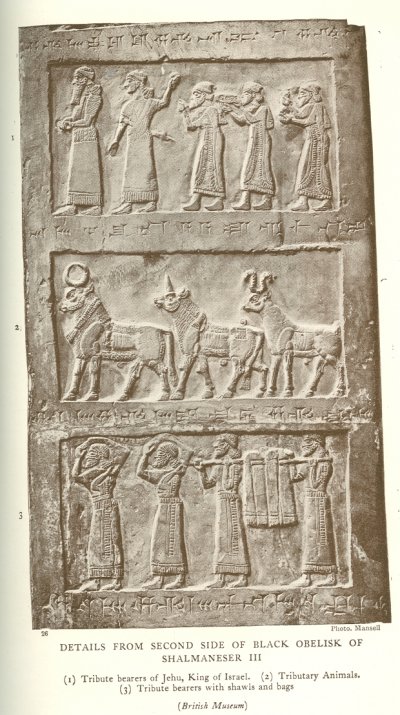
DETAILS FROM SECOND SIDE OF BLACK OBELISK OF SHALMANESER III
(1) Tribute bearers of Jehu, King of Israel. (2) Tributary Animals. (3) Tribute
bearers with shawls and bags
(British Museum)
The time seemed ripe for Assyrian conquest. In 843 B.C. Shalmaneser III crossed
the Euphrates into Syria for the sixteenth time. His first objective was Aleppo,
where he was welcomed. He made offerings there to Hadad, the local Thor, and
then suddenly marched southward. Hazael went out to oppose the advancing Assyrians,
and came into conflict with them in the vicinity of Mount Hermon. “I fought
with him”, Shalmaneser recorded, “and accomplished his defeat; I slew with the
sword 1600 of his warriors and captured 1121 chariots and 470 horses. He fled
to save his life.”
Hazael took refuge within the walls of Damascus, which the Assyrians besieged,
but failed, however, to capture. Shalmaneser’s soldiers meanwhile wasted and
burned cities without number, and carried away great booty. “In those days”,
Shalmaneser recorded, “I received tribute from the Tyrians and Sidonians and
from Yaua (Jehu) son (successor) of Khumri (Omri).” The following is a translation
from a bas relief by Professor Pinches of a passage detailing Jehu’s tribute:
The tribute of Yaua, son of Khumri: silver, gold, a golden
cup, golden vases, golden vessels, golden buckets, lead, a staff for the hand
of the king (and) sceptres, I received.2
The scholarly translator adds, “It is noteworthy that the Assyrian form of
the name, Yaua, shows that the unpronounced aleph at the end was at that time
sounded, so that the Hebrews must have called him Yahua (Jehua)”.
Shalmaneser did not again attack Damascus. His sphere of influence was therefore
confined to North Syria. He found it more profitable, indeed, to extend his
territories into Asia Minor. For several years he engaged himself in securing
control of the north-western caravan road, and did not rest until he had subdued
Cilicia and overrun the Hittite kingdoms of Tabal and Malatia.
Hazael of Damascus avenged himself meanwhile on his unfaithful allies who
had so readily acknowledged the shadowy suzerainty of Assyria. “In those days
the Lord began to cut Israel short: and Hazael smote them in all the coasts
of Israel; from Jordan eastward, all the land of Gilead, the Gadites, and the
Reubenites, and the Manassites, from Aroer, which is by the river Arnon, even
Gilead and Bashan.”1 Israel thus came completely under the sway of Damascus.
Jehu appears to have cherished the ambition of uniting Israel and Judah under
one crown. His revolt received the support of the orthodox Hebrews, and he began
well by inaugurating reforms in the northern kingdom with purpose apparently
to re-establish the worship of David’s God. He persecuted the prophets of Baal,
but soon became a backslider, for although he stamped out the Phnician religion
he began to worship “the golden calves that were in Bethel and that were in
Dan. . . . He departed not from the sins of Jeroboam, which made Israel to sin.”2 Apparently he found it necessary to secure the support of the idolators of the
ancient cult of the “Queen of Heaven”.
The crown of Judah had been seized by the Israelitish
Queen mother Athaliah after the death of her son Ahaziah at the hands of Jehu.1 She endeavoured to destroy “all the seed royal of the house of Judah”. But another
woman thwarted the completion of her monstrous design. This was Jehoshabeath,
sister of Ahaziah and wife of the priest Jehoiada, who concealed the young prince
Joash “and put him and his nurse in a bed-chamber”, in “the house of God”. There
Joash was strictly guarded for six years.2
In time Jehoiada stirred up a revolt against the Baal-worshipping queen of
Judah. Having secured the support of the captains of the royal guard and a portion
of the army, he brought out from the temple the seven years old prince Joash,
“the king’s son, and put upon him the crown, and gave him the testimony, and
made him king. And Jehoiada and his sons anointed him, and said, God save the
king.
“Now when Athaliah heard the noise of the people running and praising the
king, she came to the people into the house of the Lord: and she looked, and,
behold the king stood at his pillar at the entering in, and the princes and
the trumpets by the king: and all the people of the land rejoiced, and sounded
with trumpets, also the singers with instruments of musick, and such as taught
to sing praise. Then Athaliah rent her clothes, and said, Treason, Treason.
“Then Jehoiada the priest brought out the captains of hundreds that were
set over the host, and said unto them, Have her forth of the ranges: and whoso
followeth her, let him be slain by the sword. For the priest said, Slay her
not in the house of the Lord. So they laid hands on her; and when she was come
to the entering of the horse gate by the king’s house, they slew her there.
“And Jehoiada made a covenant between him, and between all the people, and
between the king, that they should be the Lord’s people. Then all the people
went to the house of Baal, and brake it down, and brake his altars and his images
in pieces, and slew Mattan the priest of Baal before the altars.”1
When Jehu of Israel died, he was succeeded by Jehoahaz. “The Lord was kindled
against Israel, and he delivered them into the hand of Ben-hadad the son of
Hazael all their days.” Then Jehoahaz repented. He “besought the Lord, and the
Lord hearkened unto him: for he saw the oppression of Israel, because the king
of Syria oppressed them. And the Lord gave Israel a saviour, so that they went
out from under the hands of the Syrians.”2 The “saviour”, as will be shown, was Assyria. Not only Israel, but Judah, under
King Joash, Edom, the Philistines and the Ammonites were compelled to acknowledge
the suzerainty of Damascus.
Shalmaneser III swayed an extensive and powerful empire, and kept his generals
continually employed suppressing revolts on his frontiers. After he subdued
the Hittites, Kati, king of Tabal, sent him his daughter, who was received into
the royal harem. Tribes of the Medes came under his power: the Nairi and Urartian
tribes continued battling with his soldiers on his northern borders like the
frontier tribes of India against the British troops. The kingdom of Urartu was
growing more and more powerful.
In 829 B.C. the great empire was suddenly shaken to its foundations by the
outbreak of civil war. The party of rebellion was led by Shalmaneser’s son Ashur-danin-apli,
who evidently desired to supplant the crown prince Shamshi-Adad. He was a popular
hero and received the support of most of the important Assyrian cities, including Nineveh,
Asshur, Arbela, Imgurbel, and Durbalat, as well as some of the dependencies.
Shalmaneser retained Kalkhi and the provinces of northern Mesopotamia, and it
appears that the greater part of the army also remained loyal to him.
After four years of civil war Shalmaneser died. His chosen heir, Shamshi-Adad
VII, had to continue the struggle for the throne for two more years.
When at length the new king had stamped out the last embers of revolt within
the kingdom, he had to undertake the reconquest of those provinces which in
the interval had thrown off their allegiance to Assyria. Urartu in the north
had grown more aggressive, the Syrians were openly defiant, the Medes were conducting
bold raids, and the Babylonians were plotting with the Chaldns, Elamites,
and Aramns to oppose the new ruler. Shamshi-Adad, however, proved to be as
great a general as his father. He subdued the Medes and the Nairi tribes, burned
many cities and collected enormous tribute, while thousands of prisoners were
taken and forced to serve the conqueror.
Having established his power in the north, Shamshi-Adad then turned attention
to Babylonia. On his way southward he subdued many villages. He fell upon the
first strong force of Babylonian allies at Dur-papsukal in Akkad, and achieved
a great victory, killing 13,000 and taking 3000 captives. Then the Babylonian
king, Marduk-balatsu-ikbi, advanced to meet him with his mixed force of Babylonians,
Chaldns, Elamites, and Aramns, but was defeated in a fierce battle on the
banks of the Daban canal. The Babylonian camp was captured, and the prisoners
taken by the Assyrians included 5000 foot-men, 200 horsemen, and 100 chariots Shamshi-Adad conducted in all five campaigns in Babylonia and Chald, which
he completely subdued, penetrating as far as the shores of the Persian Gulf.
In the end he took prisoner the new king, Bau-akh-iddina, the successor of Marduk-balatsu-ikbi,
and transported him to Assyria, and offered up sacrifices as the overlord of
the ancient land at Babylon, Borsippa, and Cuthah. For over half a century after
this disaster Babylonia was a province of Assyria. During that period, however,
the influence which it exercised over the Assyrian Court was so great that it
contributed to the downfall of the royal line of the Second Empire.
Footnotes
394:1 Finn and His
Warrior Band, pp. 245 et seq. (London, 1911).
396:1 Also rendered Ashur-nasir-pal.
398:1 A History of
the Babylonians and Assyrians, G. S. Goodspeed, p. 197.
401:1 Discoveries
at Nineveh, Sir A. H. Layard (London, 1856), pp. 55, 56.
402:1 “Thou art beautiful,
O my love, as Tirzah, comely as Jerusalem.” Solomon’s Song, vi, 4.
402:2 2 Chronicles,
xii, 15.
402:3 1 Kings,
xiv, 1-20.
402:4 Ibid., 21-3.
402:5 2 Chronicles,
xii, 1-12.
403:1 2 Chronicles,
xiii, 1-20.
403:2 Ibid., xiv,
1-6.
403:3 1 Kings,
xv, 25-6.
404:1 1 Kings,
xv, 16-7.
404:2 Ibid., 18-9.
404:3 Ibid., 20-2.
405:1 1 Kings,
xvi, 9-10.
405:2 Ibid., 15-8.
405:3 Ibid., 21-2.
406:1 Micah, vi,
16.
406:2 1 Kings,
xvi, 29-33.
406:3 Ibid., xviii,
1-4.
407:1 1 Kings,
xx.
407:2 Ibid., xxii,
43.
407:3 2 Chronicles,
xviii, 1-2.
408:1 1 Kings,
xxii and 2 Chronicles, xviii.
408:2 1 Kings,
xxii, 48-9.
409:1 1 Kings,
viii.
410:1 2 Kings,
ix and 2 Chronicles, xxii.
411:1 2 Kings,
viii, 1-15.
411:2 The Old Testament
in the Light of the Historical Records and Legends of Assyria and Babylonia,
pp. 337 et seq.
412:1 2 Kings,
x, 32-3.
412:2 Ibid., 1-31.
413:1 2 Kings,
xi, 1-3.
413:2 2 Chronicles,
xxii, 10-12.
414:1 2 Chronicles,
xxiii, 1-17.
414:2 2 Kings,
xiii, 1-5.
Next: Chapter XVIII. The Age of Semiramis

Leave A Comment