
CHAPTER VII
Creation Legend: Merodach the Dragon Slayer
Elder Spirits of the Primordial Deep–Apsu and the Tiamat Dragon–Plot
to Destroy the Beneficent Gods–Ea overcomes Apsu and Mummu–The Vengeful Preparations
of the Dragon–Anshar’s Appeal to Merodach–The Festival of the High Gods–Merodach
exalted as Ruler of the Universe–Dragon slain and Host taken captive–Merodach
rearranges the Pantheon-. Creation of Man–Merodach as Asari–The Babylonian
Osiris–The Chief Purpose of Mankind–Tiamat as Source of Good and Evil–The
Dragon as the Serpent or Worm–Folk Tale aspect of Creation Myth–British Neolithic
Legends–German and Egyptian Contracts–Biblical references to Dragons–The
Father and Son theme–Merodach and Tammuz–Monotheistic Tendency–Bi-sexual
Deities.
IN the beginning the whole universe was a sea. Heaven on high had not been
named, nor the earth beneath. Their begetter was Apsu, the father of the primordial
Deep, and their mother was Tiamat, the spirit of Chaos. No plain was yet formed,
no marsh could be seen; the gods had no existence, nor had their fates been
determined. Then there was a movement in the waters, and the deities issued
forth. The first who had being were the god Lachmu and the goddess Lachamu.
Long ages went past. Then were created the god Anshar and the goddess Kishar.
When the days of these deities had increased and extended, they were followed
by Anu, god of the sky, whose consort was Anatu; and Ea, most wise and all-powerful,
who was without an equal.
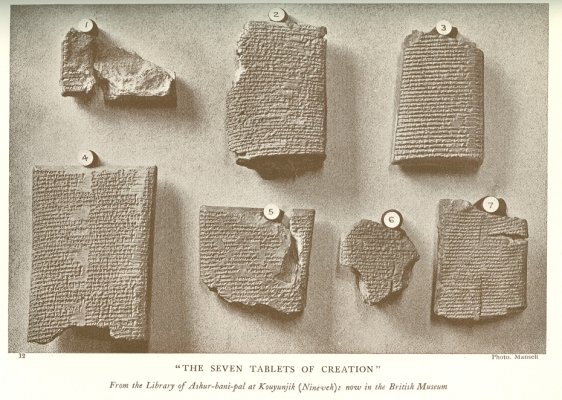
”THE SEVEN TABLETS OF CREATION”
From the Library of Ashur-bani-pal at Kouyunjik (Nineveh): now in the British
Museum.
Now Ea, god of the deep, was also Enki, “lord of earth”, and his eternal
spouse, Damkina, was Gashan-ki, “lady of earth”. The son of Ea and Damkina was
Bel, the lord, who in time created mankind.1 Thus were the high gods established in power and in glory.
Now Apsu and Tiamat remained amidst confusion in the deeps of chaos. They
were troubled because their offspring, the high gods, aspired to control the
universe and set it in order.2 Apsu was still powerful and fierce, and Tiamat snarled and raised tempests,
smiting herself. Their purpose was to work evil amidst eternal confusion.
Then Apsu called upon Mummu, his counsellor, the son who shared his desires,
and said, “O Mummu, thou who art pleasing unto me, let us go forth together
unto Tiamat and speak with her.”
So the two went forth and prostrated themselves before the Chaos Mother to
consult with her as to what should be done to prevent the accomplishment of
the purpose of the high gods.
Apsu opened his mouth and spake, saying, “O Tiamat, thou gleaming one, the
purpose of the gods troubles me. I cannot rest by day nor can I repose by night.
I will thwart them and destroy their purpose. I will bring sorrow and mourning
so that we may lie down undisturbed by them.”
Tiamat heard these words and snarled. She raised angry and roaring tempests;
in her furious grief she uttered a curse, and then spake to Apsu, saying, “What
shall we do so that their purpose may be thwarted and we may lie down undisturbed
again?”
Mummu, the counsellor, addressing Apsu, made answer, and said, “Although
the gods are powerful, thou canst overcome them; although their purpose is strong,
thou canst thwart it. Then thou shalt have rest by day and peace by night to
lie down.”
The face of Apsu grew bright when he heard these words spoken by Mummu, yet
he trembled to think of the purpose of the high gods, to whom he was hostile.
With Tiamat he lamented because the gods had changed all things; the plans of
the gods filled their hearts with dread; they sorrowed and spake with Mummu,
plotting evil.
Then Ea, who knoweth all, drew near; he beheld the evil ones conspiring and
muttering together. He uttered a pure incantation and accomplished the downfall
of Apsu and Mummu, who were taken captive.1
Kingu, who shared the desires of Tiamat, spake unto her words of counsel,
saying, “Apsu and Mummu have been overcome and we cannot repose. Thou shalt
be their Avenger, O Tempestuous One.”
Tiamat heard the words of this bright and evil god, and made answer, saying,
“On my strength thou canst trust. So let war be waged.”
Then were the hosts of chaos and the deep gathered together. By day and by
night they plotted against the high gods, raging furiously, making ready for
battle, fuming and storming and taking no rest.
Mother Chuber,2 the creator
of all, provided irresistible weapons. She also brought into being eleven kinds
of fierce monsters–giant serpents, sharp of tooth with unsparing fangs, whose
bodies were filled with poison instead of blood; snarling dragons, clad with
terror, and of such lofty stature that whoever saw them was overwhelmed with
fear, nor could any escape their attack when they lifted themselves up; vipers
and pythons, and the Lachamu, hurricane monsters, raging hounds, scorpion men,
tempest furies, fish men, and mountain rams. These she armed with fierce weapons
and they had no fear of war.
Then Tiamat, whose commands are unchangeable and mighty, exalted Kingu, who
had come to her aid, above all the evil gods; she made him the leader to direct
the army in battle, to go in front, to open the attack. Robing Kingu in splendour,
she seated him on high and spoke, saying:
“I have established thy command over all the gods. Thou shalt rule over them.
Be mighty, thou my chosen husband, and let thy name be exalted over all the
spirits of heaven and spirits of earth.”
Unto Kingu did Tiamat deliver the tablets of fate; she laid them in his bosom,
and said, “Thy commands cannot be changed; thy words shall remain firm.”
Thus was Kingu exalted; he was vested with the divine power of Anu to decree
the fate of the gods, saying, “Let thy mouth open to thwart the fire god; be
mighty in battle nor brook resistance.”
Then had Ea knowledge of Tiamat’s doings, how she had gathered her forces
together, and how she had prepared to work evil against the high gods with purpose
to avenge Apsu. The wise god was stricken with grief, and he moaned for many
days. Thereafter he went and stood before his father, Anshar, and spake, saying,
“Our mother, Tiamat, hath turned against us in her wrath. She hath gathered
the gods about her, and those thou didst create are with her also.”
When Anshar heard all that Ea revealed regarding the preparations made by
Tiamat, he smote his loins and clenched his teeth, and was ill at ease. In sorrow
and anger he spoke and said, “Thou didst go forth aforetime to battle; thou
didst bind Mummu and smite Apsu. Now Kingu is exalted, and there is none who
can oppose Tiamat.”1
Anshar called his son, Anu, before him, and spoke, saying: “O mighty one
without fear, whose attack is irresistible, go now before Tiamat and speak so
that her anger may subside and her heart be made merciful. But if she will not
hearken unto thee, speak thou for me, so that she may be reconciled.”
Anu was obedient to the commands of Anshar. He departed, and descended by
the path of Tiamat until he beheld her fuming and snarling, but he feared to
approach her, and turned back.
Then Ea was sent forth, but he was stricken with terror and turned back also.2
Anshar then called upon Merodach, son of Ea, and addressed him, saying, “My
son, who softeneth my heart, thou shalt go forth to battle and none shall stand
against thee.”
The heart of Merodach was made glad at these words. He stood before Anshar,
who kissed him, because that he banished fear. Merodach spake, saying: “O lord
of the gods, withdraw not thy words; let me go forth to do as is thy desire.
What man hath challenged thee to battle?”
Anshar made answer and said: “No man hath challenged me. It is Tiamat, the
woman, who hath resolved to wage war against us. But fear not and make merry,
for thou shalt bruise the head of Tiamat. O wise god, thou shalt overcome her
with thy pure incantation. Tarry not but hasten forth; she cannot wound thee;
thou shalt come back again.”
The words of Anshar delighted the heart of Merodach, who spake, saying: “O
lord of the gods, O fate of the high gods, if I, the avenger, am to subdue Tiamat
and save all, then proclaim my greatness among the gods. Let all the high gods
gather together joyfully in Upshukinaku (the Council Hall), so that my words
like thine may remain unchanged, and what I do may never be altered. Instead
of thee I will decree the fates of the gods.”
Then Anshar called unto his counsellor, Gaga, and addressing him, said: “O
thou who dost share my desires, thou who dost understand the purpose of my heart,
go unto Lachmu and Lachamu and summon all the high gods to come before me to
eat bread and drink wine. Repeat to them all I tell you of Tiamat’s preparations
for war, of my commands to Anu and Ea, who turned back, fearing the dragon,
of my choice of Merodach to be our avenger, and his desire to be equipped with
my power to decree fate, so that he may be made strong to combat against our
enemy.”
As Anshar commanded so did Gaga do. He went unto Lachmu and Lachamu and prostrated
himself humbly before them. Then he rose and delivered the message of Anshar,
their son, adding: “Hasten and speedily decide for Merodach your fate. Permit
him to depart to meet your powerful foe.”
When Lachmu and Lachamu heard all that Gaga revealed unto them they uttered
lamentations, while the Igigi (heavenly spirits) sorrowed bitterly, and said:
“What change hath happened that Tiamat hath become hostile to her own offspring?
We cannot understand her deeds.”
All the high gods then arose and went unto Anshar. They filled his council
chamber and kissed one another.
Then they sat down to eat bread and drink sesame wine. And when they were
made drunk and were merry and at their ease, they decreed the fate for Merodach.
In the chamber of Anshar they honoured the Avenger. He was exalted as a prince
over them all, and they said: “Among the high gods thou art the highest; thy
command is the command of Anu. Henceforth thou wilt have power to raise up and
to cast down. None of the gods will dispute thy authority. O Merodach, our avenger,
we give thee sovereignty over the entire Universe. Thy weapon will ever be irresistible.
Smite down the gods who have raised revolt, but spare the lives of those who
repose their trust in thee.”
Then the gods laid down a garment before Merodach, saying: “Open thy mouth
and speak words of command, so that the garment may be destroyed; speak again
and it will be brought back.”
Merodach spake with his mouth and the garment vanished; he spake again and
the garment was reproduced.
All the gods rejoiced, and they prostrated themselves and cried out, “Merodach
is King!”
Thereafter they gave him the sceptre and the throne and the insignia of royalty,
and also an irresistible weapon1 with which to overcome his enemies, saying: “Now, O Merodach, hasten and slay
Tiamat. Let the winds carry her blood to hidden places.”
So was the fate of Merodach decreed by the gods; so was a path of prosperity
and peace prepared for him. He made ready for battle; he strung his bow and
hung his quiver; he slung a dart over his shoulder, and he grasped a club in
his right hand; before him he set lightning, and with flaming fire he filled
his body.

MERODACH SETS FORTH TO ATTACK TIAMAT
From the Painting by E. Wallcousins.
Anu gave unto him a great net with which to snare his enemies and prevent
their escape. Then Merodach created seven winds–the wind of evil, the uncontrollable
wind, the sandstorm, and the whirlwind, the fourfold wind, the sevenfold wind,
and the wind that has no equal–and they went after him. Next he seized his
mighty weapon, the thunderstone, and leapt into his storm chariot, to which
were yoked four rushing and destructive steeds of rapid flight, with foam-flecked
mouths and teeth full of venom, trained for battle, to overthrow enemies and
trample them underfoot. A light burned on the head of Merodach, and he was clad
in a robe of terror. He drove forth, and the gods, his fathers, followed after
him: the high gods clustered around and followed him, hastening to battle.
Merodach drove on, and at length he drew nigh to the secret lair of Tiamat,
and he beheld her muttering with Kingu, her consort. For a moment he faltered,
and when the gods who followed him beheld this, their eyes were troubled.
Tiamat snarled nor turned her head. She uttered curses, and said: “O Merodach,
I fear not thy advance as chief of the gods. My allies are assembled here, and
are more powerful than thou art.”
Merodach uplifted his arm, grasping the dreaded thunderstone, and spake unto
Tiamat, the rebellious one, saying: “Thou hast exalted thyself, and with wrathful
heart hath prepared for war against the high gods and their fathers, whom thou
dost hate in thy heart of evil. Unto Kingu thou hast given the power of Anu
to decree fate, because thou art hostile to what is good and loveth what is
sinful. Gather thy forces together, and arm thyself and come forth to battle.”
When Tiamat heard these mighty words she raved and cried aloud like one who
is possessed; all her limbs shook, and she muttered a spell. The gods seized
their weapons.
Tiamat and Merodach advanced to combat against one another. They made ready
for battle. The lord of the high gods spread out the net which Anu had given
him. He snared the dragon and she could not escape. Tiamat opened her mouth
which was seven miles wide, and Merodach called upon the evil wind to smite
her; he caused the wind to keep her mouth agape so that she could not close
it. All the tempests and the hurricanes entered in, filling her body, and her
heart grew weak; she gasped, overpowered. Then the lord of the high gods seized
his dart and cast it through the lower part of her body; it tore her inward
parts and severed her heart. So was Tiamat slain.
Merodach overturned the body of the dead dragon and stood upon it. All the
evil gods who had followed her were stricken with terror and broke into flight.
But they were unable to escape. Merodach caught them in his great net, and they
stumbled and fell uttering cries of distress, and the whole world resounded
with their wailing and lamentations. The lord of the high gods broke the weapons
of the evil gods and put them in bondage. Then he fell upon the monsters which
Tiamat had created; he subdued them, divested them of their powers, and trampled
them under his feet. Kingu he seized with the others. From this god great Merodach
took the tablets of fate, and impressing upon them his own seal, placed them
in his bosom.
So were the enemies of the high gods overthrown by the Avenger. Ansar’s commands
were fulfilled and the desires of Ea fully accomplished.
Merodach strengthened the bonds which he had laid upon the evil gods and
then returned to Tiamat. He leapt upon the dragon’s body; he clove her skull
with his great club; he opened the channels of her blood which streamed forth,
and caused the north to carry her blood to hidden places. The high gods, his
fathers, clustered around; they raised shouts of triumph and made merry. Then
they brought gifts and offerings to the great Avenger.
Merodach rested a while, gazing upon the dead body of the dragon. He divided
the flesh of Ku-pu,1 and devised
a cunning plan.
Then the lord of the high gods split the body of the dragon like that of
a mashde fish into two halves. With one half he enveloped the firmament; he
fixed it there and set a watchman to prevent the waters falling down.2 With the other half he made the earth.3 Then he made the abode of Ea in the deep, and the abode of Anu in high heaven.
The abode of Enlil was in the air.
Merodach set all the great gods in their several stations. He also created
their images, the stars of the Zodiac, and fixed them all. He measured the year
and divided it into months; for twelve months he made three stars each. After
he had given starry images of the gods separate control of each day of the year,
he founded the station of Nibiru (Jupiter), his own star, to determine the limits
of all stars, so that none might err or go astray. He placed beside his own
the stations of Enlil and Ea, and on each side he opened mighty gates, fixing
bolts on the left and on the right. He set the zenith in the centre.
Merodach decreed that the moon god should rule the night and measure the
days, and each month he was given a crown. Its various phases the great lord
determined, and he commanded that on the evening of its fullest brilliancy it
should stand opposite the sun.1
He placed his bow in heaven (as a constellation) and his net also.
We have now reached the sixth tablet, which begins with a reference to words
spoken to Merodach by the gods. Apparently Ea had conceived in his heart that
mankind should be created. The lord of the gods read his thoughts and said:
“I will shed my blood and fashion bone . . . I will create man to dwell on the
earth so that the gods may be worshipped and shrines erected for them. I will
change the pathways of the gods . . .”.
The rest of the text is fragmentary, and many lines are missing. Berosus
states, however, that Belus (Bel Merodach) severed his head from his shoulders.
His blood flowed forth, and the gods mixed it with earth and formed the first
man and various animals.
In another version of the creation of man, it is related that Merodach “laid
a reed upon the face of the waters; he formed dust, and poured it out beside
the reed. . . . That he might cause the gods to dwell in the habitation of their
heart’s desire, he formed mankind.” The goddess Aruru, a deity of Sippar, and
one of the forms of “the lady of the gods”, is associated with Merodach as the
creatrix of the seed of mankind. “The beasts of the field and living creatures
in the field he formed.”
He also created the Tigris and Euphrates rivers, grass, reeds, herbs and
trees, lands, marshes and swamps, cows, goats,1
In the seventh tablet Merodach is praised by the gods–the Igigi (spirits
of heaven). As he has absorbed all their attributes, he is addressed by his
fifty-one names; henceforth each deity is a form of Merodach. Bel Enlil, for
instance, is Merodach of lordship and domination; Sin, the moon god, is Merodach
as ruler of night; Shamash is Merodach as god of law and holiness; Nergal is
Merodach of war; and so on. The tendency to monotheism appears to have been
most marked among the priestly theorists of Babylon.
Merodach is hailed to begin with as Asari, the introducer of agriculture
and horticulture, the creator of grain and plants. He also directs the decrees
of Anu, Bel, and Ea; but having rescued the gods from destruction at the hands
of Kingu and Tiamat, he was greater than his “fathers”, the elder gods. He set
the Universe in order, and created all things anew. He is therefore Tutu, “the
creator”, a merciful and beneficent god. The following are renderings of lines
25 to 32:
Tutu: Aga-azaga (the glorious crown) may he make the crowns
glorious–
The lord of the glorious incantation bringing the dead to life;
He who had mercy on the gods who had been overpowered;
Made heavy the yoke which he had laid on the gods who were his enemies,
(And) to redeem(?) them created mankind.
“The merciful one”, “he with whom is salvation”,
May his word be established, and not forgotten,
In the mouth of the black-headed ones whom his hands have made.
Pinches’ Translation.2
Tutu as Aga-azag may mankind fourthly magnify!
“The Lord of the Pure Incantation”, “the Quickener of the Dead”,
“Who had mercy upon the captive gods”,
“Who removed the yoke from upon the gods his enemies”,
“For their forgiveness did he create mankind”,
“The Merciful One, with whom it is to bestow life!”
May his deeds endure, may they never be forgotten
In the mouth of mankind whom his hands have made.
King’s Translation.1
Apparently the Babylonian doctrine set forth that mankind was created not
only to worship the gods, but also to bring about the redemption of the fallen
gods who followed Tiamat.
Those rebel angels (ili, gods) He prohibited return;
He stopped their service; He removed them unto the gods (ili) who were
His enemies.
In their room he created mankind.2
Tiamat, the chaos dragon, is the Great Mother. She has a dual character.
As the origin of good she is the creatrix of the gods. Her beneficent form survived
as the Sumerian goddess Bau, who was obviously identical with the Phnician
Baau, mother of the first man. Another name of Bau was Ma, and Nintu, “a form
of the goddess Ma”, was half a woman and half a serpent, and was depicted with
“a babe suckling her breast” (Chapter IV ). The
Egyptian goddesses Neheb-kau and Uazit were serpents, and the goddesses Isis
and Nepthys had also serpent forms. The serpent was a symbol of fertility, and
as a mother was a protector. Vishnu, the Preserver of the Hindu Trinity, sleeps
on the world-serpent’s body. Serpent charms are protective and fertility charms.
As the origin of evil Tiamat personified the deep and tempests. In this character
she was the enemy of order and good, and strove to destroy the world.
I have seen
The ambitious ocean swell and rage and foam
To be exalted with the threatening clouds.1
Tiamat was the dragon of the sea, and therefore the serpent or leviathan.
The word “dragon” is derived from the Greek “drakon”, the serpent known as “the
seeing one” or “looking one”, whose glance was the lightning. The Anglo-Saxon
“fire drake” (“draca”, Latin “draco”) is identical with the “flying dragon”.
In various countries the serpent or worm is a destroyer which swallows the
dead. “The worm shall eat them like wool”, exclaimed Isaiah in symbolic language.2 It lies in the ocean which surrounds the world in Egyptian, Babylonian, Greek,
Teutonic, Indian, and other mythologies. The Irish call it “morch”, and give
it a mermaid form like the Babylonian Nintu. In a Scottish Gaelic poem Tiamat
figures as “The Yellow Muilearteach”, who is slain by Finn-mac-Coul, assisted
by his warrior band.
There was seen coming on the top of the waves
The crooked, clamouring, shivering brave . . .
Her face was blue black of the lustre of coal,
And her bone-tufted tooth was like rusted bone.3
The serpent figures in folk tales. When Alexander the Great, according to
Ethiopic legend, was lowered in a glass cage to the depths of the ocean, he
saw a great monster going past, and sat for two days “watching for its tail
and hinder parts to appear”.4 An Argyllshire Highlander had a similar experience. He went to fish one morning
on a rock. “He was not long there when he saw the head of an eel pass. He continued
fishing for an hour and the eel was still passing. He went home, worked in the
field all day, and having returned to the same rock in the evening, the eel
was still passing, and about dusk he saw her tail disappearing.”1 Tiamat’s sea-brood is referred to in the Anglo-Saxon epic Beowulfas
“pickers”. The hero “slew by night sea monsters on the waves” (line 422).
The well dragon–the French “draco”–also recalls the Babylonian water monsters.
There was a “dragon well” near Jerusalem.2 From China to Ireland rivers are dragons, or goddesses who flee from the well
dragons. The demon of the Rhone is called the “drac”. Floods are also referred
to as dragons, and the Hydra, or water serpent, slain by Hercules, belongs to
this category. Water was the source of evil as well as good. To the Sumerians,
the ocean especially was the abode of monsters. They looked upon it as did Shakespeare’s
Ferdinand, when, leaping into the sea, he cried: “Hell is empty and all the
devils are here”.3
There can be little doubt but that in this Babylonian story of Creation we
have a glorified variation of the wide-spread Dragon myth. Unfortunately, however,
no trace can be obtained of the pre-existing Sumerian oral version which the
theorizing priests infused with such sublime symbolism. No doubt it enjoyed
as great popularity as the immemorial legend of Perseus and Andromeda, which
the sages of Greece attempted to rationalize, and parts of which the poets made
use of and developed as these appealed to their imaginations.
The lost Sumerian story may be summarized as follows: There existed in the
savage wilds, or the ocean, a family of monsters antagonistic to a group of
warriors represented in the Creation legend by the gods. Ea, the heroic king,
sets forth to combat with the enemies of man, and slays the monster father,
Apsu, and his son, Mummu. But the most powerful demon remains to be dealt with.
This is the mother Tiamat, who burns to avenge the deaths of her kindred. To
wage war against her the hero makes elaborate preparations, and equips himself
with special weapons. The queen of monsters cannot be overcome by ordinary means,
for she has great cunning, and is less vulnerable than were her husband and
son. Although Ea may work spells against her, she is able to thwart him by working
counter spells. Only a hand-to-hand combat can decide the fray. Being strongly
protected by her scaly hide, she must be wounded either on the under part of
her body or through her mouth by a weapon which will pierce her liver, the seat
of life. It will be noted in this connection that Merodach achieved success
by causing the winds which followed him to distend the monster’s jaws, so that
he might be able to inflict the fatal blow and prevent her at the same time
from uttering spells to weaken him.
This type of story, in which the mother monster is greater and more powerful
than her husband or son, is exceedingly common in Scottish folklore. In the
legend which relates the adventures of “Finn in the Kingdom of Big Men”, the
hero goes forth at night to protect his allies against the attacks of devastating
sea monsters. Standing on the beach, “he saw the sea advancing in fiery kilns
and as a darting serpent. . . . A huge monster came up, and looking down below
where he (Finn) was, exclaimed, ‘What little speck do I see here?’
Finn, aided by his fairy dog, slew the water monster. On the following night
a bigger monster, “the father”, came ashore, and he also was slain. But the
most powerful enemy had yet to be dealt with. “The next night a Big Hag came
ashore, and the tooth in the front of her mouth would make a distaff. ‘You killed
my husband and son,’ she said.” Finn acknowledged that he did, and they began
to fight. After a prolonged struggle, in which Finn was almost overcome, the
Hag fell and her head was cut off.1
The story of “Finlay the Changeling” has similar features. The hero slew
first a giant and then the giant’s father. Thereafter the Hag came against him
and exclaimed, “Although with cunning and deceitfulness you killed my husband
last night and my son on the night before last, I shall certainly kill you to-night.”
A fierce wrestling match ensued on the bare rock. The Hag was ultimately thrown
down. She then offered various treasures to ransom her life, including “a gold
sword in my cave”, regarding which she says, “never was it drawn to man or to
beast whom it did not overcome”.2 In other Scottish stories of like character the hero climbs a tree, and says
something to induce the hag to open her mouth, so that he may plunge his weapon
down her throat.
The Grendel story in Beowulf,3 the Anglo-Saxon epic, is of like character. A male water monster preys nightly
upon the warriors who sleep in the great hall of King Hrothgar. Beowulf comes
over the sea, as did Finn to the “Kingdom of Big Men”, to slay Grendel. He wrestles
with this man-eater and mortally wounds him. Great rejoicings ensue, but they
have to be brought to an abrupt conclusion, because the mother of Grendel has
meanwhile resolved “to go a sorry journey and avenge the death of her son”.
The narrative sets forth that she enters the Hall in the darkness of night.
“Quickly she grasped one of the nobles tight, and then she went towards the
fen”, towards her submarine cave. Beowulf follows in due course, and, fully
armoured, dives through the waters and ultimately enters the monster’s lair.
In the combat the “water wife” proves to be a more terrible opponent than was
her son. Indeed, Beowulf was unable to slay her until he possessed himself of
a gigantic sword, “adorned with treasure”, which was hanging in the cave. With
this magic weapon he slays the mother monster, whose poisonous blood afterwards
melts the “damasked blade”. Like Finn, he subsequently returns with the head
of one of the monsters.
An interesting point about this story is that it does not appear in any form
in the North German cycle of Romance. Indeed, the poet who included in his epic
the fiery dragon story, which links the hero Beowulf with Sigurd and Siegfried,
appears to be doubtful about the mother monster’s greatness, as if dealing with
unfamiliar material, for he says: “The terror (caused by Grendel’s mother) was
less by just so much as woman’s strength, woman’s war terror, is (measured)
by fighting men”.1 Yet, in
the narrative which follows the Amazon is proved to be the stronger monster
of the two. Traces of the mother monster survive in English folklore, especially
in the traditions about the mythical “Long Meg of Westminster”, referred to
by Ben Jonson in his masque of the “Fortunate Isles”:
Westminster Meg,
With her long leg,
As long as a crane;
And feet like a plane,
With a pair of heels
As broad as two wheels.
Meg has various graves. One is supposed to be marked by a huge stone in the
south side of the cloisters of Westminster Abbey; it probably marks the trench
in which some plague victims–regarded, perhaps, as victims of Meg–were interred.
Meg was also reputed to have been petrified, like certain Greek and Irish giants
and giantesses. At Little Salkeld, near Penrith, a stone circle is referred
to as “Long Meg and her Daughters”. Like “Long Tom”, the famous giant, “Mons
Meg” gave her name to big guns in early times, all hags and giants having been
famous in floating folk tales as throwers of granite boulders, balls of hard
clay, quoits, and other gigantic missiles.
The stories about Grendel’s mother and Long Meg are similar to those still
repeated in the Scottish Highlands. These contrast sharply with characteristic
Germanic legends, in which the giant is greater than the giantess, and the dragon
is a male, like Fafner, who is slain by Sigurd, and Regin whom Siegfried overcomes.
It is probable, therefore, that the British stories of female monsters who were
more powerful than their husbands and sons, are of Neolithic and Iberian origin–immemorial
relics of the intellectual life of the western branch of the Mediterranean race.
In Egypt the dragon survives in the highly developed mythology of the sun
cult of Heliopolis, and, as sun worship is believed to have been imported, and
the sun deity is a male, it is not surprising to find that the night demon,
Apep, was a personification of Set. This god, who is identical with Sutekh,
a Syrian and Asia Minor deity, was apparently worshipped by a tribe which was
overcome in the course of early tribal struggles in pre-dynastic times. Being
an old and discredited god, he became by a familiar process the demon of the
conquerors. In the eighteenth dynasty, however, his ancient glory was revived,
for the Sutekh of Rameses II figures as the “dragon slayer”.1 It is in accordance with Mediterranean modes of thought, however, to find that
in Egypt there is a great celestial battle heroine. This is the goddess Hathor-Sekhet,
the “Eye of Ra”.2 Similarly
in India, the post-Vedic goddess Kali is a destroyer, while as Durga she is
a guardian of heroes.3 Kali,
Durga, and Hathor-Sekhet link with the classical goddesses of war, and also
with the Babylonian Ishtar, who, as has been shown, retained the outstanding
characteristics of Tiamat, the fierce old “Great Mother” of primitive Sumerian
folk religion.
It is possible that in the Babylonian dragon myth the original hero was Ea.
As much may be inferred from the symbolic references in the Bible to Jah’s victory
over the monster of the deep: “Art thou not it that hath cut Rahab and wounded
the dragon?”4 “Thou brakest
the heads of the dragons in the waters; thou brakest the heads of leviathan
in pieces, and gayest him to be meat to the people inhabiting the wilderness”;5 “He divideth the sea with his power, and by his understanding he smiteth through
the proud (Rahab). By his spirit he hath garnished the heavens: his hand hath
formed (or pierced) the crooked serpent”;6 “Thou hast broken Rahab in pieces as one that is slain: thou hast scattered
thine enemies with thy strong arm”;7 “In that day the Lord with his sore and great and strong sword shall punish
leviathan the piercing (or stiff) serpent, even leviathan that crooked serpent;
and he shall slay the dragon that is in the sea”.1
In the Babylonian Creation legend Ea is supplanted as dragon slayer by his
son Merodach. Similarly Ninip took the place of his father, Enlil, as the champion
of the gods. “In other words,” writes Dr. Langdon, “later theology evolved the
notion of the son of the earth god, who acquires the attributes of the father,
and becomes the god of war. It is he who stood forth against the rebellious
monsters of darkness, who would wrest the dominion of the world from the gods
who held their conclave on the mountain. The gods offer him the Tablets of Fate;
the right to utter decrees is given unto him.” This development is “of extreme
importance for studying the growth of the idea of father and son, as creative
and active principles of the world”.2 In Indian mythology Indra similarly takes the place of his bolt-throwing father
Dyaus, the sky god, who so closely resembles Zeus. Andrew Lang has shown that
this myth is of widespread character.3 Were the Babylonian theorists guided by the folk-lore clue?
Now Merodach, as the son of Ea whom he consulted and received spells from,
was a brother of “Tammuz of the Abyss”. It seems that in the great god of Babylon
we should recognize one of the many forms of the primeval corn spirit and patriarch–the
shepherd youth who was beloved by Ishtar. As the deity of the spring sun, Tammuz
slew the winter demons of rain and tempest, so that he was an appropriate spouse
for the goddess of harvest and war. Merodach may have been a development of
Tammuz in his character as a demon slayer.
When he was raised to the position of Bel, “the Lord”, by the Babylonian
conquerors, Merodach supplanted the older Bel–Enlil of Nippur. Now Enlil, who
had absorbed all the attributes of rival deities, and become a world god, was
the
Lord of the harvest lands . . . lord
of the grain fields,
being “lord of the anunnaki”, or “earth spirits”. As agriculturists in early
times went to war so as to secure prisoners who could be sacrificed to feed
the corn spirit, Enlil was a god of war and was adored as such:
The haughty, the hostile land thou dost
humiliate . . . .
With thee who ventureth to make war?
He was also “the bull of goring horns . . . Enlil the
bull”, the god of fertility as well as of battle.1
Asari, one of Merodach’s names, links him with Osiris, the Egyptian Tammuz,
who was supplanted by his son Horus. As the dragon slayer, he recalls, among
others, Perseus, the Grecian hero, of whom it was prophesied that he would slay
his grandfather. Perseus, like Tammuz and Osiris, was enclosed in a chest which
was cast into the sea, to be rescued, however, by a fisher-man on the island
of Seriphos. This hero afterwards slew Medusa, one of the three terrible sisters,
the Gorgons–a demon group which links with Tiamat. In time, Perseus returned
home, and while an athletic contest was in progress, he killed his grandfather
with a quoit. There is no evidence, however, to show that the displacement of
Enlil by Merodach had any legendary sanction of like character. The god of Babylon
absorbed all other deities, apparently for political purposes, and in accordance
with the tendency of the thought of the times, when raised to supreme rank in
the national pantheon; and he was depicted fighting the winged dragon, flapping
his own storm wings, and carrying the thunder weapon associated with Ramman.
Merodach’s spouse Zer-panitumwas significantly called “the lady
of the Abyss”, a title which connects her with Damkina, the mother, and Belit-sheri,
the sister of Tammuz. Damkina was also a sky goddess like Ishtar.
Zer-panitumwas no pale reflection of her Celestial husband, but
a goddess of sharply defined character with independent powers. Apparently she
was identical with Aruru, creatrix of the seed of mankind, who was associated
with Merodach when the first man and the first woman were brought into being.
Originally she was one of the mothers in the primitive spirit group, and so
identical with Ishtar and the other prominent goddesses.
As all goddesses became forms of Ishtar, so did all gods become forms of
Merodach. Sin was “Merodach as illuminator of night”, Nergal was Merodach of
war”, Addu (Ramman) was “Merodach of rain”, and so on. A colophon which contains
a text in which these identifications are detailed, appears to be “a copy”,
says Professor Pinches, “of an old inscription”, which, he thinks, “may go back
as far as 2000 B.C. This is the period at which the name Yaum-ilu,
‘Jah is god’, is found, together with references to iluas the name for
the one great god, and is also, roughly, the date of Abraham, who, it may be
noted, was a Babylonian of Ur of the Chaldees.”1
In one of the hymns Merodach is addressed as follows:
Who shall escape from before thy power?
Thy will is an eternal mystery!
Thou makest it plain in heaven
And in the earth.
Command the sea
And the sea obeyeth thee.
Command the tempest
And the tempest becometh a calm.
Command the winding course
Of the Euphrates,
And the will of Merodach
Shall arrest the floods.
Lord, thou art holy!
Who is like unto thee?
Merodach thou art honoured
Among the gods that bear a name.
The monotheistic tendency, which was a marked feature of Merodach worship,
had previously become pronounced in the worship of Bel Enlil of Nippur. Although
it did not affect the religion of the masses, it serves to show that among the
ancient scholars and thinkers of Babylonia religious thought had, at an early
period, risen far above the crude polytheism of those who bargained with their
deities and propitiated them with offerings and extravagant flattery, or exercised
over them a magical influence by the performance of seasonal ceremonies, like
the backsliders in Jerusalem, censured so severely by Jeremiah, who baked cakes
to reward the Queen of Heaven for an abundant harvest, and wept with her for
the slain Tammuz when he departed to Hades.
Perhaps it was due to the monotheistic tendency, if not to the fusion of
father-worshipping and mother-worshipping peoples, that bi-sexual deities were
conceived of. Nannar, the moon god, was sometimes addressed as father and mother
in one, and Ishtar as a god as well as a goddess. In Egypt Isis is referred
to in a temple chant as “the woman who was made a male by her father Osiris”,
and the Nile god Hapi was depicted as a man with female breasts.
Footnotes
139:1 The elder Bel was
Enlil of Nippur and the younger Merodach of Babylon. According to Damascius
the elder Bel came into existence before Ea, who as Enki shared his attributes.
139:2 This is the inference
drawn from fragmentary texts.
140:1 A large portion
of the narrative is awanting here.
140:2 A title of Tiamat;
pron. chguttural,
142:1 There is another
gap here which interrupts the narrative.
142:2 This may refer
to Ea’s first visit when he overcame Kingu, but did not attack Tiamat.
144:1 The lightning trident
or thunderstone.
147:1 The authorities
are not agreed as to the meaning of “Ku-pu”. Jensen suggests “trunk, body”.
In European dragon stories the heroes of the Siegfried order roast and eat the
dragon’s heart. Then they are inspired with the dragon’s wisdom and cunning.
Sigurd and Siegfried immediately acquire the language of birds. The birds are
the “Fates”, and direct the heroes what next they should do. Apparently Merodach’s
“cunning plan” was inspired after he had eaten a part of the body of Tiamat.
147:2 The waters above
the firmament.
147:3 According to Berosus.
148:1 This portion is
fragmentary and seems to indicate that the Babylonians had made considerable
progress in the science of astronomy. It is suggested that they knew that the
moon derived its light from the sun.
149:1 The Seven Tablets
of Creation, L. W. King, pp. 134, 135.
149:2 The Religion
of Babylonia and Assyria, T. G. Pinches, p. 43.
150:1 The Seven Tablets
of Creation, L. W. King, vol. i, pp. 98, 99.
150:2 Trans. Soc.
Bib. Arch., iv, 251-2.
151:1 Shakespeare’s
Julius Car, i, 3, 8.
151:2 Isaiah,
li, 8.
151:3 Campbell’s West
Highland Tales, pp. 136 et seq.
151:4 The Life and
Exploits of Alexander the Great, E. A. Wallis Budge, pp. 284, 285.
152:1 Campbell’s West
Highland Tales.
152:2 Nehemiah,
ii, 13.
152:3 The Tempest,
i, 2, 212,
154:1 Waifs and Strays
of Celtic Tradition, vol. iv, p. 176 et seq.
154:2 From unpublished
folk tale.
154:3 Beowulf,
translated by Clark Hall, London, 1911, p. 18 et seq.
155:1 Beowulf; translated
by Clark Hall, London, 1911, p. 69, lines 1280-1287.
157:1 Egyptian Myth
and Legend, pp. 260, 261.
157:2 Egyptian Myth
and Legend, pp. 8, 9.
157:3 Indian Myth
and Legend, pp. xli, 149, 150.
157:4 Isaiah,
li, 9.
157:5 Psalms,
lxxiv, 13, 14. It will be noted that the Semitic dragon, like the Egyptian,
is a male.
157:6 Job, xxvi,
12, 13.
157:7 Psalms,
lxxxix, 10.
158:1 Isaiah,
xxvii, 1.
158:2 Sumerian and
Babylonian Psalms, p. 204.
158:3 Custom and Myth,
pp. 45 et seq.
159:1 Translation by
Dr. Langdon, pp. 199 et seq.
160:1 The Religion
of Babylonia and Assyria, T. G. Pinches, pp. 118, 119.
Next: Chapter VIII. Deified Heroes: Etana and
Gilgamesh

Leave A Comment