
CHAPTER VI
Wars of the City States of Sumer and Akkad
Civilization well advanced–The Patesi–Prominent City States–Surroundings
of Babylonia–The Elamites–Biblical References to Susa–The Sumerian Temperament–Fragmentary
Records–City States of Kish and Opis–A Shopkeeper who became a Queen–Goddess
Worship–Tammuz as Nin-Girsu–Great Dynasty of Lagash–Ur-Nina and his Descendants–A
Napoleonic Conqueror–Golden Age of Sumerian Art–The First Reformer in History–His
Rise and Fall–The Dynasty of Erech–Sargon of Akkad–The Royal Gardener–Sargon
Myth in India–A Great Empire–The King who Purchased Land–Naram Sin the Conqueror–Disastrous
Foreign Raid–Lagash again Prominent–Gudea the Temple Builder–Dynasty of Ur–Dynasty
of Isin–Another Gardener becomes King–Rise of Babylon–Humanized Deities–Why
Sumerian Gods wore Beards.
WHEN the curtain rises to reveal the drama of Babylonian civilization we
find that we have missed the first act and its many fascinating scenes. Sumerians
and Akkadians come and go, but it is not always possible to distinguish between
them. Although most Semites are recognizable by their flowing beards, prominent
noses, and long robes, some have so closely imitated the Sumerians as to suffer
almost complete loss of identity. It is noticeable that in the north the Akkadians
are more Semitic than their contemporaries in the south, but it is difficult
at times to say whether a city is controlled by the descendants of the indigenous
people or those of later settlers. Dynasties rise and fall, and, as in Egypt
at times, the progress of the fragmentary narrative is interrupted by a sudden
change of scene ere we have properly grasped a situation and realized its significance.
What we know for certain is that civilization is well advanced. Both in the
north and the south there are many organized and independent city states, and
not unfrequently these wage war one against another. Occasionally ambitious
rulers tower among their fellows, conduct vigorous military campaigns, and become
overlords of wide districts. As a rule, a subjugated monarch who has perforce
to acknowledge the suzerainty of a powerful king is allowed to remain in a state
of semi-independence on condition that he pays a heavy annual tribute of grain.
His own laws continue in force, and the city deities remain supreme, although
recognition may also be given to the deities of his conqueror. He styles himself
a Patesi–a “priest king”, or more literally, “servant of the chief deity”.
But as an independent monarch may also be a pious Patesi, it does not always
follow when a ruler is referred to by that title he is necessarily less powerful
than his neighbours.
When the historical narrative begins Akkad included the cities of Babylon,
Cutha, Kish, Akkad, and Sippar, and north of Babylonia proper is Semitic Opis.
Among the cities of Sumer were Eridu, Ur, Lagash, Larsa, Erech, Shuruppak, and
probably Nippur, which was situated on the “border”. On the north Assyria was
yet “in the making”, and shrouded in obscurity. A vague but vast area above
Hit on the Euphrates, and extending to the Syrian coast, was known as the “land
of the Amorites”. The fish-shaped Babylonian valley lying between the rivers,
where walled towns were surrounded by green fields and numerous canals flashed
in the sunshine, was bounded on the west by the bleak wastes of the Arabian
desert, where during the dry season “the rocks branded the body” and occasional sandstorms swept in blinding folds towards the “plain
of Shinar” (Sumer) like demon hosts who sought to destroy the world. To the
east the skyline was fretted by the Persian Highlands, and amidst the southern
mountains dwelt the fierce Elamites, the hereditary enemies of the Sumerians,
although a people apparently of the same origin. Like the Nubians and the Libyans,
who kept watchful eyes on Egypt, the Elamites seemed ever to be hovering on
the eastern frontier of Sumeria, longing for an opportunity to raid and plunder.
The capital of the Elamites was the city of Susa, where excavations have
revealed traces of an independent civilization which reaches back to an early
period in the Late Stone Age. Susa is referred to in the Old Testament–“The
words of Nehemiah . . . I was in Shushan the palace”.1 An Assyrian plan of the city shows it occupying a strategic position at a bend
of the Shawur river, which afforded protection against Sumerian attacks from
the west, while a canal curved round its northern and eastern sides, so that
Susa was completely surrounded by water. Fortifications had been erected on
the river and canal banks, and between these and the high city walls were thick
clumps of trees. That the kings of Elam imitated the splendours of Babylonian
courts in the later days of Esther and Haman and Mordecai, is made evident by
the Biblical references to the gorgeous palace, which had “white, green, and
blue hangings, fastened with cords of fine linen and purple to silver rings
and pillars of marble; the beds were of gold and silver, upon a pavement of
red, and blue, and white, and black marble”.2 Beyond Elam were the plains, plateaus, and grassy steppes occupied by the Medes
and other peoples of Aryan speech. Cultural influences came and went like spring winds
between the various ancient communities.
For ten long centuries Sumer and Akkad flourished and prospered ere we meet
with the great Hammurabi, whose name has now become almost as familiar as that
of Julius Car. But our knowledge of the leading historical events of this
vast period is exceedingly fragmentary. The Sumerians were not like the later
Assyrians or their Egyptian contemporaries–a people with a passion for history.
When inscriptions were composed and cut on stone, or impressed upon clay tablets
and bricks, the kings selected as a general rule to record pious deeds rather
than to celebrate their victories and conquests. Indeed, the average monarch
had a temperament resembling that of Keats, who declared:
The silver flow
Of Hero’s tears, the swoon of Imogen,
Fair Pastorella in the bandits’ den,
Are things to brood on with more ardency
Than the death day of empires.
The Sumerian king was emotionally religious as the great English poet was
emotionally poetical. The tears of Ishtar for Tammuz, and the afflictions endured
by the goddess imprisoned in Hades, to which she had descended for love of her
slain husband, seemed to have concerned the royal recorder to a greater degree
than the memories of political upheavals and the social changes which passed
over the land, like the seasons which alternately brought greenness and gold,
barrenness and flood.
City chronicles, as a rule, are but indices of obscure events, to which meagre
references were sometimes also made on mace heads, vases, tablets, stel and
sculptured monoliths. Consequently, present-day excavators and students have often reason
to be grateful that the habit likewise obtained of inscribing on bricks in buildings
and the stone sockets of doors the names of kings and others. These records
render obscure periods faintly articulate, and are indispensable for comparative
purposes. Historical clues are also obtained from lists of year names. Each
city king named a year in celebration of a great event–his own succession to
the throne, the erection of a new temple or of a city wall, or, mayhap, the
defeat of an invading army from a rival state. Sometimes, too, a monarch gave
the name of his father in an official inscription, or happily mentioned several
ancestors. Another may be found to have made an illuminating statement regarding
a predecessor, who centuries previously erected the particular temple that he
himself has piously restored. A reckoning of this kind, however, cannot always
be regarded as absolutely correct. It must be compared with and tested by other
records, for in these ancient days calculations were not unfrequently based
on doubtful inscriptions, or mere oral traditions, perhaps. Nor can implicit
trust be placed on every reference to historical events, for the memoried deeds
of great rulers were not always unassociated with persistent and cumulative
myths. It must be recognized, therefore, that even portions of the data which
had of late been sifted and systematized by Oriental scholars in Europe, may
yet have to be subjected to revision. Many interesting and important discoveries,
which will throw fresh light on this fascinating early period, remain to be
made in that ancient and deserted land, which still lies under the curse of
the Hebrew prophet, who exclaimed: “Babylon, the glory of kingdoms, the beauty
of the Chaldees’ excellency, shall be as when God overthrew Sodom and
Gomorrah. It shall never be inhabited; neither shall the Arabian pitch tent
there; neither shall the shepherds make their fold there. But wild beasts of
the desert shall lie there; and their houses shall be full of doleful creatures;
and owls shall dwell there, and satyrs shall dance there. And the wild beasts
of the islands shall cry in their desolate houses and dragons in their pleasant
palaces.”1
The curtain rises, as has been indicated, after civilization had been well
advanced. To begin with, our interests abide with Akkad, and during a period
dated approximately between 3000 B.C. and 2800 B.C., when Egypt was already
a united kingdom, and the Cretans were at the dawn of the first early Minoan
period, and beginning to use bronze. In Kish Sumerian and Akkadian elements
had apparently blended, and the city was the centre of a powerful and independent
government. After years have fluttered past dimly, and with them the shadow-shapes
of vigorous rulers, it is found that Kish came under the sway of the pronouncedly
Semitic city of Opis, which was situated “farthest north” and on the western
bank of the river Tigris. A century elapsed ere Kish again threw off the oppressor’s
yoke and renewed the strength of its youth.
The city of Kish was one of the many ancient centres of goddess worship.
The Great Mother appears to have been the Sumerian Bau, whose chief seat was
at Lagash. If tradition is to be relied upon, Kish owed its existence to that
notable lady, Queen Azag-Bau. Although floating legends gathered round her memory
as they have often gathered round the memories of famous men, like Sargon of
Akkad, Alexander the Great, and Theodoric the Goth, who became Emperor of Rome,
it is probable that the queen was a prominent historical personage. She was reputed to have
been of humble origin, and to have first achieved popularity and influence as
the keeper of a wine shop. Although no reference survives to indicate that she
was believed to be of miraculous birth, the Chronicle of Kish gravely credits
her with a prolonged and apparently prosperous reign of a hundred years. Her
son, who succeeded her, sat on the throne for a quarter of a century. These
calculations are certainly remarkable. If the Queen Azag-Bau founded Kish when
she was only twenty, and gave birth to the future ruler in her fiftieth year,
he must have been an elderly gentleman of seventy when he began to reign. When
it is found, further, that the dynasty in which mother and son flourished was
supposed to have lasted for 586 years, divided between eight rulers, one of
whom reigned for only three years, two for six, and two for eleven, it becomes
evident that the historian of Kish cannot be absolutely relied upon in detail.
It seems evident that the memory of this lady of forceful character, who flourished
about thirteen hundred years before the rise of Queen Hatshepsut of Egypt, has
overshadowed the doubtful annals of ancient Kish at a period when Sumerian and
Semite were striving in the various states to achieve political ascendancy.
Meanwhile the purely Sumerian city of Lagash had similarly grown powerful
and aggressive. For a time it acknowledged the suzerainty of Kish, but ultimately
it threw off the oppressor’s yoke and asserted its independence. The cumulative
efforts of a succession of energetic rulers elevated Lagash to the position
of a metropolis in Ancient Babylonia.
The goddess Bau, “the mother of Lagash”, was worshipped in conjunction with
other deities, including the god Nin-Girsu, an agricultural deity, and therefore a deity of war, who had solar attributes. One of the titles of Nin-Girsu
was En-Mersi, which, according to Assyrian evidence, was another name of Tammuz,
the spring god who slew the storm and winter demons, and made the land fertile
so that man might have food. Nin-Girsu was, it would seem, a developed form
of Tammuz, like the Scandinavian Frey, god of harvest, or Heimdal, the celestial
warrior. Bau was one of the several goddesses whose attributes were absorbed
by the Semitic Ishtar. She was a “Great Mother”, a creatrix, the source of all
human and bestial life, and, of course, a harvest goddess. She was identified
with Gula, “the great one”, who cured diseases and prolonged life. Evidently
the religion of Lagash was based on the popular worship of the “Queen of Heaven”,
and her son, the dying god who became “husband of his mother”.
The first great and outstanding ruler of Lagash was Ur-Nina, who appears
to have owed his power to the successful military operations of his predecessors.
It is uncertain whether or not he himself engaged in any great war. His records
are silent in that connection, but, judging from what we know of him, it may
be taken for granted that he was able and fully prepared to give a good account
of himself in battle. He certainly took steps to make secure his position, for
he caused a strong wall to be erected round Lagash. His inscriptions are eloquent
of his piety, which took practical shape, for he repaired and built temples,
dedicated offerings to deities, and increased the wealth of religious bodies
and the prosperity of the State by cutting canals and developing agriculture.
In addition to serving local deities, he also gave practical recognition to
Ea at Eridu and Enlil at Nippur. He, however, overlooked Anu at Erech, a fact
which suggests that he held sway over Eridu and Nippur, but had to recognize Erech as an independent city state.
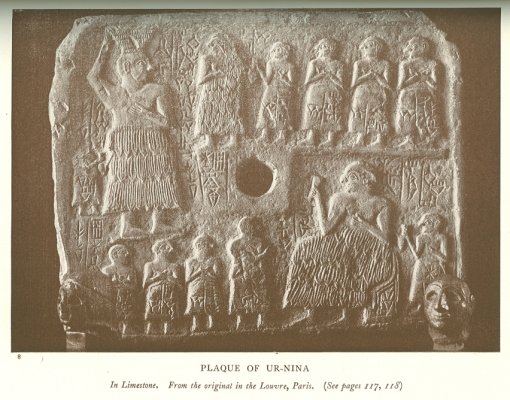
PLAQUE OF UR-NINA
In Limestone. From the original in the Louvre, Paris.
Among the deities of Lagash, Ur-Nina favoured most the goddess Nina, whose
name he bore. As she was a water deity, and perhaps identical with Belit-sheri,
sister of “Tammuz of the Abyss” and daughter of Ea, one of the canals was dedicated
to her. She was also honoured with a new temple, in which was probably placed
her great statue, constructed by special order of her royal worshipper. Like
the Egyptian goddess, the “Mother of Mendes”, Nina received offerings of fish,
not only as a patroness of fishermen, but also as a corn spirit and a goddess
of maternity. She was in time identified with Ishtar.
A famous limestone plaque, which is preserved in the Louvre, Paris, depicts
on its upper half the pious King Ur-Nina engaged in the ceremony of laying the
foundations of a temple dedicated either to the goddess Nina or to the god Nin-Girsu.
His face and scalp are clean shaven, and he has a prominent nose and firm mouth,
eloquent of decision. The folds of neck and jaw suggest Bismarckian traits.
He is bare to the waist, and wears a pleated kilt, with three flounces, which
reaches almost to his ankles. On his long head he has poised deftly a woven
basket containing the clay with which he is to make the first brick. In front
of him stand five figures. The foremost is honoured by being sculptured larger
than the others, except the prominent monarch. Apparently this is a royal princess,
for her head is unshaven, and her shoulder dress or long hair drops over one
of her arms. Her name is Lida, and the conspicuous part she took in the ceremony
suggests that she was the representative of the goddess Nina. She is accompanied
by her brothers, and at least one official, Anita, the cup-bearer, or high priest. The concluding part of this ceremony, or another ceremonial act,
is illustrated on the lower part of the plaque. Ur-Nina is seated on his throne,
not, as would seem at first sight, raising the wine cup to his lips and toasting
to the success of the work, but pouring out a libation upon the ground. The
princess is not present; the place of honour next to the king is taken by the
crown prince. Possibly in this case it is the god Nin-Girsu who is being honoured.
Three male figures, perhaps royal sons, accompany the prominent crown prince.
The cup-bearer is in attendance behind the throne.
The inscription on this plaque, which is pierced in the centre so as to be
nailed to a sacred shrine, refers to the temples erected by Ur-Nina, including
those of Nina and Nin-Girsu.
After Ur-Nina’s prosperous reign came to a close, his son Akurgal ascended
the throne. He had trouble with Umma, a powerful city, which lay to the north-west
of Lagash, between the Shatt-el-Kai and Shatt-el-Hai canals. An army of raiders
invaded his territory and had to be driven back.
The next king, whose name was Eannatum, had Napoleonic characteristics. He
was a military genius with great ambitions, and was successful in establishing
by conquest a small but brilliant empire. Like his grandfather, he strengthened
the fortifications of Lagash; then he engaged in a series of successful campaigns.
Umma had been causing anxiety in Lagash, but Eannatum stormed and captured that
rival city, appropriated one of its fertile plains, and imposed an annual tribute
to be paid in kind. An army of Elamites swept down from the hills, but Ur-Nina’s
grandson inflicted upon these bold foreigners a crushing defeat and pursued
them over the frontier. Several cities were afterwards forced to come under the sway of triumphant Lagash, including Erech and Ur, and as
his suzerainty was already acknowledged at Eridu, Eannatum’s power in Sumeria
became as supreme as it was firmly established.
Evidently Zuzu, king of the northern city of Opis, considered that the occasion
was opportune to overcome the powerful Sumerian conqueror, and at the same time
establish Semitic rule over the subdued and war-wasted cities. He marched south
with a large army, but the tireless and ever-watchful Eannatum hastened to the
fray, scattered the forces of Opis, and captured the foolhardy Zuzu.
Eannatum’s activities, however, were not confined to battlefields. At Lagash
he carried out great improvements in the interests of agriculture; he constructed
a large reservoir and developed the canal system. He also extended and repaired
existing temples in his native city and at Erech. Being a patron of the arts,
he encouraged sculpture work, and the finest Sumerian examples belong to his
reign.
Eannatum was succeeded by his brother, Enannatum I. Apparently the new monarch
did not share the military qualities of his royal predecessor, for there were
signs of unrest in the loose confederacy of states. Indeed, Umma revolted. From
that city an army marched forth and took forcible possession of the plain which
Eannatum had appropriated, removing and breaking the landmarks, and otherwise
challenging the supremacy of the sovran state. A Lagash force defeated the men
of Umma, but appears to have done little more than hold in check their aggressive
tendencies.
No sooner had Entemena, the next king, ascended the throne than the flame
of revolt burst forth again. The Patesi of Umma, was evidently determined to
free, once and for all, his native state from the yoke of Lagash. But he had gravely
miscalculated the strength of the vigorous young ruler. Entemena inflicted upon
the rebels a crushing defeat, and following up his success, entered the walled
city and captured and slew the patesi. Then he took steps to stamp out the embers
of revolt in Umma by appointing as its governor one of his own officials, named
Ili, who was duly installed with great ceremony. Other military successes followed,
including the sacking of Opis and Kish, which assured the supremacy of Lagash
for many years. Entemena, with characteristic vigour, engaged himself during
periods of peace in strengthening his city fortifications and in continuing
the work of improving and developing the irrigation system. He lived in the
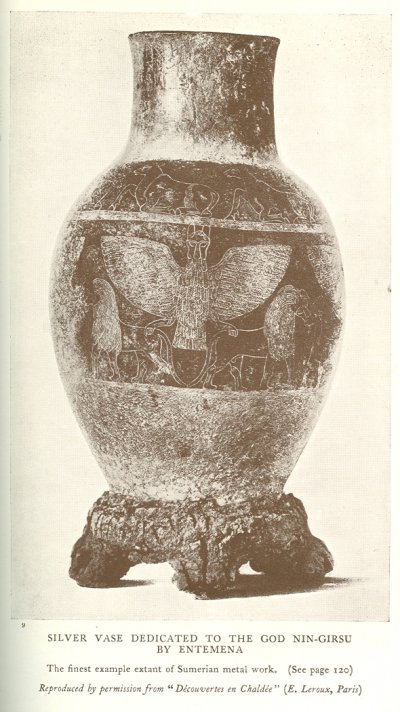
golden age of Sumerian art, and to his reign belongs the exquisite silver vase
of Lagash, which was taken from the Tello mound, and is now in the Louvre. This
votive offering was placed by the king in the temple of Nin-Girsu. It is exquisitely
shaped, and has a base of copper. The symbolic decorations include the lion-headed
eagle, which was probably a form of the spring god of war and fertility, the
lion, beloved by the Mother goddess, and deer and ibexes, which recall the mountain
herds of Astarte. In the dedicatory inscription the king is referred to as a
patesi, and the fact that the name of the high priest, Dudu, is given may be
taken as an indication of the growing power of an aggressive priesthood. After
a brilliant reign of twenty-nine years the king died, and was succeeded by his
son, Enannatum II, who was the last ruler of Ur-Nina’s line. An obscure period
ensued. Apparently there had been a city revolt, which may have given the enemies
of Lagash the desired opportunity to gather strength for the coming conflict.
There is a reference to an Elamite raid which, although repulsed, may be regarded as proof of disturbed
political conditions.
One or two priests sat on the throne of Lagash in brief succession, and then
arose to power the famous Urukagina, the first reformer in history. He began
to rule as patesi, but afterwards styled himself king. What appears certain
is that he was the leader of a great social upheaval, which received the support
of a section of the priesthood, for he recorded that his elevation was due to
the intercession of the god Nin-Girsu. Other deities, who were sons and daughters
of Nin-Girsu and Nina, had been given recognition by his predecessors, and it
is possible that the orthodox section of Lagash, and especially the agricultural
classes, supported the new ruler in sweeping away innovations to which they
were hostile.
Like Khufu and his descendants, the Pyramid kings of Egypt’s fourth dynasty,
the vigorous and efficient monarchs of the Ur-Nina dynasty of Lagash were apparently
remembered and execrated as tyrants and oppressors of the people. To maintain
many endowed temples and a standing army the traders and agriculturists had
been heavily taxed. Each successive monarch who undertook public works on a
large scale for the purpose of extending and developing the area under cultivation,
appears to have done so mainly to increase the revenue of the exchequer, so
as to conserve the strength of the city and secure its pre-eminence as a metropolis.
A leisured class had come into existence, with the result that culture was fostered
and civilization advanced. Lagash seems to have been intensely modern in character
prior to 2800 B.C., but with the passing of the old order of things there arose
grave social problems which never appear to have been seriously dealt with.
All indications of social unrest were, it would appear, severely repressed by the iron-gloved
monarchs of Ur-Nina’s dynasty.
The people as a whole groaned under an ever-increasing burden of taxation.
Sumeria was overrun by an army of officials who were notoriously corrupt; they
do not appear to have been held in check, as in Egypt, by royal auditors. “In
the domain of Nin-Girsu”, one of Urukagina’s tablets sets forth, “there were
tax gatherers down to the sea.” They not only attended to the needs of the exchequer,
but enriched themselves by sheer robbery, while the priests followed their example
by doubling their fees and appropriating temple offerings to their own use.
The splendid organization of Lagash was crippled by the dishonesty of those
who should have been its main support.
Reforms were necessary and perhaps overdue, but, unfortunately for Lagash,
Urukagina’s zeal for the people’s cause amounted to fanaticism. Instead of gradually
re-adjusting the machinery of government so as to secure equality of treatment
without impairing its efficiency as a defensive force in these perilous times,
he inaugurated sweeping and revolutionary social changes of far-reaching character
regardless of consequences. Taxes and temple fees were cut down, and the number
of officials reduced to a minimum. Society was thoroughly disorganized. The
army, which was recruited mainly from the leisured and official classes, went
practically out of existence, so that traders and agriculturists obtained relief
from taxation at the expense of their material security.
Urukagina’s motives were undoubtedly above reproach, and he showed an example
to all who occupied positions of trust by living an upright life and denying
himself luxuries. He was disinterestedly pious, and built and restored templed
and acted as the steward of his god with desire to promote the welfare and comfort of all true worshippers. His
laws were similar to those which over two centuries afterwards were codified
by Hammurabi, and like that monarch he was professedly the guardian of the weak
and the helper of the needy; he sought to establish justice and liberty in the
kingdom. But his social Arcadia vanished like a dream because he failed to recognize
that Right must be supported by Might.
In bringing about his sudden social revolution, Urukagina had at the same
time unwittingly let loose the forces of disorder. Discontented and unemployed
officials, and many representatives of the despoiled leisured and military classes
of Lagash, no doubt sought refuge elsewhere, and fostered the spirit of revolt
which ever smouldered in subject states. At any rate, Umma, remembering the
oppressions of other days, was not slow to recognize that the iron hand of Lagash
had become unnerved. The zealous and iconoclastic reformer had reigned but seven
years when he was called upon to defend his people against the invader. He appears
to have been utterly unprepared to do so. The victorious forces of Umma swept
against the stately city of Lagash and shattered its power in a single day.
Echoes of the great disaster which ensued rise from a pious tablet inscription
left by a priest, who was convinced that the conquerors would be called to account
for the sins they had committed against the great god Nin-Girsu. He lamented
the butchery and robbery which had taken place. We gather from his composition
that blood was shed by the raiders of Umma even in the sacred precincts of temples,
that statues were shattered, that silver and precious stones were carried away,
that granaries were plundered and standing crops destroyed, and that many buildings
were set on fire. Amidst these horrors of savagery and vengeance, the now tragic figure of the great reformer suddenly vanishes from before
our eyes. Perhaps he perished in a burning temple; perhaps he found a nameless
grave with the thousands of his subjects whose bodies had lain scattered about
the blood-stained streets. With Urukagina the glory of Lagash departed. Although
the city was rebuilt in time, and was even made more stately than before, it
never again became the metropolis of Sumeria.
The vengeful destroyer of Lagash was Lugal-zaggisi, Patesi of Umma, a masterful
figure in early Sumerian history. We gather from the tablet of the unknown scribe,
who regarded him as a sinner against the god Nin-Girsu, that his city goddess
was named Nidaba. He appears also to have been a worshipper of Enlil of Nippur,
to whose influence he credited his military successes. But Enlil was not his
highest god, he was the interceder who carried the prayers of Lugal-zaggisi
to the beloved father, Anu, god of the sky. No doubt Nin-Girsu represented a
school of theology which was associated with unpleasant memories in Umma. The
sacking and burning of the temples of Lagash suggests as much.
Having broken the power of Lagash, Lugal-zaggisi directed his attention to
the rival city of Kish, where Semitic influence was predominating. When Nanizak,
the last monarch of the line of the famous Queen Azag-Bau, had sat upon the
throne for but three years, he perished by the sword of the Umma conqueror.
Nippur likewise came under his sway, and he also subdued the southern cities.
Lugal-zaggisi chose for his capital ancient Erech, the city of Anu, and of
his daughter, the goddess Nana, who afterwards was identified with Ishtar. Anu’s
spouse was Anatu, and the pair subsequently became abstract deities, like Anshar
and Kishar, their parents, who figure in the
Babylonian Creation story. Nana was worshipped as the goddess of vegetation,
and her relation to Anu was similar to that of Belit-sheri to Ea at Eridu. Anu
and Ea were originally identical, but it would appear that the one was differentiated
as the god of the waters above the heaven and the other as god of the waters
beneath the earth, both being forms of Anshar. Elsewhere the chief god of the
spring sun or the moon, the lover of the goddess, became pre-eminent, displacing
the elder god, like Nin-Girsu at Lagash. At Sippar the sun god, Babbar, whose
Semitic name was Shamash, was exalted as the chief deity, while the moon god
remained supreme at Ur. This specializing process, which was due to local theorizing
and the influence of alien settlers, has been dealt with in a previous chapter.
In referring to himself as the favoured ruler of various city deities, Lugal-zaggisi
appears as a ruler of all Sumeria. How far his empire extended it is impossible
to determine with certainty. He appears to have overrun Akkad, and even penetrated
to the Syrian coast, for in one inscription it is stated that he “made straight
his path from the Lower Sea (the Persian Gulf) over the Euphrates and Tigris
to the Upper Sea (the Mediterranean)”. The allegiance of certain states, however,
depended on the strength of the central power. One of his successors found it
necessary to attack Kish, which was ever waiting for an opportunity to regain
its independence.
According to the Chronicle of Kish, the next ruler of Sumer and Akkad after
Lugal-zaggisi was the famous Sargon I. It would appear that he was an adventurer
or usurper, and that he owed his throne indirectly to Lugal-zaggisi, who had
dethroned the ruler of Akkad. Later traditions, which have been partly confirmed
by contemporary inscriptions, agree that Sargon was of humble birth. In the previous chapter reference was made to the Tammuz-like myth
attached to his memory. His mother was a vestal virgin dedicated to the sun
god, Shamash, and his father an unknown stranger from the mountains–a suggestion
of immediate Semitic affinities. Perhaps Sargon owed his rise to power to the
assistance received by bands of settlers from the land of the Amorites, which
Lugal-zaggisi had invaded.
According to the legend, Sargon’s birth was concealed. He was placed in a
vessel which was committed to the river. Brought up by a commoner, he lived
in obscurity until the Semitic goddess, Ishtar, gave him her aid.
A similar myth was attached in India to the memory of Karna, the Hector of
that great Sanskrit epic the Mahhata. Karna’s mother, the Princess
Pritha, who afterwards became a queen, was loved by the sun god, Surya. When
in secret she gave birth to her son she placed him in an ark of wickerwork,
which was set adrift on a stream. Ultimately it reached the Ganges, and it was
borne by that river to the country of Anga, where the child was rescued by a
woman and afterwards reared by her and her husband, a charioteer. In time Karna
became a great warrior, and was crowned King of Anga by the Kaurava warriors.1
Before he became king, Sargon of Akkad, the Sharrukin of the texts, was,
according to tradition, a gardener and watchman attached to the temple of the
war god Zamama of Kish. This deity was subsequently identified with Merodach,
son of Ea; Ninip, son of Enlil; and Nin-Girsu of Lagash. He was therefore one
of the many developed forms of Tammuz–a solar, corn, and military deity, and
an interceder for mankind. The goddess of Kish appears to have been a form of
Bau, as is testified by the name of Queen Azag-Bau, the legendary founder of the city.
Unfortunately our knowledge of Sargon’s reign is of meagre character. It
is undoubted that he was a distinguished general and able ruler. He built up
an empire which included Sumer and Akkad, and also Amurru, “the western land”,
or “land of the Amorites”. The Elamites gave him an opportunity to extend his
conquests eastward. They appear to have attacked Opis, but he drove them back,
and on more than one occasion penetrated their country, over the western part
of which, known as Anshan, he ultimately imposed his rule. Thither went many
Semitic settlers who had absorbed the culture of Sumeria.
During Sargon’s reign Akkad attained to a splendour which surpassed that
of Babylon. In an omen text the monarch is lauded as the “highly exalted one
without a peer”. Tradition relates that when he was an old man all the Babylonian
states rose in revolt against him and besieged Akkad. But the old warrior led
forth his army against the combined forces and achieved a shattering victory.
Manishtusu, who succeeded Sargon I, had similarly to subdue a great confederacy
of thirty-two city states, and must therefore have been a distinguished general.
But he is best known as the monarch who purchased several large estates adjoining
subject cities, his aim having been probably to settle on these Semitic allies
who would be less liable to rebel against him than the workers they displaced.
For the latter, however, he found employment elsewhere. These transactions,
which were recorded on a monument subsequently carried off with other spoils
by the Elamites and discovered at Susa, show that at this early period (about
2600 B.C.) even a conquering monarch considered it advisable to observe existing land laws.
Urumush,1 the
next ruler, also achieved successes in Elam and elsewhere, but his life was
cut short by a palace revolution.
The prominent figure of Naram Sin, a later king of Akkad, bulks largely in
history and tradition. According to the Chronicle of Kish, he was a son of Sargon.
Whether he was or not, it is certain that he inherited the military and administrative
genius of that famous ex-gardener. The arts flourished during his reign. One
of the memorable products of the period was an exquisitely sculptured monument
celebrating one of Naram Sin’s victories, which was discovered at Susa. It is
one of the most wonderful examples of Babylonian stone work which has come to
light.
A successful campaign had been waged against a mountain people. The stele
shows the warrior king leading his army up a steep incline and round the base
of a great peak surmounted by stars. His enemies flee in confusion before him.
One lies on the ground clutching a spear which has penetrated his throat, two
are falling over a cliff, while others apparently sue for mercy. Trees have
been depicted to show that part of the conquered territory is wooded. Naram
Sin is armed with battleaxe and bow, and his helmet is decorated with horns.
The whole composition is spirited and finely grouped; and the military bearing
of the disciplined troops contrasts sharply with the despairing attitudes of
the fleeing remnants of the defending army.
During this period the Semitized mountaineers to the north-east of Babylonia
became the most aggressive opponents of the city states. The two most prominent
were the Gutium, or men of Kutu, and the Lulubu.
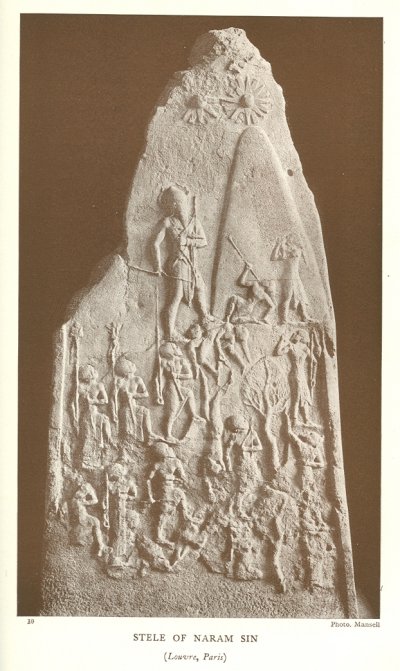
STELE OF NARAM SIN
(Louvre, Paris)
Naram Sin’s great empire included the whole of Sumer and Akkad, Amurru and
northern Palestine, and part of Elam, and the district to the north. He also
penetrated Arabia, probably by way of the Persian Gulf, and caused diorite to
be quarried there. One of his steles, which is now in the Imperial Ottoman Museum
at Constantinople, depicts him as a fully bearded man with Semitic characteristics.
During his lifetime he was deified–a clear indication of the introduction of
foreign ideas, for the Sumerians were not worshippers of kings and ancestors.
Naram Sin was the last great king of his line. Soon after his death the power
of Akkad went to pieces, and the Sumerian city of Erech again became the centre
of empire. Its triumph, however, was shortlived. After a quarter of a century
had elapsed, Akkad and Sumer were overswept by the fierce Gutium from the north-eastern
mountains. They sacked and burned many cities, including Babylon, where the
memory of the horrors perpetrated by these invaders endured until the Grecian
Age. An obscure period, like the Egyptian Hyksos Age, ensued, but it was of
comparatively brief duration.
When the mists cleared away, the city Lagash once more came to the front,
having evidently successfully withstood the onslaughts of the Gutium, but it
never recovered the place of eminence it occupied under the brilliant Ur-Nina
dynasty. It is manifest that it must have enjoyed under the various overlords,
during the interval, a considerable degree of independence, for its individuality
remained unimpaired. Of all its energetic and capable patesis, the most celebrated
was Gudea, who reigned sometime before 2400 B.C. In contrast to the Semitic
Naram Sin, he was beardless and pronouncedly Sumerian in aspect. His favoured
deity, the city god
Nin-Girsu, again became prominent, having triumphed over his jealous rivals
after remaining in obscurity for three or four centuries. Trade flourished,
and the arts were fostered. Gudea had himself depicted, in one of the most characteristic
sculptures of his age, as an architect, seated reverently with folded hands
with a temple plan lying on his knees, and his head uplifted as if watching
the builders engaged in materializing the dream of his life. The temple in which
his interests were centred was erected in honour of Nin-Girsu. Its ruins suggest
that it was of elaborate structure and great beauty. Like Solomon in later days,
Gudea procured material for his temple from many distant parts–cedar from Lebanon,
marble from Amurru, diorite from Arabia, copper from Elam, and so forth. Apparently
the King of Lagash was strong enough or wealthy enough to command respect over
a wide area.
Another city which also rose into prominence, amidst the shattered Sumerian
states, was Ur, the centre of moon worship. After Gudea’s death, its kings exercised
sway over Lagash and Nippur, and, farther south, over Erech and Larsa as well.
This dynasty endured for nearly a hundred and twenty years, during which Ur
flourished like Thebes in Egypt. Its monarchs styled themselves as “Kings of
the Four Regions”. The worship of Nannar (Sin) became officially recognized
at Nippur, the seat of Enlil, during the reign of King Dungi of Ur; while at
Erech, the high priest of Anu, the sky god, became the high priest of the moon
god. Apparently matriarchal ideas, associated with lunar worship, again came
into prominence, for the king appointed two of his daughters to be rulers of
conquered states in Elam and Syria. In the latter half of his reign, Dungi,
the conqueror, was installed as high priest at Eridu.
STATUE OF GUDEA
(Louvre, Paris)
Photo. Mansell
It would thus appear that there was a renascence of early Sumerian religious
ideas. Ea, the god of the deep, had long been overshadowed, but a few years
before Dungi’s death a temple was erected to him at Nippur, where he was worshipped
as Dagan. Until the very close of his reign, which lasted for fifty-eight years,
this great monarch of tireless activity waged wars of conquest, built temples
and palaces, and developed the natural resources of Sumer and Akkad. Among his
many reforms was the introduction of standards of weights, which received divine
sanction from the moon god, who, as in Egypt, was the measurer and regulator
of human transactions and human life.
To this age also belongs many of the Sumerian business and legal records,
which were ultimately carried off to Susa, where they have been recovered by
French excavators.
About half a century after Dungi’s death the Dynasty of Ur came to an end,
its last king having been captured by an Elamite force.
At some time subsequent to this period, Abraham migrated from Ur to the northern
city of Harran, where the moon god was also the chief city deity–the Baal,
or “lord”. It is believed by certain Egyptologists that Abraham sojourned in
Egypt during its Twelfth Dynasty, which, according to the Berlin system of minimum
dating, extended from about 2000 B.C. till 1780 B.C. The Hebrew patriarch may
therefore have been a contemporary of Hammurabi’s, who is identified with Amraphel,
king of Shinar (Sumer) in the Bible.1
But after the decline of Ur’s ascendancy, and long before Babylon’s great
monarch came to the throne, the centre of power in Sumeria was shifted to Isin,
where sixteen kings flourished for two and a quarter centuries. Among the royal
names, recognition was given to Ea and Dagan, Sin, Enlil, and Ishtar, indicating
that Sumerian religion in its Semitized corm was receiving general recognition.
The sun god was identical with Ninip and Nin-Girsu, a god of fertility, harvest,
and war, but now more fully developed and resembling Babbar, “the shining one”,
the solar deity of Akkadian Sippar, whose Semitic name was Shamash. As Shamash
was ultimately developed as the god of justice and righteousness, it would appear
that his ascendancy occurred during the period when well-governed communities
systematized their religious beliefs to reflect social conditions.
The first great monarch of the Isin dynasty was Ishbi-Urra, who reigned for
thirty-two years. Like his successors, he called himself “King of Sumer and
Akkad”, and it appears that his sway extended to the city of Sippar, where solar
worship prevailed. Traces of him have also been found at Eridu, Ur, Erech, and
Nippur, so that he must have given recognition to Ea, Sin, Anu, and Enlil. In
this period the early national pantheon may have taken shape, Bel Enlil being
the chief deity. Enlil was afterwards displaced by Merodach of Babylon.
Before 2200 B.C. there occurred a break in the supremacy of Isin. Gungunu,
King of Ur, combined with Larsa, whose sun temple he restored, and declared
himself ruler of Sumer and Akkad. But Isin again gathered strength under Ur-Ninip,
who was not related to his predecessor. Perhaps he came from Nippur, where the
god Ninip was worshipped as the son of Bel Enlil.
According to a Babylonian document, a royal grand-son of Ur-Ninip’s, having
no direct heir, selected as his successor his gardener, Enlil-bani. He placed
the crown on the head of this obscure individual, abdicated in his favour, and then died a mysterious death within his palace.
It is highly probable that Enlil-bani, whose name signifies “Enlil is my
creator”, was a usurper like Sargon of Akkad, and he may have similarly circulated
a myth regarding his miraculous origin to justify his sudden rise to power.
The truth appears to be that he came to the throne as the leader of a palace
revolution at a time of great unrest. But he was not allowed to remain in undisputed
possession. A rival named Sin-ikisha, evidently a moon worshipper and perhaps
connected with Ur, displaced the usurper, and proclaimed himself king. After
a brief reign of six months he was overthrown, however, by Enlil-bani, who piously
credited his triumph over his enemy to the chief god of Nippur, whose name he
bore. Although he took steps to secure his position by strengthening the fortifications
of Isin, and reigned for about a quarter of a century, he was not succeeded
by his heir, if he had one. King Zambia, who was no relation, followed him,
but his reign lasted for only three years. The names of the next two kings are
unknown. Then came Sin-magir, who was succeeded by Damik-ilishu, the last King
of Isin.
Towards the close of Damik-ilishu’s reign of twenty-four years he came under
the suzerainty of Larsa, whose ruler was Rim Sin. Then Isin was captured by
Sin-muballit, King of Babylon, the father of the great Hammurabi. Rim Sin was
an Elamite.
Afterwards the old order of things passed away. Babylon became the metropolis,
the names of Sumer and Akkad dropped out of use, and the whole country between
the rivers was called Babylonia.1 The various systems of law which obtained in the different states were then codified by Hammurabi,
who appointed governors in all the cities which came under his sway to displace
the patesis and kings. A new national pantheon of representative character was
also formed, over which Merodach (Marduk), the city god of Babylon, presided.
How this younger deity was supposed to rise to power is related in the Babylonian
legend of Creation, which is dealt with in the next
chapter .1 In framing this myth from the fragments of older myths, divine sanction was
given to the supremacy achieved by Merodach’s city. The allegiance of future
generations was thus secured, not only by the strong arm of the law, but also
by the combined influence of the reorganized priesthoods at the various centres
of administration.
An interesting problem, which should be referred to here, arises in connection
with the sculptured representations of deities before and after the rise of
Akkad as a great Power. It is found, although the Sumerians shaved their scalps
and faces at the dawn of the historical age, that they worshipped gods who had
long hair and also beards, which were sometimes square and sometimes pointed.
At what period the Sumerian deities were given human shape it is impossible
to determine. As has been shown (Chapters II and
III ) all the chief gods and goddesses had animal
forms and composite monster forms before they became anthropomorphic deities.
Ea had evidently a fish shape ere he was clad in the skin of a fish, as an Egyptian
god was simply a bull before he was depicted in human shape wearing a bull’s
skin. The archaic Sumerian animal and composite monster gods of animistic and totemic origin survived after the anthropomorphic period as mythical
figures, which were used for decorative or magical purposes and as symbols.
A form of divine headdress was a cap enclosed in horns, between which appeared
the soaring lion-headed eagle, which symbolized Nin-Girsu. This god had also
lion and antelope forms, which probably figured in lost myths–perhaps they
were like the animals loved by Ishtar and referred to in the Gilgamesh epic.
Similarly the winged bull was associated with the moon god Nannar, or Sin, of
Ur, who was “a horned steer”. On various cylinder seals appear groups of composite
monsters and rearing wild beasts, which were evidently representations of gods
and demons in conflict.
Suggestive data for comparative study is afforded in this connection by ancient
Egypt. Sokar, the primitive Memphite deity, retained until the end his animal
and composite monster forms. Other gods were depicted with human bodies and
the heads of birds, serpents, and crocodiles, thus forming links between the
archaic demoniac and the later anthropomorphic deities. A Sumerian example is
the deified Ea-bani, who, like Pan, has the legs and hoofs of a goat.
The earliest representations of Sumerian humanized deities appear on reliefs
from Tello, the site of Lagash. These examples of archaic gods, however, are
not bearded in Semitic fashion. On the contrary, their lips and cheeks are shaved,
while an exaggerated chin tuft is retained. The explanation suggested is that
the Sumerians gave their deities human shape before they themselves were clean
shaven, and that the retention of the characteristic facial hair growth of the
Mediterranean Race is another example of the conservatism of the religious instinct.
In Egypt the clean-shaven Pharaohs, who represented gods, wore false chin-tuft
beards; even Queen
Hatshepsut considered it necessary to assume a beard on state occasions. Ptah-Osiris
retained his archaic beard until the Ptolemaic period.
It seems highly probable that in similarly depicting their gods with beards,
the early Sumerians were not influenced by the practices of any alien people
or peoples. Not until the period of Gudea, the Patesi of Lagash, did they give
their gods heavy moustaches, side whiskers, and flowing beards of Semitic type.
It may be, however, that by then they had completely forgotten the significance
of an ancient custom. Possibly, too, the sculptors of Lagash were working under
the influence of the Akkadian school of art, which had produced the exquisite
stele of victory for Naram-Sin, and consequently adopted the conventional Semitic
treatment of bearded figures. At any rate, they were more likely to study and
follow the artistic triumphs of Akkad than the crude productions of the archaic
period. Besides, they lived in an age when Semitic kings were deified and the
Semitic overlords had attained to great distinction and influence.
The Semitic folks were not so highly thought of in the early Sumerian period.
It is not likely that the agricultural people regarded as models of gods the
plunderers who descended from the hills, and, after achieving successes, returned
home with their spoils. More probably they regarded them as “foreign devils”.
Other Semites, however, who came as traders, bringing wood, stone, and especially
copper, and formed communities in cities, may well have influenced Sumerian
religious thought. The god Ramman, for instance, who was given recognition all
through Babylonia, was a god of hill folks as far north as Asia Minor and throughout
Syria. He may have been introduced by settlers who adopted Sumerian habits of life and shaved scalp and face. But although the old cities could
never have existed in a complete state of isolation from the outer world, it
is unlikely that their inhabitants modelled their deities on those worshipped
by groups of aliens. A severe strain is imposed on our credulity if we are expected
to believe that it was due to the teachings and example of uncultured nomads
that the highly civilized Sumerians developed their gods from composite monsters
to anthropomorphic deities. Such a supposition, at any rate, is not supported
by the evidence of Ancient Egypt.
Footnotes
111:1 Nehemiah,
i, 1
111:2 Esther,
i, 6.
114:1 Isaiah,
iii, 19-22.
126:1 Indian Myth
and Legend, pp. 173-175 and 192-194.
128:1 Or Rimush.
131:1 Genesis,
xiv.
133:1 That is, the equivalent
of Babylonia. During the Kassite period the name was Karduniash.
134:1 The narrative follows
The Seven Tablets of Creationand other fragments, while the account
given by Berosus is also drawn upon.
Next: Chapter VII. Creation Legend: Merodach
the Dragon Slayer

Leave A Comment