
CHAPTER XX
The Last Days of Assyria and Babylonia
Doom of Nineveh and Babylon–Babylonian Monotheism–Ashur-banipal
and his Brother, King of Babylon–Ceremony of “Taking the Hands of Bel”–Merodach
restored to E-sagila–Assyrian Invasion of Egypt and Sack of Thebes–Lydia’s
Appeal to Assyria–Elam subdued–Revolt of Babylon–Death of Babylonian King–Sack
of Susa–Psamtik of Egypt–Cimmerians crushed–Ashur-bani-pal’s Literary Activities–The
Sardanapalus Legend–Last Kings of Assyria–Fall of Nineveh–The New Babylonian
Empire–Necho of Egypt expelled from Syria–King Jehoaikin of Judah deposed–Zedekiah’s
Revolt and Punishment–Fall of Jerusalem and Hebrew Captivity–Jeremiah laments
over Jerusalem–Babylonia’s Last Independent King–Rise of Cyrus the Conqueror–The
Persian Patriarch and Eagle Legend–Cyrus conquers Lydia–Fall of Babylon–Jews
return to Judah–Babylon from Cyrus to Alexander the Great.
THE burden of Nineveh . . . The Lord is slow to anger, and
great in power, and will not at all acquit the wicked: the Lord hath his way
in the whirlwind and in the storm, and the clouds are the dust of his feet.
He rebuketh the sea, and maketh it dry, and drieth up all the rivers: Bashan
languisheth, and Carmel, and the flower of Lebanon languisheth. . . . He that
dasheth in pieces is come up before thy face. . . . The gates of the rivers
shall be opened, and the palace shall be dissolved. And Huzzab shall be led
away captive, she shall be brought up, and her maids shall lead her as with
the voice of doves, tabering upon their breasts. . . . Draw thee waters for
the siege, fortify thy strong holds: go into clay, and tread the morter, make
strong the brick-kiln. There shall the fire devour thee; the sword shall cut
thee off. . . . Thy shepherds slumber, O king of Assyria: thy nobles shall dwell
in the dust: thy people is scattered upon the mountains, and no man gathereth
them. There is no healing of thy bruise; thy wound is grievous: all that hear
the bruit of thee shall clap the hands over thee: for upon whom hath not thy wickedness passed continually?1
The doom of Babylon was also foretold:
Bel boweth down, Nebo stoopeth. . . . Come down, and sit
in the dust, O virgin daughter of Babylon, sit on the ground: there is no throne,
O daughter of the Chaldeans. . . . Stand now with thine enchantments, and with
the multitude of thy sorceries, wherein thou hast laboured from thy youth; if
so be thou shalt be able to profit, if so be thou mayest prevail. Thou art wearied
in the multitude of thy counsels. Let now the astrologers, the star-gazers,
the monthly prognosticators, stand up, and save thee from these things that
shall come upon thee. Behold, they shall be as stubble; the fire shall burn
them. . . . Thus shall they be unto thee with whom thou hast laboured, even
thy merchants, from thy youth: they shall wander every one to his quarter; none
shall save thee.2
Against a gloomy background, dark and ominous as a thundercloud, we have
revealed in the last century of Mesopotamian glory the splendour of Assyria
and the beauty of Babylon. The ancient civilizations ripened quickly before
the end came. Kings still revelled in pomp and luxury. Cities resounded with
“the noise of a whip, and the noise of the rattling of the wheels, and of the
pransing horses, and of the jumping chariots. The horseman lifteth up both the
bright sword and the glittering spear. . . . The valiant men are in scarlet.”3 But the minds of cultured men were more deeply occupied than ever with the mysteries
of life and creation. In the libraries, the temples, and observatories, philosophers
and scientists were shattering the unsubstantial fabric of immemorial superstition;
they attained to higher conceptions of the duties and responsibilities of mankind;
they conceived of divine love and divine guidance; they discovered, like Wordsworth,
that the soul has–
An obscure sense
Of possible sublimity, whereto
With growing faculties she doth aspire.
One of the last kings of Babylon, Nebuchadrezzar, recorded a prayer which
reveals the loftiness of religious thought and feeling attained by men to whom
graven images were no longer worthy of adoration and reverence–men whose god
was not made by human hands–
O eternal prince! Lord of all being!
As for the king whom thou lovest, and
Whose name thou hast proclaimed
As was pleasing to thee,
Do thou lead aright his life,
Guide him in a straight path.
I am the prince, obedient to thee,
The creature of thy hand;
Thou hast created me, and
With dominion over all people
Thou hast entrusted me.
According to thy grace, O Lord,
Which thou dost bestow on
All people,
Cause me to love thy supreme dominion,
And create in my heart
The worship of thy godhead
And grant whatever is pleasing to thee,
Because thou hast fashioned my life.1
The “star-gazers” had become scientists, and foretold eclipses: in every sphere
of intellectual activity great men were sifting out truth from the debris of
superstition. It seemed as if Babylon and Assyria were about to cross the threshold of a new age, when their doom was sounded and their power was
shattered for ever. Nineveh perished with dramatic suddenness: Babylon died
of “senile decay”.
When, in 668 B.C., intelligence reached Nineveh that Esarhaddon had passed
away, on the march through Egypt, the arrangements which he had made for the
succession were carried out smoothly and quickly. Nakia, the queen mother,
was acting as regent, and completed her lifework by issuing a proclamation exhorting
all loyal subjects and vassals to obey the new rulers, her grandsons, Ashur-bani-pal,
Emperor of Assyria, and Shamash-shum-ukin, King of Babylon. Peace prevailed
in the capital, and there was little or no friction throughout the provinces:
new rulers were appointed to administer the States of Arvad and Ammon, but there
were no changes elsewhere.
Babylon welcomed its new king–a Babylonian by birth and the son of a Babylonian
princess. The ancient kingdom rejoiced that it was no longer to be ruled as
a province; its ancient dignities and privileges were being partially restored.
But one great and deep-seated grievance remained. The god Merodach was still
a captive in the temple of Ashur. No king could reign aright if Merodach were
not restored to E-sagila. Indeed he could not be regarded as the lord of the
land until he had “taken the hands of Bel”.
The ceremony of taking the god’s hands was an act of homage. When it was
consummated the king became the steward or vassal of Merodach, and every day
he appeared before the divine one to receive instructions and worship him. The
welfare of the whole kingdom depended on the manner in which the king acted
towards the god. If Merodach was satisfied with the king he sent blessings to
the land; if he was angry he sent calamities.
A pious and faithful monarch was therefore the protector of the people.
This close association of the king with the god gave the priests great influence
in Babylon. They were the power behind the throne. The destinies of the royal
house were placed in their hands; they could strengthen the position of a royal
monarch, or cause him to be deposed if he did not satisfy their demands. A king
who reigned over Babylon without the priestly party on his side occupied an
insecure position. Nor could he secure the co-operation of the priests unless
the image of the god was placed in the temple. Where king was, there Merodach
had to he also.
Shamash-shum-ukin pleaded with his royal brother and overlord to restore
Bel Merodach to Babylon. Ashur-bani-pal hesitated for a time; he was unwilling
to occupy a less dignified position, as the representative of Ashur, than his
distinguished predecessor, in his relation to the southern kingdom. At length,
however, he was prevailed upon to consult the oracle of Shamash, the solar lawgiver,
the revealer of destiny. The god was accordingly asked if Shamash-shum-ukin
could “take the hands of Bel” in Ashur’s temple, and then proceed to Babylon
as his representative. In response, the priests of Shamash informed the emperor
that Bel Merodach could not exercise sway as sovereign lord so long as he remained
a prisoner in a city which was not his own.
Ashur-bani-pal accepted the verdict, and then visited Ashur’s temple to plead
with Bel Merodach to return to Babylon. “Let thy thoughts”, he cried, “dwell
in Babylon, which in thy wrath thou didst bring to naught. Let thy face be turned
towards E-sagila, thy lofty and divine temple. Return to the city thou hast
deserted for a house unworthy of thee. O Merodach! lord of the gods, issue thou the command to return again to Babylon.”
Thus did Ashur-bani-pal make pious and dignified submission to the will of
the priests. A favourable response was, of course, received from Merodach when
addressed by the emperor, and the god’s image was carried back to E-sagila,
accompanied by a strong force. Ashur-bani-pal and Shamash-shum-ukin led the
procession of priests and soldiers, and elaborate ceremonials were ob-served
at each city they passed, the local gods being carried forth to do homage to
Merodach.
Babylon welcomed the deity who was thus restored to his temple after the
lapse of about a quarter of a century, and the priests celebrated with unconcealed
satisfaction and pride the ceremony at which Shamash-shum-ukin “took the hands
of Bel”. The public rejoicings were conducted on an elaborate scale. Babylon
believed that a new era of prosperity had been inaugurated, and the priests
and nobles looked forward to the day when the kingdom would once again become
free and independent and powerful.
Ashur-bani-pal (668-626 B.C.) made arrangements to complete his father’s
designs regarding Egypt. His Tartan continued the campaign, and Taharka, as
has been stated, was driven from Memphis. The beaten Pharaoh returned to Ethiopia
and did not again attempt to expel the Assyrians. He died in 666 B.C. It was
found that some of the petty kings of Lower Egypt had been intriguing with Taharka,
and their cities were severely dealt with. Necho of Sais had to be arrested,
among others, but was pardoned after he appeared before Ashur-bani-pal, and
sent back to Egypt as the Assyrian governor.
Tanutamon, a son of Pharaoh Shabaka, succeeded Taharka, and in 663 B.C. marched
northward from Thebes with a strong army. He captured Memphis. It is believed Necho was slain,
and Herodotus relates that his son Psamtik took refuge in Syria. In 661 B.C.
Ashur-bani-pal’s army swept through Lower Egypt and expelled the Ethiopians.
Tanutamon fled southward, but on this occasion the Assyrians followed up their
success, and besieged and captured Thebes, which they sacked. Its nobles were
slain or taken captive. According to the prophet Nahum, who refers to Thebes
as No (Nu-Amon = city of Amon), “her young children also were dashed in pieces
at the top of all the streets: and they (the Assyrians) cast lots for her honourable
men, and all her great men were bound in chains”.1 Thebes never again recovered its prestige. Its treasures were transported to
Nineveh. The Ethiopian supremacy in Egypt was finally extinguished, and Psamtik,
son of Necho, who was appointed the Pharaoh, began to reign as the vassal of
Assyria.
When the kings on the seacoasts of Palestine and Asia Minor found that they
could no longer look to Egypt for help, they resigned themselves to the inevitable,
and ceased to intrigue against Assyria. Gifts were sent to Ashur-bani-pal by
the kings of Arvad, Tyre, Tarsus, and Tabal. The Arvad ruler, however, was displaced,
and his son set on his throne. But the most extraordinary development was the
visit to Nineveh of emissaries from Gyges, king of Lydia, who figures in the
legends of Greece. This monarch had been harassed by the Cimmerians after they
accomplished the fall of Midas of Phrygia in 676 B.C., and he sought the help
of Ashur-bani-pal. It is not known whether the Assyrians operated against the
Cimmerians in Tabal, but, as Gyges did not send tribute, it would appear that
he held his own with the aid of mercenaries from the State of Caria in south-western Asia Minor.
The Greeks of Cilicia, and the Achns and Phnicians of Cyprus remained faithful
to Assyria.
Elam gave trouble in 665 B.C. by raiding Akkad, but the Assyrian army repulsed
the invaders at Dur-ilu and pushed on to Susa. The Elamites received a crushing
defeat in a battle on the banks of the River Ula. King Teumman was slain, and
a son of the King of Urtagu was placed on his throne. Elam thus came under Assyrian
sway.
The most surprising and sensational conspiracy against Ashur-bani-pal was
fomented by his brother Shamash-shum-ukin of Babylon, after the two had co-operated
peacefully for fifteen years. No doubt the priestly party at E-sagila were deeply
concerned in the movement, and the king may have been strongly influenced by
the fact that Babylonia was at the time suffering from severe depression caused
by a series of poor harvests. Merodach, according to the priests, was angry;
it was probably argued that he was punishing the people because they had not
thrown off the yoke of Assyria.
The temple treasures of Babylon were freely drawn upon to purchase the allegiance
of allies. Ere Ashur-bani-pal had any knowledge of the conspiracy his brother
had won over several governors in Babylonia, the Chaldns, Aramns and Elamites,
and many petty kings in Palestine and Syria: even Egypt and Libya were prepared
to help him. When, however, the faithful governor of Ur was approached, he communicated
with his superior at Erech, who promptly informed Ashur-bani-pal of the great
conspiracy. The intelligence reached Nineveh like a bolt from the blue. The
emperor’s heart was filled with sorrow and anguish. In after-time he lamented
in an inscription that his “faithless brother” forgot the favours he had shown
him. “Outwardly with his lips he spoke friendly things, while inwardly his heart
plotted murder.”
In 652 B.C. Shamash-shum-ukin precipitated the crisis by forbidding Ashur-bani-pal
to make offerings to the gods in the cities of Babylonia. He thus declared his
independence.
War broke out simultaneously. Ur and Erech were besieged and captured by
the Chaldns, and an Elamite army marched to the aid of the King of Babylon,
but it was withdrawn before long on account of the unsettled political conditions
at home. The Assyrian armies swept through Babylonia, and the Chaldns in the
south were completely subjugated before Babylon was captured. That great commercial
metropolis was closely besieged for three years, and was starved into submission.
When the Assyrians were entering the city gates a sensational happening occurred.
Shamash-shum-ukin, the rebel king, shut himself up in his palace and set fire
to it, and perished there amidst the flames with his wife and children, his
slaves and all his treasures. Ashur-bani-pal was in 647 B.C. proclaimed King
Kandalanu1 of Babylon, and reigned over it until his death in 626 B.C.
Elam was severely dealt with. That unhappy country was terribly devastated
by Assyrian troops, who besieged and captured Susa, which was pillaged and wrecked.
It was recorded afterwards as a great triumph of this campaign that the statue
of Nana of Erech, which had been carried off by Elamites 1635 years previously,
was recovered and restored to the ancient Sumerian city. Elam’s power of resistance
was finally extinguished, and the country fell a ready prey to the Medes and
Persians, who soon entered into possession of it. Thus, by destroying a buffer State, Ashur-bani-pal
strengthened the hands of the people who were destined twenty years after his
death to destroy the Empire of Assyria.
The western allies of Babylon were also dealt with, and it may be that at
this time Manasseh of Judah was taken to Babylon (2 Chronicles, xxxiii,
11), where, however, he was forgiven. The Medes and the Mannai in the north-west
were visited and subdued, and a new alliance was formed with the dying State
of Urartu.
Psamtik of Egypt had thrown off the yoke of Assyria, and with the assistance
of Carian mercenaries received from his ally, Gyges, king of Lydia, extended
his sway southward. He made peace with Ethiopia by marrying a princess of its
royal line. Gyges must have weakened his army by thus assisting Psamtik, for
he was severely defeated and slain by the Cimmerians. His son, Ardys, appealed
to Assyria for help. Ashur-bani-pal dispatched an army to Cilicia. The joint
operations of Assyria and Lydia resulted in the extinction of the kingdom of
the Cimmerians about 645 B.C.
The records of Ashur-bani-pal cease after 640 B.C., so that we are unable
to follow the events of his reign during its last fourteen years. Apparently
peace prevailed everywhere. The great monarch, who was a pronounced adherent
of the goddess cults, appears to have given himself up to a life of indulgence
and inactivity. Under the name Sardanapalus he went down to tradition as a sensual
Oriental monarch who lived in great pomp and luxury, and perished in his burning
palace when the Medes revolted against him. It is evident, however, that the
memory of more than one monarch contributed to the Sardanapalus legend, for
Ashur-bani-pal had lain nearly twenty years in his grave before the siege of
Nineveh took place.
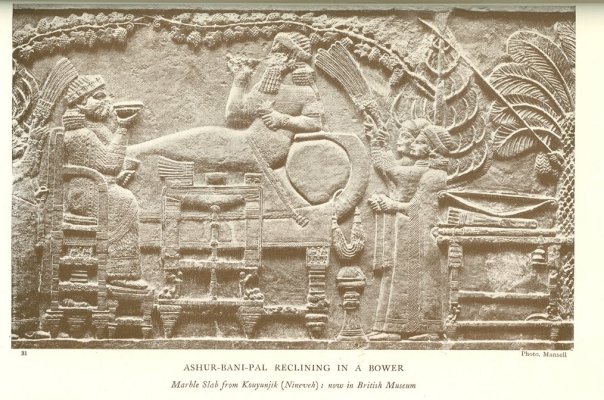
ASHUR-BANI-PAL RECLINING IN A BOWER
Marble Slab from Kouyunjik (Nineveh); now in British Museum.
Photo. Mansell
In the Bible he is referred to as “the great and noble Asnapper”, and he
appears to have been the emperor who settled the Babylonian, Elamite, and other
colonists “in the cities of Samaria”.1
He erected at Nineveh a magnificent palace, which was decorated on a lavish
scale. The sculptures are the finest productions of Assyrian art, and embrace
a wide variety of subjects–battle scenes, hunting scenes, and elaborate Court
and temple ceremonies. Realism is combined with a delicacy of touch and a degree
of originality which raises the artistic productions of the period to the front
rank among the artistic triumphs of antiquity.
Ashur-bani-pal boasted of the thorough education which he had received from
the tutors of his illustrious father, Esarhaddon. In his palace he kept a magnificent
library. It contained thousands of clay tablets on which were inscribed and
translated the classics of Babylonia. To the scholarly zeal of this cultured
monarch is due the preservation of the Babylonian story of creation, the Gilgamesh
and Etana legends, and other literary and religious products of remote antiquity.
Most of the literary tablets in the British Museum were taken from Ashur-bani-pal’s
library.
There are no Assyrian records of the reigns of Ashur-bani-pal’s two sons,
Ashur-etil-ilani–who erected a small palace and reconstructed the temple to
Nebo at Kalkhi–and Sin-shar-ishkun, who is supposed to have perished in Nineveh.
Apparently Ashur-etil-ilani reigned for at least six years, and was succeeded
by his brother.
A year after Ashur-bani-pal died, Nabopolassar, who was probably a Chaldn,
was proclaimed king at Babylon. According to Babylonian legend he was an Assyrian
general who had been sent southward with an army to oppose the advance of invaders
from the sea. Nabopolassar’s sway at first was confined to Babylon and Borsippa,
but he strengthened himself by forming an offensive and defensive alliance with
the Median king, whose daughter he had married to his son Nebuchadrezzar. He
strengthened the fortifications of Babylon, rebuilt the temple of Merodach,
which had been destroyed by Ashur-bani-pal, and waged war successfully against
the Assyrians and their allies in Mesopotamia.
About 606 B.C. Nineveh fell, and Sin-shar-ishkun may have burned himself
there in his palace, like his uncle, Shamash-shum-ukin of Babylon, and the legendary
Sardanapalus. It is not certain, however, whether the Scythians or the Medes
were the successful besiegers of the great Assyrian capital. “Woe to the bloody
city! it is all full of lies and robbery”, Nahum had cried. “. . . The gates
of the rivers shall be opened, and the palace shall be dissolved. . . . Take
ye the spoil of silver, take the spoil of gold. . . . Behold, I am against thee,
saith the Lord of hosts.”1
According to Herodotus, an army of Medes under Cyaxares had defeated the
Assyrians and were besieging Nineveh when the Scythians overran Media. Cyaxares
raised the siege and went against them, but was defeated. Then the Scythians
swept across Assyria and Mesopotamia, and penetrated to the Delta frontier of
Egypt. Psamtik ransomed his kingdom with handsome gifts. At length, however,
Cyaxares had the Scythian leaders slain at a banquet, and then besieged and
captured Nineveh.
Assyria was completely overthrown. Those of its nobles and priests who escaped
the sword no doubt escaped to Babylonia. Some may have found refuge also in Palestine and Egypt.
Necho, the second Pharaoh of the Twenty-sixth Egyptian Dynasty, did not hesitate
to take advantage of Assyria’s fall. In 609 B.C. he proceeded to recover the
long-lost Asiatic possessions of Egypt, and operated with an army and fleet.
Gaza and Askalon were captured. Josiah, the grandson of Manasseh, was King of
Judah. “In his days Pharaoh-nechoh king of Egypt went up against the king of
Assyria to the river Euphrates: and king Josiah went against him; and he (Necho)
slew him at Megiddo.”1 His son, Jehoahaz, succeeded him, but was deposed three months later by Necho,
who placed another son of Josiah, named Eliakim, on the throne, “and turned
his name to Jehoiakim”.2 The people were heavily taxed to pay tribute to the Pharaoh.
When Necho pushed northward towards the Euphrates he was met by a Babylonian
army under command of Prince Nebuchadrezzar.3 The Egyptians were routed at Carchemish in 60s B.C. (Jeremiah, xvi, 2).
In 604 B.C. Nabopolassar died, and the famous Nebuchadrezzar II ascended
the throne of Babylon. He lived to be one of its greatest kings, and reigned
for over forty years. It was he who built the city described by Herodotus (pp.
219 et seq.), and constructed its outer
wall, which enclosed so large an area that no army could invest it. Merodach’s
temple was decorated with greater magnificence than ever before. The great palace
and hanging gardens were erected by this mighty monarch, who no doubt attracted
to the city large numbers of the skilled artisans who had fled from Nineveh.
He also restored temples at other cities, and made generous gifts to the priests. Captives were drafted into Babylonia from various lands, and employed
cleaning out the canals and as farm labourers.
The trade and industries of Babylon flourished greatly, and Nebuchadrezzar’s
soldiers took speedy vengeance on roving bands which infested the caravan roads.
“The king of Egypt”, after his crushing defeat at Carchemish, “came not again
any more out of his land: for the king of Babylon had taken from the river of
Egypt unto the river Euphrates all that pertained to the king of Egypt.”1 Jehoiakim of Judah remained faithful to Necho until he was made a prisoner by
Nebuchadrezzar, who “bound him in fetters to carry him to Babylon”.2 He was afterwards sent back to Jerusalem. “And Jehoiakim became his (Nebuchadrezzar’s)
servant three years: then he turned and rebelled against him.”3
Bands of Chaldns, Syrians, Moabites, and Ammonites were harassing the frontiers
of Judah, and it seemed to the king as if the Babylonian power had collapsed.
Nebuchadrezzar hastened westward and scattered the raiders before him. Jehoiakim
died, and his son Jehoiachan, a youth of eighteen years, succeeded him. Nebuchadrezzar
laid siege to Jerusalem, and the young king submitted to him and was carried
off to Babylon, with “all the princes, and all the mighty men of valour, even
ten thousand captives, and all the craftsmen and smiths: none remained save
the poorest sort of the people of the land”.4 Nebuchadrezzar had need of warriors and work-men.
Zedekiah was placed on the throne of Judah as an Assyrian vassal. He remained
faithful for a few years, but at length began to conspire with Tyre and Sidon,
Moab, Edom, and Ammon in favour of Egyptian suzerainty. Pharaoh Hophra (Apries),
the fourth king of the Twenty-sixth Dynasty, took active steps to assist the
conspirators, and “Zedekiah rebelled against the king of Babylon”.1
Nebuchadrezzar led a strong army through Mesopotamia, and divided it at Riblah,
on the Orontes River. One part of it descended upon Judah and captured Lachish
and Azekah. Jerusalem was able to hold out for about eighteen months. Then “the
famine was sore in the city, so that there was no bread for the people of the
land. Then the city was broken up, and all the men of war fled, and went forth
out of the city by night by way of the gate between the two walls, which was
by the king’s garden.” Zedekiah attempted to escape, but was captured and carried
before Nebuchadrezzar, who was at Riblah, in the land of Hamath.
And the king of Babylon slew the sons of Zedekiah before
his eyes. . . . Then he put out the eyes of Zedekiah; and the king of Babylon
bound him in chains and carried him to Babylon and put him in prison till the
day of his death.2
The majority of the Jews were deported to Babylonia, where they were employed
as farm labourers. Some rose to occupy important official positions. A remnant
escaped to Egypt with Jeremiah.
Jerusalem was plundered and desolated. The Assyrians “burned the house of
the Lord and the king’s house, and all the houses of Jerusalem”, and “brake
down all the walls of Jerusalem round about”. Jeremiah lamented:
How doth the city sit solitary, that was full of people!
how is she become as a widow! she that was great among the nations, and
princess among the provinces, how is she become tributary!
She weepeth sore in the night, and her tears are on her cheeks: among all her
lovers she hath none to comfort her: all her friends have dealt treacherously
with her, they are become her enemies.
Judah is gone into captivity because of affliction, and because of great
servitude: she dwelleth among the heathen, she findeth no rest: all her persecutors
overtook her between the straits. . . .
Jerusalem remembered in the days of her affliction and of her miseries all
her pleasant things that she had in the days of old. . . .1
Tyre was besieged, but was not captured. Its king, however, arranged terms
of peace with Nebuchadrezzar.
Amel-Marduk, the “Evil Merodach” of the Bible, the next king of Babylon,
reigned for a little over two years. He released Jehoiachin from prison, and
allowed him to live in the royal palace.2 Berosus relates that Amel-Marduk lived a dissipated life, and was slain by his
brother-in-law, Nergal-shar-utsur, who reigned two years (559-6 B.C.). Labashi-Marduk,
son of Nergal-shar-utsur, followed with a reign of nine months. He was deposed
by the priests. Then a Babylonian prince named Nabunaid (Nabonidus) was set
on the throne. He was the last independent king of Babylonia. His son Belshazzar
appears to have acted as regent during the latter part of the reign.
Nabonidus engaged himself actively during his reign (556-540 B.C.) in restoring
temples. He entirely reconstructed the house of Shamash, the sun god, at Sippar,
and, towards the end of his reign, the house of Sin, the moon god, at Haran.
The latter building had been destroyed by the Medes.
The religious innovations of Nabonidus made him exceedingly unpopular throughout
Babylonia, for he carried away the gods of Ur, Erech, Larsa, and Eridu, and had them placed in E-sagila. Merodach and his priests were displeased:
the prestige of the great god was threatened by the policy adopted by Nabonidus.
As an inscription composed after the fall of Babylon sets forth, Merodach “gazed
over the surrounding lands . . . looking for a righteous prince, one after his
own heart, who should take his hands. . . . He called by name Cyrus.”
Cyrus was a petty king of the shrunken Elamite province of Anshan, which
had been conquered by the Persians. He claimed to be an Achenian–that is
a descendant of the semi-mythical Akhamanish (the Achenes of the Greeks),
a Persian patriarch who resembled the Aryo-Indian Manu and the Germanic Mannus.
Akhamanish was reputed to have been fed and protected in childhood by an eagle–the
sacred eagle which cast its shadow on born rulers. Probably this eagle was remotely
Totemic, and the Achenians were descendants of an ancient eagle tribe. Gilgamesh
was protected by an eagle, as we have seen, as the Aryo-Indian Shakuntala was
by vultures and Semiramis by doves. The legends regarding the birth and boyhood
of Cyrus resemble those related regarding Sargon of Akkad and the Indian Karna
and Krishna.
Cyrus acknowledged as his overlord Astyages, king of the Medes. He revolted
against Astyages, whom he defeated and took prisoner. Thereafter he was proclaimed
King of the Medes and Persians, who were kindred peoples of Indo-European speech.
The father of Astyages was Cyaxares, the ally of Nabopolassar of Babylon. When
this powerful king captured Nineveh he entered into possession of the northern
part of the Assyrian Empire, which extended westward into Asia Minor to the
frontier of the Lydian kingdom; he also possessed himself of Urartu
(Armenia). Lydia had, after the collapse of the Cimmerian power, absorbed Phrygia,
and its ambitious king, Alyattes, waged war against the Medes. At length, owing
to the good offices of Nebuchadrezzar of Babylon and Syennesis of Cilicia, the
Medes and Lydians made peace in 585 B.C. Astyages then married a daughter of
the Lydian ruler.
When Cyrus overthrew Cyaxares, king of the Medes, Crsus, king of Lydia,
formed an alliance against him with Amasis, king of Egypt, and Nabonidus, king
of Babylon. The latter was at first friendly to Cyrus, who had attacked Cyaxares
when he was advancing on Babylon to dispute Nabonidus’s claim to the throne,
and perhaps to win it for a descendant of Nebuchadrezzar, his father’s ally.
It was after the fall of the Median Dynasty that Nabonidus undertook the restoration
of the moon god’s temple at Haran.
Cyrus advanced westward against Crsus of Lydia before that monarch could
receive assistance from the intriguing but pleasure-loving Amasis of Egypt;
he defeated and overthrew him, and seized his kingdom (547–546 B.C.). Then,
having established himself as supreme ruler in Asia Minor, he began to operate
against Babylonia. In 539 B.C. Belshazzar was defeated near Opis. Sippar fell
soon afterwards. Cyrus’s general, Gobryas, then advanced upon Babylon, where
Belshazzar deemed himself safe. One night, in the month of Tammuz–
Belshazzar the king made a great feast to a thousand of his
lords, and drank wine before the thousand. Belshazzar, whiles he tasted the
wine, commanded to bring the golden and silver vessels which his father Nebuchadnezzar
had taken out of the temple which was in Jerusalem; that the king, and his princes,
his wives, and his concubines, might drink therein. . . . They drank wine, and
praised the gods of gold, and of silver, of brass, of iron, of wood, and of stone. . . . In that night was Belshazzar the
king of the Chaldeans slain.1
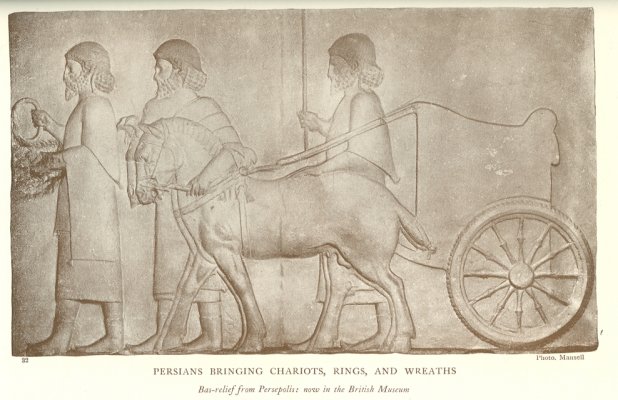
PERSIANS BRINGING CHARIOTS, RINGS, AND WREATHS
Bas-relief from Persepolis: now in the British Museum.
Photo. Mansell
On the 16th of Tammuz the investing army under Gobryas entered Babylon, the
gates having been opened by friends within the city. Some think that the Jews
favoured the cause of Cyrus. It is quite as possible, however, that the priests
of Merodach had a secret understanding with the great Achenian, the “King
of kings”.
A few days afterwards Cyrus arrived at Babylon. Belshazzar had been slain,
but Nabonidus still lived, and he was deported to Carmania. Perfect order prevailed
throughout the city, which was firmly policed by the Persian soldiers, and there
was no looting. Cyrus was welcomed as a deliverer by the priesthood. He “took
the hands” of Bel Merodach at E-sagila, and was proclaimed “King of the world,
King of Babylon, King of Sumer and Akkad, and King of the Four Quarters”.
Cyrus appointed his son Cambyses as governor of Babylon. Although a worshipper
of Ahura-Mazda and Mithra, Cambyses appears to have conciliated the priesthood.
When he became king, and swept through Egypt, he was remembered as the madman
who in a fit of passion slew a sacred Apis bull. It is possible, however, that
he performed what he considered to be a pious act: he may have sacrificed the
bull to Mithra.
The Jews also welcomed Cyrus. They yearned for their native land.
By the rivers of Babylon, there we sat down, yea, we wept,
when we remembered Zion. We hanged our harps upon the willows in the midst thereof.
For there they that carried us away captive required of us a song; and they
that wasted us required of us mirth, saying, Sing us one of the songs of Zion.
How shall we sing the Lord’s song in a strange land? If I forget thee, O
Jerusalem, let my right hand forget her cunning. If I do not remember thee,
let my tongue cleave to the roof of my mouth; if I prefer not Jerusalem above
my chief joy.1
Cyrus heard with compassion the cry of the captives.
Now in the first year of Cyrus king of Persia, that the word
of the Lord by the mouth of Jeremiah might be fulfilled, the Lord stirred up
the spirit of Cyrus king of Persia, that he made a proclamation throughout all
his kingdom, and put it also in writing, saying, Thus saith Cyrus king of Persia,
The Lord God of heaven hath given me all kingdoms of the earth; and he hath
charged me to build him an house at Jerusalem, which is in Judah. Who is there
among you of all his people? his God be with him, and let him go up to Jerusalem,
which is in Judah, and build the house of the Lord God of Israel (he is the
God) which is in Jerusalem.2
In 538 B.C. the first party of Jews who were set free saw through tears the
hills of home, and hastened their steps to reach Mount Zion. Fifty years later
Ezra led back another party of the faithful. The work of restoring Jerusalem
was undertaken by Nehemiah in 445 B.C.
The trade of Babylon flourished under the Persians, and the influence of
its culture spread far and wide. Persian religion was infused with new doctrines,
and their deities were given stellar attributes. Ahura-Mazda became identified
with Bel Merodach, as, perhaps, he had previously been with Ashur, and the goddess
Anahita absorbed the attributes of Nina, Ishtar, Zerpanitum, and
other Babylonian “mother deities”.
Another “Semiramis” came into prominence. This was the wife and sister of
Cambyses. After Cambyses died she married Darius I, who, like Cyrus, claimed
to be an Achenian. He had to overthrow a pretender, but submitted to the demands
of the orthodox Persian party to purify the Ahura-Mazda religion of its Babylonian innovations. Frequent
revolts in Babylon had afterwards to be suppressed. The Merodach priesthood
apparently suffered loss of prestige at Court. According to Herodotus, Darius
plotted to carry away from E-sagila a great statue of Bel “twelve cubits high
and entirely of solid gold”. He, however, was afraid “to lay his hands upon
it”. Xerxes, son of Darius (485-465 B.C.), punished Babylon for revolting, when
intelligence reached them of his disasters in Greece, by pillaging and partly
destroying the temple. “He killed the priest who forbade him to move the statue,
and took it away.”1 The city lost its vassal king, and was put under the control of a governor.
It, however, regained some of its ancient glory after the burning of Susa palace,
for the later Persian monarchs resided in it. Darius II died at Babylon, and
Artaxerxes II promoted in the city the worship of Anaitis.
When Darius III, the last Persian emperor, was overthrown by Alexander the
Great in 331 B.C., Babylon welcomed the Macedonian conqueror as it had welcomed
Cyrus. Alexander was impressed by the wisdom and accomplishments of the astrologers
and priests, who had become known as “Chaldns”, and added Bel Merodach to
his extraordinary pantheon, which already included Amon of Egypt, Melkarth,
and Jehovah. Impressed by the antiquity and magnificence of Babylon, he resolved
to make it the capital of his world-wide empire, and there he received ambassadors
from countries as far east as India and as far west as Gaul.
The canals of Babylonia were surveyed, and building operations on a vast
scale planned out. No fewer than ten thousand men were engaged working for two
months reconstructing and decorating the temple of Merodach, which towered to a height of 607 feet. It looked as if Babylon were about
to rise to a position of splendour unequalled in its history, when Alexander
fell sick, after attending a banquet, and died on an evening of golden splendour
sometime in June of 323 B.C.
One can imagine the feelings of the Babylonian priests and astrologers as
they spent the last few nights of the emperor’s life reading “the omens of the
air”–taking note of wind and shadow, moon and stars and planets, seeking for
a sign, but unable to discover one favourable. Their hopes of Babylonian glory
were suspended in the balance, and they perished completely when the young emperor
passed away in the thirty-third year of his life. For four days and four nights
the citizens mourned in silence for Alexander and for Babylon.
The ancient city fell into decay under the empire of the Seleucid Seleucus
I had been governor of Babylon, and after the break-up of Alexander’s empire
he returned to the ancient metropolis as a conqueror. “None of the persons who
succeeded Alexander”, Strabo wrote, “attended to the undertaking at Babylon”–the
reconstruction of Merodach’s temple. “Other works were neglected, and the city
was dilapidated partly by the Persians and partly by time and through the indifference
of the Greeks, particularly after Seleucus Nicator fortified Seleukeia on the
Tigris.”1
Seleucus drafted to the city which bore his name the great bulk of the inhabitants
of Babylon. The remnant which was left behind continued to worship Merodach
and other gods after the walls had crumbled and the great temple began to tumble
down. Babylon died slowly, but at length the words of the Hebrew prophet were
fulfilled:
The cormorant and the bittern shall possess it; the owl also
and the raven shall dwell in it. . . . They shall call the nobles thereof to
the kingdom, but none shall be there, and all her princes shall be nothing.
And thorns shall come up in her palaces, nettles and brambles in the fortresses
thereof: and it shall be an habitation of dragons, and a court for owls. The
wild beasts of the desert shall also meet with the wild beasts of the island,
and the satyr shall cry to his fellow: the screech owl also shall rest there,
and find for herself a place of rest.1
Footnotes
478:1 Nahum, i,
ii, and iii.
478:2 Isaiah,
xivi, 1; xlvii, 1-15.
478:3 Nahum, iii,
2, 3; ii, 3.
479:1 Goodspeed’s A History of the Babylonians and Assyrians, p. 348.
483:1 Nahum, iii,
8-11.
485:1 Ptolemy’s Kineladanus.
487:1 Ezra, iv,
10.
488:1 Nahum, iii
and ii.
489:1 2 Kings,
xxiii, 29.
489:2 Ibid., 33-5.
489:3 Nebuchadrezzar
is more correct than Nebuchadnezzar.
490:1 2 Kings,
xxiv, 7.
490:2 2 Chronicles,
xxxvi, 6.
490:3 2 Kings,
xxiv, 1.
490:4 2 Kings,
xxiv, 8-15.
491:1 Jeremiah,
lii, 3.
491:2 Jeremiah,
lii, 4-11.
492:1 The Lamentations
of Jeremiah, i, 1-7.
492:2 Jeremiah,
lii, 31-4.
495:1 Daniel,
v, 1 et seq.
496:1 Psalms,
cxxxvii, 1-6.
496:2 Ezra, i,
1-3.
497:1 Herodotus,
i, 183; Strabo, xvi, 1, 5; and Arrian, vii, 17.
498:1 Strabo,
xvi, 1-5.
499:1 Isaiah,
xxxiv, 11-4.
Next: A-C

Leave A Comment