
CHAPTER XIX
Assyria’s Age of Splendour
Tiglath-pileser IV, the Biblical Pul–Babylonian Campaign–Urartian
Ambitions in North Syria–Battle of Two Kings and Flight of Sharduris–Conquest
of Syro-Cappadocian States–Hebrew History from Jehu to Menahem–Israel subject
to Assyria–Urartu’s Power broken–Ahaz ‘s Appeal to Assyria–Damascus and Israel
subdued–Babylonia united to Assyria–Shalmaneser and Hoshea–Sargon deports
the “Lost Ten Tribes”–Merodach Baladan King of Babylonia–Egyptian Army of
Allies routed–Ahaz and Isaiah–Frontier Campaigns–Merodach Baladan overthrown–Sennacherib
and the Hittite States–Merodach Baladan’s second and brief Reign–Hezekiah
and Sennacherib–Destruction of Assyrian Army–Sack of Babylon–Esarhaddon–A
Second Semiramis–Raids of Elamites, Cimmerians, Scythians, and Medes–Sack
of Sidon–Manasseh and Isaiah’s Fate–Esarhaddon conquers Lower Egypt–Revolt
of Assyrian Nobles–Ashurbanipal.
WE now enter upon the last and most brilliant phase of Assyrian civilization–the
period of the Third or New Empire during which flourished Tiglath-pileser IV,
the mighty conqueror; the Shalmaneser of the Bible; “Sargon the Later”, who
transported the “lost ten tribes” of Israel; Sennacherib, the destroyer of Babylon,
and Esarhaddon, who made Lower Egypt an Assyrian province. We also meet with
notable figures of Biblical fame, in-chiding Ahaz, Hezekiah, Isaiah, and the
idolatrous Manasseh.
Tiglath-pileser IV, who deposed Ashur-nirari IV, was known to the Babylonians
as Pulu, which, some think, was a term of contempt signifying “wild animal”.
In the Bible he is referred to as Pul, Tiglath-pilneser, and Tiglath-pileser.1 He came to the Assyrian throne towards the end of April in 745 B.C. and reigned
until 727 B.C. We know nothing regarding his origin, but it seems clear that
he was not of royal descent. He appears to have been a popular leader of the
revolt against Ashur-nirari, who, like certain of his predecessors, had pronounced
pro-Babylonian tendencies. It is significant to note in this connection that
the new king was an unswerving adherent of the cult of Ashur, by the adherents
of which he was probably strongly supported.
Tiglath-pileser combined in equal measure those qualities of generalship
and statesmanship which were necessary for the reorganization of the Assyrian
state and the revival of its military prestige. At the beginning of his reign
there was much social discontent and suffering. The national exchequer had been
exhausted by the loss of tribute from revolting provinces, trade was paralysed,
and the industries were in a languishing condition. Plundering bands of Aramns
were menacing the western frontiers and had overrun part of northern Babylonia.
New political confederacies in Syria kept the north-west regions in a constant
state of unrest, and the now powerful Urartian kingdom was threatening the Syro-Cappadocian
states as if its rulers had dreams of building up a great world empire on the
ruins of that of Assyria.
Tiglath-pileser first paid attention to Babylonia, and extinguished the resistance
of the Aramns in Akkad. He appears to have been welcomed by Nabonassar, who
became his vassal, and he offered sacrifices in the cities of Babylon, Sippar,
Cuthah, and Nippur. Sippar had been occupied by Aramns, as on a previous occasion
when they destroyed the temple of the sun god Shamash which was restored by
Nabu-aplu-iddina of Babylon.
Tiglath-pileser did not overrun Chald, but he destroyed its capital, Sarrabanu,
and impaled King Nabu-ushabshi. He proclaimed himself “King of Sumer and Akkad”
and “King of the Four Quarters”. The frontier states of Elam and Media were
visited and subdued.
Having disposed of the Aramns and other raiders, the Assyrian monarch had
next to deal with his most powerful rival, Urartu. Argistis I had been succeeded
by Sharduris III, who had formed an alliance with the north Mesopotamian king,
Mati-ilu of Agusi, on whom Ashur-nirari had reposed his faith. Ere long Sharduris
pressed southward from Malatia and compelled the north Syrian Hittite states,
including Carchemish, to acknowledge his suzerainty. A struggle then ensued
between Urartu and Assyria for the possession of the Syro-Cappadocian states.
At this time the reputation of Tiglath-pileser hung in the balance. If he
failed in his attack on Urartu, his prestige would vanish at home and abroad
and Sharduris might, after establishing himself in northern Syria, invade Assyria
and compel its allegiance.
Two courses lay before Tiglath-pileser. He could either cross the mountains
and invade Urartu, or strike at his rival in north Syria, where the influence
of Assyria had been completely extinguished. The latter appeared to him to be
the most feasible and judicious procedure, for if he succeeded in expelling
the invaders he would at the same time compel the allegiance of the rebellious
Hittite states.
In the spring of 743 B.C. Tiglath-pileser led his army across the Euphrates
and reached Arpad without meeting with any resistance. The city appears to have
opened its gates to him although it was in the kingdom of Mati-ilu, who acknowledged
Urartian sway.
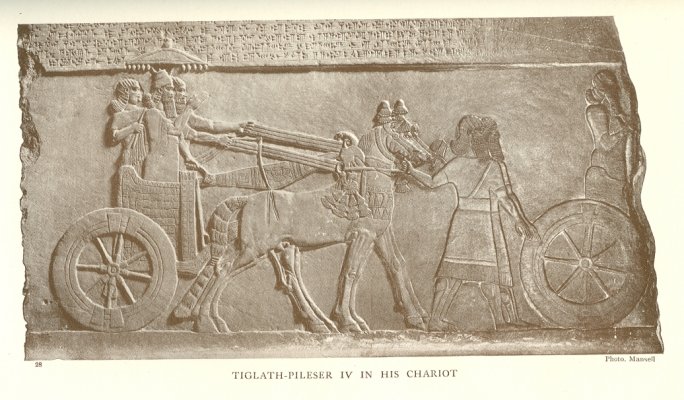
TIGLATH-PILESER IV IN HIS CHARIOT
Photo. Mansell
Its foreign garrison was slaughtered. Well might Sharduris exclaim, in the
words of the prophet, “Where is the king of Arpad? where are the gods of Arpad?”1
Leaving Arpad, Tiglath-pileser advanced to meet Sharduris, who was apparently
hastening southward to attack the Assyrians in the rear. Tiglath-pileser, however,
crossed the Euphrates and, moving northward, delivered an unexpected attack
on the Urartian army in Qummukh. A fierce battle ensued, and one of its dramatic
incidents was a single combat between the rival kings. The tide of battle flowed
in Assyria’s favour, and when evening was falling the chariots and cavalry of
Urartu were thrown into confusion. An attempt was made to capture King Sharduris,
who leapt from his chariot and made hasty escape on horseback, hotly pursued
in the gathering darkness by an Assyrian contingent of cavalry. Not until “the
bridge of the Euphrates” was reached was the exciting night chase abandoned.
Tiglath-pileser had achieved an overwhelming victory against an army superior
to his own in numbers. Over 70,000 of the enemy were slain or taken captive,
while the Urartian camp with its stores and horses and followers fell into the
hands of the triumphant Assyrians. Tiglath-pileser burned the royal tent and
throne as an offering to Ashur, and carried Sharduris’s bed to the temple of
the goddess of Nineveh, whither he returned to prepare a new plan of campaign
against his northern rival.
Despite the blow dealt against Urartu, Assyria did not immediately regain
possession of north Syria. The shifty Mati-ilu either cherished the hope that
Sharduris would recover strength and again invade north Syria, or that he might
himself establish an empire in that region. Tiglath-pileser had therefore to
march westward again.
For three years he conducted vigorous campaigns in “the western land”, where
he met with vigorous resistance. In 740 B.C. Arpad was captured and Mati-ilu
deposed and probably put to death. Two years later Kullani and Hamath fell,
and the districts which they controlled were included in the Assyrian empire
and governed by Crown officials.
Once again the Hebrews came into contact with Assyria. The Dynasty of Jehu
had come to an end by this time. Its fall may not have been unconnected with
the trend of events in Assyria during the closing years of the Middle Empire.
Supported by Assyria, the kings of Israel had become powerful and haughty.
Jehoash, the grandson of Jehu, had achieved successes in conflict with Damascus.
In Judah the unstable Amaziah, son of Joash, was strong enough to lay a heavy
hand on Edom, and flushed with triumph then resolved to readjust his relations
with his overlord, the king of Israel. Accordingly he sent a communication to
Jehoash which contained some proposal regarding their political relations, concluding
with the offer or challenge, “Come, let us look one another in the face”. A
contemptuous answer was returned.
Jehoash the king of Israel sent to Amaziah king of
Judah, saying, The thistle that was in Lebanon sent to the cedar that was in
Lebanon, saying, Give thy daughter to my son to wife: and there passed by a
wild beast that was in Lebanon, and trode down the thistle. Thou hast indeed
smitten Edom, and thine heart hath lifted thee up: glory of this, and tarry
at home, for why shouldest thou meddle to thy hurt, that thou shouldest fall,
even thou, and Judah with thee?
But Amaziah would not hear. Therefore Jehoash king
of Israel went up; and he and Amaziah king of Judah looked one another in the
face at Beth-shemesh [city of Shamash, the sun god], which belongeth to Judah.
And Judah was put to the worse before Israel; and they fled every man to their
tents.
Jehoash afterwards destroyed a large portion of the wall of Jerusalem and
plundered the temple and palace, returning home to Samaria with rich booty and
hostages.1 Judah thus remained
a vassal state of Israel’s.
Jeroboam, son of Jehoash, had a long and prosperous reign. About 773 B.C.
he appears to have co-operated with Assyria and conquered Damascus and Hamath.
His son Zachariah, the last king of the Jehu Dynasty of Israel, came to the
throne in 740 B.C. towards the close of the reign of Azariah, son of Amaziah,
king of Judah. Six months afterwards he was assassinated by Shallum. This usurper
held sway at Samaria for only a month. “For Menahem the son of Gadi went up
from Tirzah, and came to Samaria, and smote Shallum the son of Jabesh in Samaria,
and slew him, and reigned in his stead.”2
Tiglath-pileser was operating successfully in middle Syria when he had dealings
with, among others, “Menihimme (Menahem) of the city of the Samarians”, who
paid tribute. No resistance was possible on the part of Menahem, the usurper,
who was probably ready to welcome the Assyrian conqueror, so that, by arranging
an alliance, he might secure his own position. The Biblical reference is as
follows: “And Pul the king of Assyria came against the land: and Menahem gave
Pul a thousand talents of silver, that his hand might be with him to confirm
the kingdom in his hand. And Menahem exacted the money of Israel, even of all
the mighty men of wealth, of each man fifty shekels of silver, to give to the
king of Assyria. So the king of Assyria turned back, and stayed not there in
the land.”3 Rezin of Damascus,
Hiram of Tyre, and Zabibi, queen of the Arabians, also sent gifts to Tiglath-pileser
at this time (738 B.C.). Aramn revolts on the borders of Elam were suppressed
by Assyrian governors, and large numbers of the inhabitants were transported
to various places in Syria.
Tiglath-pileser next operated against the Median and other hill tribes in
the north-east. In 735 B.C. he invaded Urartu, the great Armenian state which
had threatened the supremacy of Assyria in north Syria and Cappadocia. King
Sharduris was unable to protect his frontier or hamper the progress of the advancing
army, which penetrated to his capital. Dhuspas was soon captured, but Sharduris
took refuge in his rocky citadel which he and his predecessors had laboured
to render impregnable. There he was able to defy the might of Assyria, for the
fortress could he approached on the western side alone by a narrow path between
high walls and towers, so that only a small force could find room to operate
against the numerous garrison.
Tiglath-pileser had to content himself by devastating the city on the plain
and the neighbouring villages. He overthrew buildings, destroyed orchards, and
transported to Nineveh those of the inhabitants he had not put to the sword,
with all the live stock he could lay hands on. Thus was Urartu crippled and
humiliated: it never regained its former prestige among the northern states.
In the following year Tiglath-pileser returned to Syria. The circumstances
which made this expedition necessary are of special interest on account of its
Biblical associations. Menahem, king of Israel, had died, and was succeeded
by his son Pekahiah. “But Pekah the son of Remaliah, a captain of his, conspired
against him and smote him in Samaria, in the palace of the king’s house, . .
. and he killed him, and reigned in his room.”1 When Pekah was on the throne, Ahaz began to reign over Judah.
Judah had taken advantage of the disturbed conditions in Israel to assert
its independence. The walls of Jerusalem were repaired by Jotham, father of
Ahaz, and a tunnel constructed to supply it with water. Isaiah refers to this
tunnel: “Go forth and meet Ahaz . . . at the end of the conduit of the upper
pool in the highway of the fuller’s field” (Isaiah, vii, 3).
Pekah had to deal with a powerful party in Israel which favoured the re-establishment
of David’s kingdom in Palestine. Their most prominent leader was the prophet
Amos, whose eloquent exhortations were couched in no uncertain terms. He condemned
Israel for its idolatries, and cried:
For thus saith the Lord unto the house of Israel, Seek
ye me and ye shall live. . . . Have ye offered unto me sacrifices and offerings
in the wilderness forty years, O house of Israel? But ye have borne the tabernacle
of your Moloch and Chiun your images, the star of your god, which ye made to
yourselves.1
Pekah sought to extinguish the orthodox party’s movement by subduing Judah.
So he plotted with Rezin, king of Damascus. Amos prophesied,
Thus saith the Lord. . . . I will send a fire into
the house of Hazael, which will devour the palaces of Ben-hadad. I will break
also the bar of Damascus . . . and the people of Syria shall go into captivity
unto Kir. . . . The remnant of the Philistines shall perish.
Tyre, Edom, and Ammon would also be punished.2
Judah was completely isolated by the allies who acknowledged the suzerainty
of Damascus. Soon after Ahaz came to the throne he found himself hemmed in on
every side by adversaries who desired to accomplish his fall. “At that time
Rezin, king of Syria, and Pekah . . . came up to Jerusalem to war: and they
besieged Ahaz, but could not overcome him.”1 Judah, however, was overrun; the city of Elath was captured and restored to
Edom, while the Philistines were liberated from the control of Jerusalem.
Isaiah visited Ahaz and said,
Take heed, and be quiet; fear not, neither be faint-hearted
for the two tails of these smoking firebrands, for the fierce anger of Rezin
with Syria, and of the son of Remaliah. Because Syria, Ephraim, and the son
of Remaliah, have taken evil counsel against thee, saying, Let us go up against
Judah, and vex it, and let us make a breach therein for us, and set a king in
the midst of it, even the son of Tabeal: Thus saith the Lord God, It shall not
stand, neither shall it come to pass.2
The unstable Ahaz had sought assistance from the Baal, and “made his son
to pass through the fire, according to the abominations of the heathen”.3 Then he resolved to purchase the sympathy of one of the great Powers. There
was no hope of assistance from “the fly that is in the uttermost part of the
rivers of Egypt”, for the Ethiopian Pharaohs had not yet conquered the Delta
region, so he turned to “the bee that is in the land of Assyria”.4 Assyria was the last resource of the king of Judah.
So Ahaz sent messengers to Tiglath-pileser king of
Assyria, saying, I am thy servant and thy son: come up and save me out of the
hand of Syria and out of the hand of the king of Israel, which rise up against
me. And Ahaz took the silver and gold that was found in the house of the Lord,
and in the treasures of the king’s house, and sent it for a present to the king
of Assyria.
And the king of Assyria hearkened unto him: for the
king of Assyria went up against Damascus, and took it, and carried the people
of it captive to Kir5 and slew Rezin.6
Tiglath-pileser recorded that Rezin took refuge in his city like “a mouse”.
Israel was also dealt with.
In the days of Pekah king of Israel came Tiglath-pileser
king of Assyria, and took Ijon and Abel-beth-maachah, and Janoah and Kedesh,
and Hazor, and Gilead, and Galilee, all the land of Naphtali, and carried them
captive to Assyria. And Hoshea the son of Elah made a conspiracy against Pekah
the son of Remaliah, and smote him, and slew him, and reigned in his stead.1
Tiglath-pileser recorded: “They overthrew Paqaha (Pekah), their king, and
placed Ausia (Hoshea) over them”. He swept through Israel “like a hurricane”.
The Philistines and the Arabians of the desert were also subdued. Tribute was
sent to the Assyrian monarch by Phoenicia, Moab, Ammon, and Edom. It was a proud
day for Ahaz when he paid a visit to Tiglath-pileser at Damascus.2 An Assyrian governor was appointed to rule over Syria and its subject states.
Babylon next claimed the attention of Tiglath-pileser. Nabonassar had died
and was succeeded by his son Nabu-nadin-zeri, who, after reigning for two years,
was slain in a rebellion. The throne was then seized by Nabu-shum-ukin, but
in less than two months this usurper was assassinated and the Chaldns had
one of their chiefs, Ukinzer, proclaimed king (732 B.C.).
When the Assyrian king returned from Syria in 731 B.C. he invaded Babylonia.
He was met with a stubborn resistance. Ukinzer took refuge in his capital, Shapia,
which held out successfully, although the surrounding country was ravaged and
despoiled. Two years afterwards Tiglath-pileser returned, captured Shapia, and
restored peace throughout Babylonia. He was welcomed in Babylon, which opened
its gates to him, and he had himself proclaimed king of Sumer and Akkad. The
Chaldns paid tribute.
Tiglath-pileser had now reached the height of his ambition. He had not only
extended his empire in the west from Cappadocia to the river of Egypt, crippled
Urartu and pacified his eastern frontier, but brought Assyria into close union
with Babylonia, the mother land, the home of culture and the land of the ancient
gods. He did not live long, however, to enjoy his final triumph, for he died
a little over twelve months after he “took the hands of Bel (Merodach)” at Babylon.
He was succeeded by Shalmaneser V (727-722 B.C.), who may have been his son,
but this is not quite certain. Little is known regarding his brief reign. In
725 B.C. he led an expedition to Syria and Phoenicia. Several of the vassal
peoples had revolted when they heard of the death of Tiglath-pileser. These
included the Phnicians, the Philistines, and the Israelites who were intriguing
with either Egypt or Mutsri.
Apparently Hoshea, king of Israel, pretended when the Assyrians entered his
country that he remained friendly. Shalmaneser, however, was well informed,
and made Hoshea a prisoner. Samaria closed its gates against him although their
king had been dispatched to Assyria.
The Biblical account of the campaign is as follows: “Against him (Hoshea)
came up Shalmaneser king of Assyria; and Hoshea became his servant, and gave
him presents. And the king of Assyria found conspiracy in Hoshea: for he had
sent messengers to So king of Egypt,1 and brought no present to the king of Assyria, as he had done year by year;
therefore the king of Assyria shut him up and bound him in prison.
“Then the king of Assyria came up throughout all the land, and went up to
Samaria, and besieged it three years.”1
Shalmaneser died before Samaria was captured, and may have been assassinated.
The next Assyrian monarch, Sargon II (722-705 B.C.), was not related to either
of his two predecessors. He is referred to by Isaiah,2 and is the Arkeanos of Ptolemy. He was the Assyrian monarch who deported the
“Lost Ten Tribes”.
“In the ninth year of Hoshea” (and the first of Sargon) “the king of Assyria
took Samaria, and carried Israel away into Assyria, and placed them in Halah
and in Habor by the river of Gozan, and in the cities of the Medes.”3 In all, according to Sargon’s record, “27,290 people dwelling in the midst of
it (Samaria) I carried off”.
They (the Israelites) left all the commandments of
the Lord their God, and made them molten images, even two calves, and made a
grove, and worshipped all the host of heaven (the stars), and served Baal. And
they caused their sons and their daughters to pass through the fire, and used
divination and enchantments, and sold themselves to do evil in the sight of
the Lord, to provoke him to anger. Therefore the Lord was very angry with Israel,
and removed them out of his sight: there was none left but the tribe of Judah
only.
And the king of Assyria brought men from Babylon, and
from Cuthah, and from Ava, and from Hamath, and from Sepharvaim, and placed
them in the cities of Samaria instead of the children of Israel: and they possessed
Samaria, and dwelt in the cities thereof. . . . And the men of Babylon made
Succoth-benoth, and the men of Cuth (Cuthah) made Nergal, and the men of Hamath
made
Ashima, and the Avites made Nibhaz and Tartak, and
the Sepharites burnt their children in fire to Adram-melech and Anam-melech,
the gods of Sepharvaim.
A number of the new settlers were slain by lions, and the king of Assyria
ordered that a Samaritan priest should be sent to “teach them the manner of
the God of the land”. This man was evidently an orthodox Hebrew, for he taught
them “how they should fear the Lord. . . . So they feared the Lord”, but also
“served their own gods . . . their graven images”.1
There is no evidence to suggest that the “Ten Lost Tribes”, “regarding whom
so many nonsensical theories have been formed”, were not ultimately absorbed
by the peoples among whom they settled between Mesopotamia and the Median Highlands.2 The various sections must have soon lost touch with one another. They were not
united like the Jews (the people of Judah), who were transported to Babylonia
a century and a half later, by a common religious bond, for although a few remained
faithful to Abraham’s God, the majority of the Israelites worshipped either
the Baal or the Queen of Heaven.
The Assyrian policy of transporting the rebellious inhabitants of one part
of their empire to another was intended to break their national spirit and compel
them to become good and faithful subjects amongst the aliens, who must have
disliked them. “The colonists,” says Professor Maspero, “exposed to the same
hatred as the original Assyrian conquerors, soon forgot to look upon the latter
as the oppressors of all, and, allowing their present grudge to efface the memory
of past injuries, did not hesitate to make common cause with them.
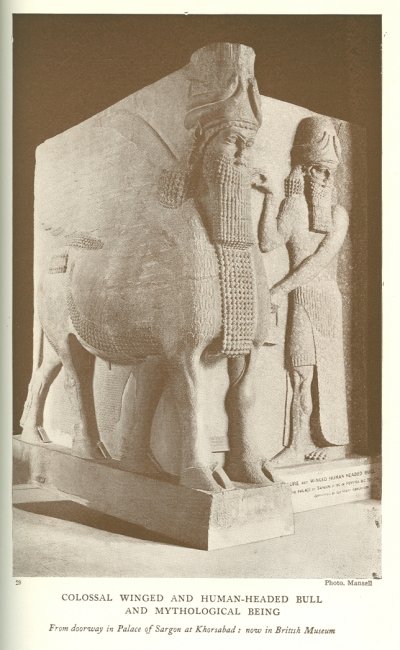
COLOSSAL WINGED AND HUMAN-HEADED BULL AND MYTHOLOGICAL BEING
From doorway in Palace of Sargon at Khorsabad: now in British Museum.
Photo. Mansell
In time of peace the (Assyrian) governor did his best to protect them against
molestation on the part of the natives, and in return for this they rallied
round him whenever the latter threatened to get out of hand, and helped him
to stifle the revolt, or hold it in check until the arrival of reinforcements.
Thanks to their help, the empire was consolidated and maintained without too
many violent outbreaks in regions far removed from the capital, and beyond the
immediate reach of the sovereign.”1
While Sargon was absent in the west, a revolt broke out in Babylonia. A Chaldn
king, Merodach Baladan III, had allied himself with the Elamites, and occupied
Babylon. A battle was fought at Dur-ilu and the Elamites retreated. Although
Sargon swept triumphantly through the land, he had to leave his rival, the tyrannous
Chaldn, in possession of the capital, and he reigned there for over eleven
years.
Trouble was brewing in Syria. It was apparently fostered by an Egyptian king–probably
Bocchoris of Sais, the sole Pharaoh so far as can be ascertained of the Twenty-fourth
Dynasty, who had allied himself with the local dynasts of Lower Egypt and apparently
sought to extend his sway into Asia, the Ethiopians being supreme in Upper Egypt.
An alliance had been formed to cast off the yoke of Assyria. The city states
involved Arpad, Simirra, Damascus, Samaria, and Gaza. Hanno of Gaza had fled
to Egypt after Tiglath-pileser came to the relief of Judah and broke up the
league of conspirators by capturing Damascus, and punishing Samaria, Gaza, and
other cities. His return in Sargon’s reign was evidently connected with the
new rising in which he took part. The throne of Hamath had been seized by an
adventurer, named Ilu-bidi, a smith. The Philistines of Ashdod and the Arabians
being strongly pro-Egyptian in tendency, were willing sympathizers and helpers
against the hated Assyrians.
Sargon appeared in the west with a strong army before the allies had matured
their plans. He met the smith king of Hamath in battle at Qarqar, and, having
defeated him, had him skinned alive. Then he marched southward. At Rapiki (Raphia)
he routed an army of allies. Shabi (? So), the Tartan (commander-in-chief) of
Piru1 (Pharaoh), King of
Mutsri (an Arabian state confused, perhaps, with Misraim = Egypt), escaped “like
to a shepherd whose sheep have been taken”. Piru and other two southern kings,
Samsi and Itamara, afterwards paid tribute to Sargon. Hanno of Gaza was transported
to Asshur.
In 715 B.C. Sargon, according to his records, appeared with his army in Arabia,
and received gifts in token of homage from Piru of Mutsri, Samsi of Aribi, and
Itamara of Saba.
Four years later a revolt broke out in Ashdod which was, it would appear,
directly due to the influence of Shabaka, the Ethiopian Pharaoh, who had deposed
Bocchoris of Sais. Another league was about to be formed against Assyria. King
Azuri of Ashdod had been deposed because of his Egyptian sympathies by the Assyrian
governor, and his brother Akhimiti was placed on the throne. The citizens, however,
overthrew Akhimiti, and an adventurer from Cyprus was proclaimed king (711 B.C.).
It would appear that advances were made by the anti-Assyrians to Ahaz of
Judah. That monarch was placed in a difficult position. He knew that if the
allies succeeded in stamping out Assyrian authority in Syria and Palestine they
would certainly depose him, but if on the other hand he joined them and Assyria
triumphed, its emperor would show him small mercy. As Babylon defied Sargon
and received the active support of Elam, and there were rumours of risings in
the north, it must have seemed to the western kings as if the Assyrian empire
was likely once again to go to pieces.
Fortunately for Ahaz he had a wise counsellor at this time in the great statesman
and prophet, the scholarly Isaiah. The Lord spake by Isaiah saying, “Go and
loose the sackcloth from off thy loins, and put off thy shoe from thy foot.
And he did so, walking naked and barefoot. And the Lord said, Like as my servant
Isaiah hath walked naked and barefoot three years for a sign and wonder upon
Egypt and upon Ethiopia; so shall the king of Assyria lead away the Egyptians
prisoners. . . . And they (the allies) shall be afraid and ashamed of Ethiopia
their expectation, and of Egypt their glory.”1
Isaiah warned Ahaz against joining the league, “in the year that Tartan2 came unto Ashdod (when Sargon the king of Assyria sent him)”. The Tartan “fought
against Ashdod and took it”.3 According to Sargon’s record the Pretender of Ashdod fled to Arabia, where he
was seized by an Arabian chief and delivered up to Assyria. The pro-Egyptian
party in Palestine went under a cloud for a period thereafter.
Before Sargon could deal with Merodach Baladan of Babylon, he found it necessary
to pursue the arduous task of breaking up a powerful league which had been formed
against him in the north. The Syro-Cappadocian Hittite states, including Tabal
in Asia Minor and Carchemish in north Syria, were combining for the last time
against Assyria, supported by Mita (Midas), king of the Muski-Phrygians, and
Rusas, son of Sharduris III, king of Urartu.
Urartu had recovered somewhat from the disasters which it had suffered at
the hands of Tiglath-pileser, and was winning back portions of its lost territory
on the north-east frontier of Assyria. A buffer state had been formed in that
area by Tiglath-pileser, who had assisted the king of the Mannai to weld together
the hill tribes-men between Lake Van and Lake Urmia into an organized nation.
Iranzu, its ruler, remained faithful to Assyria and consequently became involved
in war with Rusas of Urartu, who either captured or won over several cities
of the Mannai. Iranzu was succeeded by his son Aza, and this king was so pronounced
a pro-Assyrian that his pro-Urartian subjects assassinated him and set on the
throne Bagdatti of Umildish.
Soon after Sargon began his operations in the north he captured Bagdatti
and had him skinned alive. The flag of revolt, however, was kept flying by his
brother, Ullusunu, but ere long this ambitious man found it prudent to submit
to Sargon on condition that he would retain the throne as a faithful Assyrian
vassal. His sudden change of policy appears to have been due to the steady advance
of the Median tribes into the territory of the Mannai. Sargon conducted a vigorous
and successful campaign against the raiders, and extended Ullusunu’s area of
control.
The way was now clear to Urartu. In 714 B.C. Sargon attacked the revolting
king of Zikirtu, who was supported by an army led by Rusas, his overlord. A
fierce battle was fought in which the Assyrians achieved a great victory. King
Rusas fled, and when he found that the Assyrians pressed home their triumph
by laying waste the country before them, he committed suicide, according to
the Assyrian records, although those of Urartu indicate that he subsequently
took part in the struggle against Sargon. The Armenian peoples were compelled
to acknowledge the suzerainty of Assyria, and the conqueror received gifts from
various tribes between Lake Van and the Caspian Sea, and along the frontiers
from Lake Van towards the south-east as far as the borders of Elam.
Rusas of Urartu was succeeded by Argistes II, who reigned over a shrunken
kingdom. He intrigued with neighbouring states against Assyria, but was closely
watched. Ere long he found himself caught between two fires. During his reign
the notorious Cimmerians and Scythians displayed much activity in the north
and raided his territory.
The pressure of fresh infusions of Thraco-Phrygian tribes into western Asia
Minor had stirred Midas of the Muski to co-operate with the Urartian power in
an attempt to stamp out Assyrian influence in Cilicia, Cappadocia, and north
Syria. A revolt in Tabal in 718 B.C. was extinguished by Sargon, but in the
following year evidences were forthcoming of a more serious and wide-spread
rising. Pisiris, king of Carchemish, threw off the Assyrian yoke. Before, however,
his allies could hasten to his assistance he was overcome by the vigilant Sargon,
who deported a large proportion of the city’s inhabitants and incorporated it
in an Assyrian province. Tabal revolted in 713 B.C. and was similarly dealt
with. In 712 B.C. Milid had to be overcome. The inhabitants were transported,
and “Suti” Aramn peoples settled in their homes. The king of Commagene, having
remained faithful, received large extensions of territory. Finally in 709 B.C.
Midas of the Muski-Phrygians was compelled to acknowledge the suzerainty of
Assyria. The northern confederacy was thus completely worsted and broken up.
Tribute was paid by many peoples, including the rulers of Cyprus.
Sargon was now able to deal with Babylonia, which for about twelve years
had been ruled by Merodach Baladan, who oppressed the people and set at defiance
ancient laws by seizing private estates and transferring them to his Chaldn
kinsmen. He still received the active support of Elam.
Sargon’s first move was to interpose his army between those of the Babylonians
and Elamites. Pushing southward, he subdued the Aramns on the eastern banks
of the Tigris, and drove the Elamites into the mountains. Then he invaded middle
Babylonia from the east. Merodach Baladan hastily evacuated Babylon, and, moving
southward, succeeded in evading Sargon’s army. Finding Elam was unable to help
him, he took refuge in the Chaldn capital, Bit Jakin, in southern Babylonia.
Sargon was visited by the priests of Babylon and Borsippa, and hailed as
the saviour of the ancient kingdom. He was afterwards proclaimed king at E-sagila,
where he “took the hands of Bel”. Then having expelled the Aramns from Sippar,
he hastened southward, attacked Bit Jakin and captured it. Merodach Baladan
escaped into Elam. The whole of Chald was subdued.
Thus “Sargon the Later” entered at length into full possession of the empire
of Sargon of Akkad. In Babylonia he posed as an incarnation of his ancient namesake,
and had similarly Messianic pretensions which were no doubt inspired by the
Babylonian priesthood. Under him Assyria attained its highest degree of splendour.
He recorded proudly not only his great conquests but also his works of public
utility: he restored ancient cities, irrigated vast tracts of country, fostered
trade, and promoted the industries. Like the pious Pharaohs of Egypt he boasted
that he fed the hungry and protected the weak against the strong.
Sargon found time during his strenuous career as a conqueror to lay out and
build a new city, called Dur-Sharrukin, “the burgh of Sargon”, to the north
of Nineveh. It was completed before he undertook the Babylonian campaign. The
new palace was occupied in 708 B.C. Previous to that period he had resided principally
at Kalkhi, in the restored palace of Ashur-natsir-pal III.
He was a worshipper of many gods. Although he claimed to have restored the
supremacy of Asshur “which had come to an end”, he not only adored Ashur but
also revived the ancient triad of Anu, Bel, and Ea, and fostered the growth
of the immemorial “mother-cult” of Ishtar. Before he died he appointed one of
his sons, Sennacherib, viceroy of the northern portion of the empire. He was
either assassinated at a military review or in some frontier war. As much is
suggested by the following entry in an eponym list.
Eponymy of Upahhir-belu, prefect of the city of Amedu
. . .
According to the oracle of the Kulummite(s) . . .
A soldier (entered) the camp of the king of Assyria (and killed him?), month
Ab, day 12th, Sennacherib (sat on the throne).1
The fact that Sennacherib lamented his father’s sins suggests that the old
king had in some manner offended the priesthood. Perhaps, like some of the Middle
Empire monarchs, he succumbed to the influence of Babylon during the closing
years of his life. It is stated that “he was not buried in his house”, which
suggests that the customary religious rites were denied him, and that his lost
soul was supposed to be a wanderer which had to eat offal and drink impure water
like the ghost of a pauper or a criminal.
The task which lay before Sennacherib (705-680 B.C.) was to maintain the
unity of the great empire of his distinguished father. He waged minor wars against
the Kassite and Illipi tribes on the Elamite border, and the Muski and Hittite
tribes in Cappadocia and Cilicia. The Kassites, however, were no longer of any
importance, and the Hittite power had been extinguished, for ere the states
could recover from the blows dealt by the Assyrians the Cimmerian hordes ravaged
their territory. Urartu was also overrun by the fierce barbarians from the north.
It was one of these last visits of the Assyrians to Tabal of the Hittites and
the land of the Muski (Meshech) which the Hebrew prophet referred to in after-time
when he exclaimed:
Asshur is there and all her company: his graves are
about him: all of them slain, fallen by the sword. . . . There is Meshech, Tubal,
and all her multitude: her graves are round about him: all of them uncircumcised,
slain by the sword, though they caused their terror in the land of the living.
. . . (Ezekiel, xxxii.)
Sennacherib found that Ionians had settled in Cilicia, and he deported large
numbers of them to Nineveh. The metal and ivory work at Nineveh show traces
of Greek influence after this period.
A great conspiracy was fomented in several states against Sennacherib when
the intelligence of Sargon’s death was bruited abroad. Egypt was concerned in
it. Taharka (the Biblical Tirhakah1 ),
the last Pharaoh of the Ethiopian Dynasty, had dreams of re-establishing Egyptian
supremacy in Palestine and Syria, and leagued himself with Luli, king of Tyre,
Hezekiah, king of Judah, and others. Merodach Baladan, the Chaldn king, whom
Sargon had deposed, supported by Elamites and Aramns, was also a party to
the conspiracy. “At that time Merodach Baladan, the son of Baladan, king of
Babylon, sent letters and a present to Hezekiah . . . And Hezekiah was glad
of them.”2
Merodach Baladan again seized the throne of Babylon. Sargon’s son, who had
been appointed governor, was murdered and a pretender sat on the throne for
a brief period, but Merodach Baladan thrust him aside and reigned for nine months,
during which period he busied himself by encouraging the kings of Judah and
Tyre to revolt. Sennacherib invaded Babylonia with a strong army, deposed Merodach
Baladan, routed the Chaldns and Aramns, and appointed as vassal king Bel-ibni,
a native prince, who remained faithful to Assyria for about three years.
In 707 B.C. Sennacherib appeared in the west. When he approached Tyre, Luli,
the king, fled to Cyprus. The city was not captured, but much of its territory
was ceded to the king of Sidon. Askalon was afterwards reduced. At Eltekeh Sennacherib
came into conflict with an army of allies, including Ethiopian, Egyptian, and
Arabian Mutsri forces, which he routed. Then he captured a number of cities
in Judah and transported 200,150 people. He was unable, however, to enter Jerusalem,
in which Hezekiah was compelled to remain “like a bird in a cage”. It appears
that Hezekiah “bought off” the Assyrians on this occasion with gifts of gold
and silver and jewels, costly furniture, musicians, and female slaves.
In 689 B.C. Sennacherib found it necessary to penetrate Arabia. Apparently
another conspiracy was brewing, for Hezekiah again revolted. On his return from
the south–according to Berosus he had been in Egypt–the Assyrian king marched
against the king of Judah.
And when Hezekiah saw that Sennacherib was come, and
that he was purposed to fight against Jerusalem, he took counsel with the princes
and his mighty men to stop the waters of the fountains which were without the
city: and they did help him. . . . Why should the kings of Assyria come and
find much water?
Sennacherib sent messengers to Jerusalem to attempt to stir up the people
against Hezekiah. C1 He wrote also letters to rail on the Lord God of Israel,
and to speak against him, saying, As the gods of the nations of other lands
have not delivered their people out of mine hand, so shall not the God of Hezekiah
deliver his people out of mine hand.”1
Hezekiah sent his servants to Isaiah, who was in Jerusalem at the time, and
the prophet said to them:
Thus shall ye say to your master. Thus saith the Lord,
Be not afraid of the words which thou hast heard, with which the servants of
the king of Assyria have blasphemed me. Behold, I will send a blast upon him,
and he shall hear a rumour, and shall return to his own land; and I will cause
him to fall by the sword in his own land.2
According to Berosus, the Babylonian priestly historian, the camp of Sennacherib
was visited in the night by swarms of field mice which ate up the quivers and
bows and the (leather) handles of shields. Next morning the army fled.
The Biblical account of the disaster is as follows:
And it came to pass that night, that the angel of the
Lord went out, and smote the camp of the Assyrians an hundred and four score
and five thousand: and when they arose early in the morning, behold, they were
all dead corpses. So Sennacherib king of Assyria departed, and went and returned
and dwelt at Nineveh.1
A pestilence may have broken out in the camp, the infection, perhaps, having
been carried by field mice. Byron’s imagination was stirred by the vision of
the broken army of Assyria.
The Assyrian came down like a wolf on the fold,
And his cohorts were gleaming with purple and gold;
And the sheen of their spears was like stars of the sea,
When the blue wave rolls nightly on deep Galilee.
Like the leaves of the forest when summer is green,
That host with their banners at sunset were seen;
Like the leaves of the forest when autumn hath blown,
That host on the morrow lay withered and strown.
For the Angel of Death spread his wings on the blast,
And breathed on the face of the foe as he passed;
And the eyes of the sleepers waxed deadly and chill,
And their hearts but once heaved–and forever grew still!
And there lay the steed with his nostril all wide,
But through it there rolled not the breath of his pride;
And the foam of his gasping lay white on the turf,
And cold as the spray of the rock-beating surf.
And there lay the rider distorted and pale,
With the dew on his brow, and the rust on his mail;
And the tents were all silent–the banners alone–
The lances uplifted–the trumpet unblown.
And the widows of Asshur are loud in their wail,
And the idols are broke in the temple of Baal;
And the might of the Gentile, unsmote by the sword,
Hath melted like snow in the glance of the Lord.
Before this disaster occurred Sennacherib had to invade Babylonia again,
for the vassal king, Bel-ibni, had allied himself with the Chaldns and raised
the standard of revolt. The city of Babylon was besieged and captured, and its
unfaithful king deported with a number of nobles to Assyria. Old Merodach Baladan
was concerned in the plot and took refuge on the Elamite coast, where the Chaldns
had formed a colony. He died soon afterwards.
Sennacherib operated in southern Babylonia and invaded Elam. But ere he could
return to Assyria he was opposed by a strong army of allies, including Babylonians,
Chaldns, Aramns, Elamites, and Persians, led by Samunu, son of Merodach
Baladan. A desperate battle was fought. Although Sennacherib claimed a victory,
he was unable to follow it up. This was in 692 B.C. A Chaldn named Mushezib-Merodach
seized the Babylonian throne.
In 691 B.C. Sennacherib again struck a blow for Babylonia, but was unable
to depose Mushezib-Merodach. His opportunity came, however, in 689 B.C. Elam
had been crippled by raids of the men of Parsua (Persia), and was unable to
co-operate with the Chaldn king of Babylon. Sennacherib captured the great
commercial metropolis, took Mushezib-Merodach prisoner, and dispatched him to
Nineveh. Then he wreaked his vengeance on Babylon. For several days the Assyrian
soldiers looted the houses and temples, and slaughtered the inhabitants without
mercy. E-sagila was robbed of its treasures, images of deities were either broken
in pieces or sent to Nineveh: the statue of Bel-Merodach was dispatched to Asshur
so that he might take his place among the gods who were vassals of Ashur.
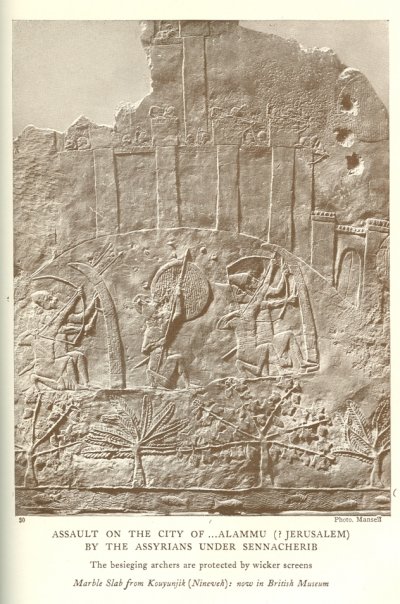
ASSAULT ON THE CITY OF . . .ALAMMU (? JERUSALEM) BY THE ASSYRIANS
UNDER SENNACHERIB
The besieging archers are protected by wicker screens
Marble Slab from Kouyunjik (Nineveh): now in British Museum.
Photo. Mansell
“The city and its houses,” Sennacherib recorded, “from foundation to roof;
I destroyed them, I demolished them, I burned them with fire; walls, gateways,
sacred chapels, and the towers of earth and tiles, I laid them low and cast
them into the Arakhtu.”1
“So thorough was Sennacherib’s destruction of the city in 689 B.C.,” writes
Mr. King, “that after several years of work, Dr. Koldewey concluded that all
traces of earlier buildings had been destroyed on that occasion. More recently
some remains of earlier strata have been recognized, and contract-tablets have
been found which date from the period of the First Dynasty. Moreover, a number
of earlier pot-burials have been unearthed, but a careful examination of the
greater part of the ruins has added little to our knowledge of this most famous
city before the Neo-Babylonian period.”2
It is possible that Sennacherib desired to supplant Babylon as a commercial
metropolis by Nineveh. He extended and fortified that city, surrounding it with
two walls protected by moats. According to Diodorus, the walls were a hundred
feet high and about fifty feet wide. Excavators have found that at the gates
they were about a hundred feet in breadth. The water supply of the city was
ensured by the construction of dams and canals, and strong quays were erected
to prevent flooding. Sennacherib repaired a lofty platform which was isolated
by a canal, and erected upon it his great palace. On another platform he had
an arsenal built.
Sennacherib’s palace was the most magnificent building of its kind ever erected
by an Assyrian emperor. It was lavishly decorated, and its bas-reliefs display
native art at its highest pitch of excellence. The literary remains of the time
also give indication of the growth of culture: the inscriptions are distinguished
by their prose style. It is evident that men of culture and refinement were
numerous in Assyria. The royal library of Kalkhi received many additions during
the reign of the destroyer of Babylon.
Like his father, Sennacherib died a violent death. According to the Babylonian
Chronicle he was slain in a revolt by his son “on the twentieth day of Tebet”
(680 B.C.). The revolt continued from the “20th of Tebet” (early in January)
until the 2nd day of Adar (the middle of February). On the 18th of Adar, Esarhaddon,
son of Sennacherib, was proclaimed king.
Berosus states that Sennacherib was murdered by two of his sons, but Esarhaddon
was not one of the conspirators. The Biblical reference is as follows: “Sennacherib
. . . dwelt at Nineveh. And it came to pass, as he was worshipping in the house
of Nisroch (?Ashur) his god, that Adrammelech and Sharezer (Ashur-shar-etir)
his sons smote him with the sword: and they escaped into the land of Armenia
(Urartu). And Esarhaddon his son reigned in his stead.” Ashur-shar-etir appears
to have been the claimant to the throne.
Esarhaddon (680-668 B.C.) was a man of different type from his father. He
adopted towards vassal states a policy of conciliation, and did much to secure
peace within the empire by his magnanimous treatment of rebel kings who had
been intimidated by their neighbours and forced to entwine themselves in the
meshes of intrigue. His wars were directed mainly to secure the protection of
outlying provinces against aggressive raiders.
The monarch was strongly influenced by his mother, Nakia, a Babylonian princess
who appears to have been as distinguished a lady as the famous Sammu-rammat.
Indeed, it is possible that traditions regarding her contributed to the Semiramis
legends. But it was not only due to her that Esarhaddon espoused the cause of
the pro-Babylonian party. He appears to be identical with the Axerdes of Berosus,
who ruled over the southern kingdom for eight years. Apparently he had been
appointed governor by Sennacherib after the destruction of Babylon, and it may
be that during his term of office in Babylonia he was attracted by its ethical
ideals, and developed those traits of character which distinguished him from
his father and grandfather. He married a Babylonian princess, and one of his
sons, Shamash-shum-ukin, was born in a Babylonian palace, probably at Sippar.
He was a worshipper of the mother goddess Ishtar of Nineveh and Ishtar of Arbela,
and of Shamash, as well as of the national god Ashur.
As soon as Esarhaddon came to the throne he undertook the restoration of
Babylon, to which many of the inhabitants were drifting back. In three years
the city resumed its pre-eminent position as a trading and industrial centre.
Withal, he won the hearts of the natives by expelling Chaldns from the private
estates which they had seized during the Merodach-Baladan regime, and restoring
them to the rightful heirs.
A Chaldn revolt was inevitable. Two of Merodach Baladan’s sons gave trouble
in the south, but were routed in battle. One fled to Elam, where he was assassinated;
the other sued for peace, and was accepted by the diplomatic Esarhaddon as a
vassal king.
Egypt was intriguing in the west. Its Ethiopian king, Taharka (the Biblical
Tirhakah) had stirred up Hezekiah to revolt during Sennacherib’s reign. An Assyrian
ambassador who had visited Jerusalem “heard say concerning Tirhakah. . . . He
sent messengers to Hezekiah saying . . . Let not thy God, in whom thou trustest,
deceive thee saying, Jerusalem shall not be given into the hand of the king
of Assyria. Behold, thou hast heard what the kings of Assyria have done to all
lands by destroying them utterly; and shalt thou be delivered? Have the gods
of the nations delivered them which my fathers have destroyed, as Gozan, and
Haran, and Rezeph, and the children of Eden which were in Telassar? Where is
the king of Hamath, and the king of Arphad, and the king of the city of Sepharvaim,
Hena, and Ivah?”1 Sidon was
a party to the pro-Egyptian league which had been formed in Palestine and Syria.
Early in his reign Esarhaddon conducted military operations in the west,
and during his absence the queen-mother Nakia held the reins of government.
The Elamites regarded this innovation as a sign of weakness, and invaded Babylon.
Sippar was plundered, and its gods carried away. The Assyrian governors, however,
ultimately repulsed the Elamite king, who was deposed soon after he returned
home. His son, who succeeded him, restored the stolen gods, and cultivated good
relations with Esarhaddon. There was great unrest in Elam at this period: it
suffered greatly from the inroads of Median and Persian pastoral fighting folk.
In the north the Cimmerians and Scythians, who were constantly warring against
Urartu, and against each other, had spread themselves westward and east. Esarhaddon
drove Cimmerian invaders out of Cappadocia, and they swamped Phrygia.
The Scythian peril on the north-east frontier was, however, of more pronounced
character. The fierce mountaineers had allied themselves with Median tribes
and overrun the buffer State of the Mannai. Both Urartu and Assyria were sufferers
from the brigandage of these allies. Esarhaddon’s generals, however, were able
to deal with the situation, and one of the notable results of the pacification
of the north-eastern area was the conclusion of an alliance with Urartu.
The most serious situation with which the emperor had to deal was in the
west. The King of Sidon, who had been so greatly favoured by Sennacherib, had
espoused the Egyptian cause. He allied himself with the King of Cilicia, who,
however, was unable to help him much. Sidon was besieged and captured; the royal
allies escaped, but a few years later were caught and beheaded. The famous seaport
was destroyed, and its vast treasures deported to Assyria (about 676 B.C.).
Esarhaddon replaced it by a new city called Kar-Esarhaddon, which formed the
nucleus of the new Sidon.
It is believed that Judah and other disaffected States were dealt with about
this time. Manasseh had succeeded Hezekiah at Jerusalem when but a boy of twelve
years. He appears to have come under the influence of heathen teachers.
For he built up again the high places which Hezekiah
his father had destroyed; and he reared up altars for Baal, and made a grove,
as did Ahab king of Israel; and worshipped all the host of heaven, and served
them. . . . And he built altars for all the host of heaven in the two courts
of the house of the Lord. And he made his son pass through the fire, and observed
times, and used enchantments, and dealt with familiar spirits and wizards: he
wrought much wickedness in the sight of the Lord, to provoke him to anger. And
he set a graven image of the grove that he had made in the house, of which the
Lord said to David, and to Solomon his son, In this house, and in Jerusalem,
which I have chosen out of all tribes of Israel, will I put my name for ever.1
Isaiah ceased to prophesy after Manasseh came to the throne. According to
Rabbinic traditions he was seized by his enemies and enclosed in the hollow
trunk of a tree, which was sawn through. Other orthodox teachers appear to have
been slain also. “Manasseh shed innocent blood very much, till he had filled
Jerusalem from one end to another.”1 It is possible that there is a reference to Isaiah’s fate in an early Christian
lament regarding the persecutions of the faithful: “Others had trial of cruel
mockings and scourgings, yea, moreover of bonds and imprisonment: they were
stoned, they were sawn asunder, were tempted, were slain with the sword”.2 There is no Assyrian evidence regarding the captivity of Manasseh. “Wherefore
the Lord brought upon them (the people of Judah) the captains of the host of
the king of Assyria, which took Manasseh among the thorns, and bound him with
fetters, and carried him to Babylon. And when he was in affliction, he besought
the Lord his God, and humbled himself greatly before the God of his fathers,
and prayed unto him: and he was intreated of him, and heard his supplication,
and brought him again to Jerusalem into his kingdom.”3 It was, however, in keeping with the policy of Esarhaddon to deal in this manner
with an erring vassal. The Assyrian records include Manasseh of Judah (Menas
of the city of Yaudu) with the kings of Edom, Moab, Ammon, Tyre, Ashdod, Gaza,
Byblos, &c., and “twenty-two kings of Khatti” as payers of tribute to Esarhaddon,
their overlord. Hazael of Arabia was conciliated by having restored to him his
gods which Sennacherib had carried away.
Egypt continued to intrigue against Assyria, and Esarhaddon resolved to deal
effectively with Taharka, the last Ethiopian Pharaoh. In 674 B.C. he invaded
Egypt, but suffered a reverse and had to retreat. Tyre revolted soon afterwards
(673 B.C.).
Esarhaddon, however, made elaborate preparations for his next campaign. In
671 B.C. he went westward with a much more powerful army. A detachment advanced
to Tyre and invested it. The main force meanwhile pushed on, crossed the Delta
frontier, and swept victoriously as far south as Memphis, where Taharka suffered
a crushing defeat. That great Egyptian metropolis was then occupied and plundered
by the soldiers of Esarhaddon. Lower Egypt became an Assyrian province; the
various petty kings, including Necho of Sais, had set over them Assyrian governors.
Tyre was also captured.
When he returned home Esarhaddon erected at the Syro-Cappadocian city of
Singirli1 a statue of victory,
which is now in the Berlin museum. On this memorial the Assyrian “King of the
kings of Egypt” is depicted as a giant. With one hand he pours out an oblation
to a god; in the other he grasps his sceptre and two cords attached to rings,
which pierce the lips of dwarfish figures representing the Pharaoh Taharka of
Egypt and the unfaithful King of Tyre.
In 668 B.C. Taharka, who had fled to Napata in Ethiopia, returned to Upper
Egypt, and began to stir up revolts. Esarhaddon planned out another expedition,
so that he might shatter the last vestige of power possessed by his rival. But
before he left home he found it necessary to set his kingdom in order.
During his absence from home the old Assyrian party, who disliked the emperor
because of Babylonian sympathies, had been intriguing regarding the succession
to the throne. According to the Babylonian Chronicle, “the king remained in
Assyria” during 669 B.C., “and he slew with the sword many noble men”. Ashur-bani-pal
was evidently concerned in the conspiracy, and it is significant to find that
he pleaded on behalf of certain of the conspirators. The crown prince Sinidinabal
was dead: perhaps he had been assassinated.
At the feast of the goddess Gula (identical with Bau, consort of Ninip),
towards the end of April in 668 B.C., Esarhaddon divided his empire between
two of his sons. Ashur-bani-pal was selected to be King of Assyria, and Shamash-shum-ukin
to be King of Babylon and the vassal of Ashur-banipal. Other sons received important
priestly appointments.
Soon after these arrangements were completed Esarhaddon, who was suffering
from bad health, set out for Egypt. He died towards the end of October, and
the early incidents of his campaign were included in the records of Ashur-bani-pal’s
reign. Taharka was defeated at Memphis, and retreated southward to Thebes.
So passed away the man who has been eulogized as “the noblest and most sympathetic
figure among the Assyrian kings”. There was certainly much which was attractive
in his character. He inaugurated many social reforms, and appears to have held
in check his overbearing nobles. Trade flourished during his reign. He did not
undertake the erection of a new city, like his father, but won the gratitude
of the priesthood by his activities as a builder and restorer of temples. He
founded a new “house of Ashur” at Nineveh, and reconstructed several temples
in Babylonia. His son Ashur-bani-pal was the last great Assyrian ruler.
Footnotes
445:1 2 Kings,
xv, 19 and 29; 2 Chronicles, xxviii, 20.
447:1 2 Kings,
xviii, 34 and xix, 13.
449:1 2 Kings,
xiv, 1-14.
<449:2 2 Kings,
xv, 1-14.
449:3 2 Kings,
xv, 19, 20.
450:1 2 Kings,
xv, 25.
451:1 Amos, v.
451:2 Amos, i.
452:1 2 Kings,
xvi, 5.
452:2 Isaiah,
vii, 3-7.
452:3 2 Kings,
xv, 3.
452:4 Isaiah,
vii, s 8.
452:5 Kir was probably
on the borders of Elam.
452:6 2 Kings,
xvi, 7-9.
453:1 2 Kings,
xv, 29, 30.
453:2 2 Kings,
xvi, 10.
454:1 In the Hebrew text
this monarch is called Sua, Seveh, and So, says Maspero. The Assyrian texts
refer to him as Sebek, Shibahi, Shab &c. He has been identified with Pharaoh
Shabaka of the Twenty-fifth Egyptian Dynasty; that monarch may have been a petty
king before he founded his Dynasty. Another theory is that he was Seve, king of Mutsri,
and still another that he was a petty king of an Egyptian state in the Delta
and not Shabaka.
455:1 2 Kings,
xvii, 3-5.
<455:2 Isaiah,
xx, 1.
455:3 2 Kings,
xvii, 6.
456:1 2 Kings,
xvii, 16-41.
456:2 The people carried
away would not be the whole of the inhabitants–only, one would suppose, the
more important personages, enough to make up the number 27,290 given above.
457:1 Passing of the
Empires, pp. 200-1.
458:1 Those who, like
Breasted, identify “Piru of Mutsri” with “Pharaoh of Egypt” adopt the view that
Bocchoris of Sais paid tribute to Sargon. Piru, however, is subsequently referred
to with two Arabian kings as tribute payers to Sargon apparently after Lower
Egypt had come under the sway of Shabaka, the first king of the Ethiopian or
Twenty-fifth Dynasty.
459:1 Isaiah,
xx, 2-5.
459:2 Commander-in-chief.
459:3 Isaiah,
xx, 1.
463:1 The Old Testament
in the Light of the Historical Records and Legends of Assyria and Babylonia,
T. G. Pinches, p. 392.
465:1 Isaiah,
xxxvii, 9.
465:2 Isaiah,
xxxix, 1, 2.
466:1 2 Chronicles,
xxxii, 9-17.
466:2 2 Kings,
xix, 6, 7.
467:1 2 Kings,
xix, 35, 36.
469:1 Smith-Sayce, History of Sennacherib, pp. 132-5.
469:2 A History of
Sumer and Akkad, p. 37.
472:1 Isaiah,
xxxvii, 8-13.
473:1 2 Kings,
xxi, 3-7.
474:1 2 Kings,
xxi, 16.
474:2 Hebrews,
xi, 36, 37.
474:3 2 Chronicles,
xxxiii, 11-3. It may be that Manasseh was taken to Babylon during Ashur-bani-pal’s
reign. See next chapter .
475:1 Pronounce gas in gem.
Next: Chapter XX. The Last Days of Assyria and
Babylonia

Leave A Comment