
CHAPTER IV
Demons, Fairies, and Ghosts
Spirits in Everything and Everywhere–The Bringers of Luck and Misfortune–Germ
Theory Anticipated–Early Gods indistinguishable from Demons–Repulsive form
of Ea–Spirit Groups as Attendants of Deities–Egyptian, Indian, Greek, and
Germanic parallels–Elder Gods as Evil Gods–Animal Demons–The Babylonian “Will-o-the-Wisp”–“Foreign
Devils”–Elves and Fairies–Demon Lovers–“Adam’s first wife, Lilith”–Children
Charmed against Evil Spirits–The Demon of Nightmare–Ghosts as Enemies of the
Living–The Vengeful Dead Mother in Babylonia, India, Europe, and Mexico–Burial
Contrast–Calling Back the Dead–Fate of Childless Ghosts–Religious Need for
Offspring–Hags and Giants and Composite Monsters–Tempest Fiends–Legend of
Adapa and the Storm Demon–Wind Hags of Ancient Britain–Tyrolese Storm Maidens–Zu
Bird Legend and Indian Garuda Myth–Legend of the Eagle and the Serpent–The
Snake Mother Goddess–Demons and the Moon God–Plague Deities–Classification
of Spirits, and Egyptian, Arabian, and Scottish parallels–Traces of Progress
from Animism to Monotheism.
THE memorable sermon preached by Paul to the Athenians when he stood “in
the midst of Mars hill”, could have been addressed with equal appropriateness
to the ancient Sumerians and Akkadians. “I perceive”, he declared, “that in
all things ye are too superstitious. . . . God that made the world and all things
therein, seeing that he is Lord of heaven and earth, dwelleth not in temples
made with hands; neither is worshipped with men’s hands as though he needed
any thing, seeing he giveth to all life, and breath, and all things . . . for
in him we live, and move, and have our being; as certain also of your own poets
have said, For we are also his offspring. Forasmuch then as we are the offspring
of God, we ought not to think that the Godhead is like unto gold, or silver,
or stone, graven by art and man’s device.” 1
Babylonian temples were houses of the gods in the literal sense; the gods
were supposed to dwell in them, their spirits having entered into the graven
images or blocks of stone. It is probable that like the Ancient Egyptians they
believed a god had as many spirits as he had attributes. The gods, as we have
said, appear to have evolved from early spirit groups. All the world swarmed
with spirits, which inhabited stones and trees, mountains and deserts, rivers
and ocean, the air, the sky, the stars, and the sun and moon. The spirits controlled
Nature: they brought light and darkness, sunshine and storm, summer and winter;
they were manifested in the thunderstorm, the sandstorm, the glare of sunset,
and the wraiths of mist rising from the steaming marshes. They controlled also
the lives of men and women. The good spirits were the source of luck. The bad
spirits caused misfortunes, and were ever seeking to work evil against the Babylonian.
Darkness was peopled by demons and ghosts of the dead. The spirits of disease
were ever lying in wait to clutch him with cruel invisible hands.
Some modern writers, who are too prone to regard ancient peoples from a twentieth-century
point of view, express grave doubts as to whether “intelligent Babylonians “really
believed that spirits came down in the rain and entered the soil to rise up
before men’s eyes as stalks of barley or wheat. There is no reason for supposing
that they thought otherwise. The early folks based their theories on the accumulated
knowledge of their age. They knew nothing regarding the composition of water
or the atmosphere, of the cause of thunder and lightning, or of the chemical
changes effected in soils by the action of bacteria. They attributed all natural
phenomena to the operations of spirits or gods. In believing that certain demons
caused certain diseases, they may be said to have achieved distinct. progress,
for they anticipated the germ theory. They made discoveries, too, which have
been approved and elaborated in later times when they lit sacred fires, bathed
in sacred waters, and used oils and herbs to charm away spirits of pestilence.
Indeed, many folk cures, which were originally associated with magical ceremonies,
are still practised in our own day. They were found to be effective by early
observers, although they were unable to explain why and how cures were accomplished,
like modern scientific investigators.
In peopling the Universe with spirits, the Babylonians, like other ancient
folks, betrayed that tendency to symbolize everything which has ever appealed
to the human mind. Our painters and poets and sculptors are greatest when they
symbolize their ideals and ideas and impressions, and by so doing make us respond
to their moods. Their “beauty and their terror are sublime”. But what may seem
poetic to us, was invariably a grim reality to the Babylonians. The statue or
picture was not merely a work of art but a manifestation of the god or demon.
As has been said, they believed that the spirit of the god inhabited the idol;
the frown of the brazen image was the frown of the wicked demon. They entertained
as much dread of the winged and human-headed bulls guarding the entrance to
the royal palace as do some of the Arab workmen who, in our own day, assist
excavators to rescue them from sandy mounds in which they have been hidden for
long centuries
When an idol was carried away from a city by an invading army, it was believed
that the god himself had been taken prisoner, and was therefore unable any longer
to help his people.
In the early stages of Sumerian culture, the gods and goddesses who formed
groups were indistinguishable from demons. They were vaguely defined, and had
changing shapes. When attempts were made to depict them they were represented
in many varying forms. Some were winged bulls or lions with human heads; others
had even more remarkable composite forms. The “dragon of Babylon”, for instance,
which was portrayed on walls of temples, had a serpent’s head, a body covered
with scales, the fore legs of a lion, hind legs of an eagle, and a long wriggling
serpentine tail. Ea had several monster forms. The following description of
one of these is repulsive enough:–
The head is the head of a serpent,
From his nostrils mucus trickles,
His mouth is beslavered with water;
The ears are like those of a basilisk,
His horns are twisted into three curls,
He wears a veil in his head band,
The body is a suh-fish full of stars,
The base of his feet are claws,
The sole of his foot has no heel,
His name is Sassu-wunnu,
A sea monster, a form of Ea.
R. C. Thompson’s Translation. 1

WINGED MAN-HEADED LION
In Marble. From N.W. Palace of Nimroud; now in the British Museum.
Photo. Mansell
Even after the gods were given beneficent attributes;, to reflect the growth
of culture, and were humanized, they still retained many of their savage characteristics.
Bel Enlil and his fierce son, Nergal, were destroyers of mankind; the storm
god desolated the land; the sky god deluged it with rain; the sea raged furiously,
ever hungering for human victims; the burning sun struck down its victims; and
the floods played havoc with the dykes and houses of human beings. In Egypt
the sun god Ra was similarly a “producer of calamity”, the composite monster
god Sokar was “the lord of fear”. 1 Osiris in prehistoric times had been “a dangerous god”, and some of the Pharaohs
sought protection against him in the charms inscribed in their tombs.
2 The Indian Shiva, “the Destroyer”,
in the old religious poems has also primitive attributes of like character.
The Sumerian gods never lost their connection with the early spirit groups.
These continued to be represented by their attendants, who executed a deity’s
stern and vengeful decrees. In one of the Babylonian charms the demons are referred
to as “the spleen of the gods”–the symbols of their wrathful emotions and vengeful
desires. Bel Enlil, the air and earth god, was served by the demons of disease,
“the beloved sons of Bel”, which issued from the Underworld to attack mankind.
Nergal, the sulky and ill-tempered lord of death and destruction, who never
lost his demoniac character, swept over the land, followed by the spirits of
pestilence, sunstroke, weariness, and destruction. Anu, the sky god, had “spawned”
at creation the demons of cold and rain and darkness. Even Ea and his consort,
Damkina, were served by groups of devils and giants, which preyed upon mankind
in bleak and desolate places when night fell. In the ocean home of Ea were bred
the “seven evil spirits” of tempest–the gaping dragon, the leopard which preyed
upon children, the great Beast, the terrible serpent, In Indian mythology Indra
was similarly followed by the stormy Maruts, and fierce Rudra by the tempestuous
Rudras. In Teutonic mythology Odin is the “Wild Huntsman in the Raging Host”.
In Greek mythology the ocean furies attend upon fickle Poseidon. Other examples
of this kind could be multiplied.
As we have seen (Chapter II ) the earliest group
of Babylonian deities consisted probably of four pairs of gods and goddesses
as in Egypt. The first pair was Apsu-Rishtu and Tiamat, who personified the
primordial deep. Now the elder deities in most mythologies–the “grandsires”
and “grandmothers” and “fathers” and “mothers”–are ever the most powerful and
most vengeful. They appear to represent primitive “layers” of savage thought.
The Greek Cronos devours even his own children, and, as the late Andrew Lang
has shown, there are many parallels to this myth among primitive peoples in
various parts of the world.
Lang regarded the Greek survival as an example of “the conservatism of the
religious instinct”. 1 The grand-mother
of the Teutonic deity Tyr was a fierce giantess with nine hundred heads; his
father was an enemy of the gods. In Scotland the hag-mother of winter and storm
and darkness is the enemy of growth and all life, and she raises storms to stop
the grass growing, to slay young animals, and prevent the union of her son with
his fair bride. Similarly the Babylonian chaos spirits, Apsu and Tiamat, the
father and mother of the gods, resolve to destroy their offspring, because they
begin to set the Universe in order. Tiamat, the female dragon, is more powerful
than her husband Apsu, who is slain by his son Ea. She summons to her aid the
gods of evil, and creates also a brood of monsters–serpents, dragons, vipers,
fish men, raging hounds, &c.–so as to bring about universal and enduring confusion
and evil. Not until she is destroyed can the beneficent gods establish law and
order and make the earth habitable and beautiful.
But although Tiamat was slain, the everlasting battle between the forces
of good and evil was ever waged in the Babylonian world. Certain evil spirits
were let loose at certain periods, and they strove to accomplish the destruction
of mankind and his works. These invisible enemies were either charmed away by
performing magical ceremonies, or by invoking the gods to thwart them and bind
them.
Other spirits inhabited the bodies of animals and were ever hovering near.
The ghosts of the dead and male and female demons were birds, like the birds
of Fate which sang to Siegfried. When the owl raised its melancholy voice in
the darkness the listener heard the spirit of a departed mother crying for her
child. Ghosts and evil spirits wandered through the streets in darkness; they
haunted empty houses; they fluttered through the evening air as bats; they hastened,
moaning dismally, across barren wastes searching for food or lay in wait for
travellers; they came as roaring lions and howling jackals, hungering for human
flesh. The “shedu” was a destructive bull which might slay man wantonly or as
a protector of temples. Of like character was the “lamassu”, depicted as a winged
bull with human head, the protector of palaces; the “alu” was a bull-like demon
of tempest, and there were also many composite, distorted, or formless monsters
which were vaguely termed “seizers” or “overthrowers”, the Semitic “labashu”
and “ach-chazu”, the Sumerian “dimmea” and “dimme-kur”. A dialectic form of
“gallu” or devil was “mulla”. Professor Pinches thinks it not improbable that
“mulla” may be connected with the word “mula”, meaning “star”, and suggests
that it referred to a “will-o-the-wisp”. 1 In these islands, according to an old rhyme,
Some call him Robin Good-fellow,
Hob-goblin, or mad Crisp,
And some againe doe tearme him oft
By name of Will the Wisp.
Other names are “Kitty”, “Peg”, and “Jack with a lantern”. “Poor Robin” sang:
I should indeed as soon expect
That Peg-a-lantern would direct
Me straightway home on misty night
As wandring stars, quite out of sight.
In Shakespeare’s Tempest2 a sailor exclaims: “Your fairy, which, you say, is a harmless fairy, has done
little better than played the Jack with us”. Dr. Johnson commented that the
reference was to “Jack with a lantern”. Milton wrote also of the “wandering
fire”,
Which oft, they say, some evil spirit attends,
Hovering and blazing with delusive light,
Misleads th amazd night wandrer from his way
To bogs and mires, and oft through pond or pool;
There swallowed up and lost from succour far. 3
“When we stick in the mire”, sang Drayton, “he doth with laughter leave us.”
These fires were also “fallen stars”, “death fires”, and “fire drakes”:
So have I seen a fire drake glide along
Before a dying man, to point his grave,
And in it stick and hide. 4
Pliny referred to the wandering lights as stars. 1 The Sumerian “mulla” was undoubtedly an evil spirit.
In some countries the “fire drake” is a bird with gleaming breast: in Babylonia
it assumed the form of a bull, and may have had some connection with the bull
of Ishtar. Like the Indian “Dasyu” and “Dasa”, 2 Gallu was applied in the sense of “foreign devil”
to human and superhuman adversaries of certain monarchs. Some of the supernatural
beings resemble our elves and fairies and the Indian Rakshasas. Occasionally
they appear in comely human guise; at other times they are vaguely monstrous.
The best known of this class is Lilith, who, according to Hebrew tradition,
preserved in the Talmud, was the demon lover of Adam. She has been immortalized
by Dante Gabriel Rossetti:
Of Adam’s first wife Lilith, it is told
(The witch he loved before the gift of Eve)
That, ere the snake’s, her sweet tongue could deceive,
And her enchanted hair was the first gold.
And still she sits, young while the earth is old,
And, subtly of herself contemplative,
Draws men to watch the bright web she can weave,
Till heart and body and life are in its hold.
The rose and poppy are her flowers; for where
Is he not found, O Lilith, whom shed scent
And soft shed kisses and soft sleep shall snare?
Lo! as that youth’s eyes burned at thine, so went
Thy spell through him, and left his straight neck bent
And round his heart one strangling golden hair.
Lilith is the Babylonian Lilithu, a feminine form of Lilu, the Sumerian Lila.
She resembles Surpanakha of the Rana, who made love to Rama and Lakshmana,
and the sister of the demon Hidimva, who became enamoured of Bhima, one of the
heroes of the Mahhata, 1 and the various fairy lovers of Europe who lured men to eternal imprisonment
inside mountains, or vanished for ever when they were completely under their
influence, leaving them demented. The elfin Lilu similarly wooed young women,
like the Germanic Laurin of the “Wonderful Rose Garden”, 2 who carried away the fair lady Kunhild to
his underground dwelling amidst the Tyrolese mountains, or left them haunting
the place of their meetings, searching for him in vain:
A savage place! as holy and enchanted
As ere beneath the waning moon was haunted
By woman wailing for her demon lover . . .
His flashing eyes, his floating hair!
Weave a circle round him thrice,
And close your eyes with holy dread,
For he on honey dew hath fed
And drunk the milk of Paradise.
Coleridge’s Kubla Khan.
Another materializing spirit of this class was Ardat Lili, who appears to
have wedded human beings like the swan maidens, the mermaids, and Nereids of
the European folk tales, and the goddess Ganga, who for a time was the wife
of King Shantanu of the Mahhata. 3
The Labartu, to whom we have referred, was a female who haunted mountains
and marshes; like the fairies and hags of Europe, she stole or afflicted children,
who accordingly had to wear charms round their necks for protection. Seven of
these supernatural beings were reputed to be daughters of Anu, the sky god.
The Alu, a storm deity, was also a spirit which caused nightmare. It endeavoured
to smother sleepers like the Scandinavian hag Mara, and similarly deprived them
of power to move. In Babylonia this evil spirit might also cause sleeplessness
or death by hovering near a bed. In shape it might be as horrible and repulsive
as the Egyptian ghosts which caused children to die from fright or by sucking
out the breath of life.
As most representatives of the spirit world were enemies of the living, so
were the ghosts of dead men and women. Death chilled all human affections; it
turned love to hate; the deeper the love had been, the deeper became the enmity
fostered by the ghost. Certain ghosts might also be regarded as particularly
virulent and hostile if they happened to have left the body of one who was ceremonially
impure. The most terrible ghost in Babylonia was that of a woman who had died
in childbed. She was pitied and dreaded; her grief had demented her; she was
doomed to wail in the darkness; her impurity clung to her like poison. No spirit
was more prone to work evil against mankind, and her hostility was accompanied
by the most tragic sorrow. In Northern India the Hindus, like the ancient Babylonians,
regard as a fearsome demon the ghost of a woman who died while pregnant, or
on the day of the child’s birth. 1 A similar belief prevailed in Mexico. In Europe there are many folk tales of
dead mothers who return to avenge themselves on the cruel fathers of neglected
children.
A sharp contrast is presented by the Mongolian Buriats, whose outlook on
the spirit world is less gloomy than was that of the ancient Babylonians. According
to Mr. Jeremiah Curtin, this interesting people are wont to perform a ceremony
with purpose to entice the ghost to return to the dead body–a proceeding which
is dreaded in the Scottish Highlands. 1 The Buriats address the ghost, saying: “You shall sleep well. Come back to your
natural ashes. Take pity on your friends. It is necessary to live a real life.
Do not wander along the mountains. Do not be like bad spirits. Return to your
peaceful home. . . . Come back and work for your children. How can you leave
the little ones?” If it is a mother, these words have great effect; sometimes
the spirit moans and sobs, and the Buriats tell that there have been instances
of it returning to the body. 2 In his Arabia Deserta 3 Doughty
relates that Arab women and children mock the cries of the owl. One explained
to him: “It is a wailful woman seeking her lost child; she has become this forlorn
bird”. So do immemorial beliefs survive to our own day.
The Babylonian ghosts of unmarried men and women and of those without offspring
were also disconsolate night wanderers. Others who suffered similar fates were
the ghosts of men who died in battle far from home and were left unburied, the
ghosts of travellers who perished in the desert and were not covered over, the
ghosts of drowned men which rose from the water, the ghosts of prisoners starved
to death or executed, the ghosts of people who died violent deaths before their
appointed time. The dead required to be cared for, to have libations poured
out, to be fed, so that they might not prowl through the streets or enter houses
searching for scraps of food and pure water. The duty of giving offerings to
the dead was imposed apparently on near relatives. As in India, it would appear
that the eldest son performed the funeral ceremony: a dreadful fate therefore
awaited the spirit of the dead Babylonian man or woman without offspring. In
Sanskrit literature there is a reference to a priest who was not allowed to
enter Paradise, although he had performed rigid penances, because he had no
children. 1
There were hags and giants of mountain and desert, of river and ocean. Demons
might possess the pig, the goat, the horse, the lion, or the ibis, the raven,
or the hawk. The seven spirits of tempest, fire, and destruction rose from the
depths of ocean, and there were hosts of demons which could not be overcome
or baffled by man without the assistance of the gods to whom they were hostile.
Many were sexless; having no offspring, they were devoid of mercy and compassion.
They penetrated everywhere:
The high enclosures, the broad enclosures, like a flood
they pass through,
From house to house they dash along.
No door can shut them out;
No bolt can turn them back.
Through the door, like a snake, they glide,
Through the hinge, like the wind, they storm,
Tearing the wife from the embrace of the man,
Driving the freedman from his family home. 2
These furies did not confine their unwelcomed attentions to mankind alone:
They hunt the doves from their cotes,
And drive the birds from their nests,
And chase the marten from its hole. . . .
Through the gloomy street by night they roam,
Smiting sheepfold and cattle pen,
Shutting up the land as with door and bolt.
R. C. Thompson’s Translation.
The Babylonian poet, like Burns, was filled with pity for the animals which
suffered in the storm:
Listning the doors an winnocks rattle,
I thought me o the ourie cattle,
Or silly sheep, wha bide this brattle
O winter war. . . .
Ilk happing bird, wee, helpless thing!
That in the merry months o spring
Delighted me to hear thee sing,
What comes o thee?
Whare wilt thou cowr thy chittering wing,
And close thy ee?
According to Babylonian belief, “the great storms directed from heaven” were
caused by demons. Mankind heard them “loudly roaring above, gibbering below”.
1 The south wind was raised
by Shutu, a plumed storm demon resembling Hraesvelgur of the Icelandic Eddas:
Corpse-swallower sits at the end of heaven,
A Jun in eagle form;
From his wings, they say, comes the wind which fares
Over all the dwellers of earth.
2
The northern story of Thor’s fishing, when he hooked and wounded the Midgard
serpent, is recalled by the Babylonian legend of Adapa, son of the god Ea. This
hero was engaged catching fish, when Shutu, the south wind, upset his boat.
In his wrath Adapa immediately attacked the storm demon and shattered her pinions.
Anu, the sky god, was moved to anger against Ea’s son and summoned him to the
Celestial Court. Adapa, however, appeared in garments of mourning and was forgiven.
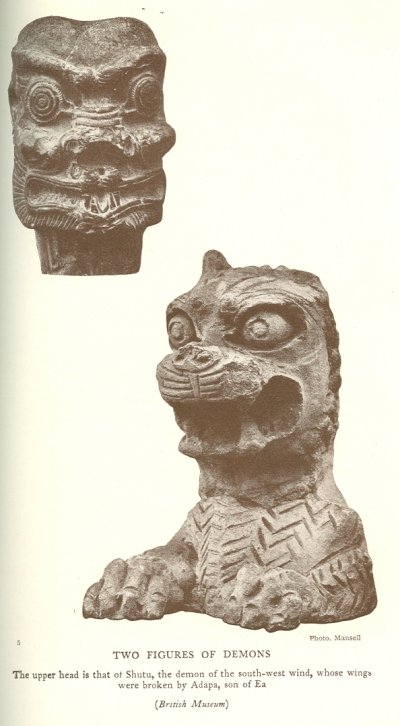
TWO FIGURES OF DEMONS
The upper head is that of Shutu, the demon of the south-west wind, whose wings
were broken by Adapa, son of Ea
(British Museum)
Photo. Mansell
Anu offered him the water of life and the bread of life which would have
made him immortal, but Ea’s son refused to eat or drink, believing, as his father
had warned him, that the sky god desired him to partake of the bread of death
and to drink of the water of death.
Another terrible atmospheric demon was the south-west wind, which caused
destructive storms and floods, and claimed many human victims like the Icelandic
“corpse swallower”. She was depicted with lidless staring eyes, broad flat nose,
mouth gaping horribly, and showing tusk-like teeth, and with high cheek bones,
heavy eyebrows, and low bulging forehead.
In Scotland the hag of the south-west wind is similarly a bloodthirsty and
fearsome demon. She is most virulent in the springtime. At Cromarty she is quaintly
called “Gentle Annie” by the fisher folks, who repeat the saying: “When Gentle
Annie is skyawlan (yelling) roond the heel of Ness (a promontory) wi a white
feather on her hat (the foam of big billows) they (the spirits) will be harrying
(robbing) the crook”–that is, the pot which hangs from the crook is empty during
the spring storms, which prevent fishermen going to sea. In England the wind
hag is Black Annis, who dwells in a Leicestershire hill cave. She may be identical
with the Irish hag Anu, associated with the “Paps of Anu”. According to Gaelic
lore, this wind demon of spring is the “Cailleach” (old wife). She gives her
name In the Highland calendar to the stormy period of late spring; she raises
gale after gale to prevent the coming of summer. Angerboda, the Icelandic hag,
is also a storm demon, but represents the east wind. A Tyrolese folk tale tells
of three magic maidens who dwelt on Jochgrimm mountain, where they “brewed the
winds”. Their demon lovers were Ecke, “he who causes fear”; Vasolt, “he who
causes dismay”; and the scornful Dietrich in his mythical character of Donar
or Thunor (Thor), the thunderer.
Another Sumerian storm demon was the Zu bird, which is represented among
the stars by Pegasus and Taurus. A legend relates that this “worker of evil,
who raised the head of evil”, once aspired to rule the gods, and stole from
Bel, “the lord” of deities, the Tablets of Destiny, which gave him his power
over the Universe as controller of the fates of all. The Zu bird escaped with
the Tablets and found shelter on its mountain top in Arabia. Anu called on Ramman,
the thunderer, to attack the Zu bird, but he was afraid; other gods appear to
have shrunk from the conflict. How the rebel was overcome is not certain, because
the legend survives in fragmentary form. There is a reference, however, to the
moon god setting out towards the mountain in Arabia with purpose to outwit the
Zu bird and recover the lost Tablets. How he fared it is impossible to ascertain.
In another legend–that of Etana–the mother serpent, addressing the sun god,
Shamash, says:
Thy net is like unto the broad earth;
Thy snare is like unto the distant heaven!
Who hath ever escaped from thy net?
Even Zu, the worker of evil, who raised the head of evil [did not escape]!
L. W. King’s Translation.
In Indian mythology, Garuda, half giant, half eagle, robs the Amrita (ambrosia)
of the gods which gives them their power and renders them immortal. It had assumed
a golden body, bright as the sun. Indra, the thunderer, flung his bolt in vain;
he could not wound Garuda, and only displaced a single feather. Afterwards,
however, he stole the moon goblet containing the Amrita, which Garuda had delivered
to his enemies, the serpents, to free his mother from bondage. This Indian eagle
giant became the vehicle of the god Vishnu, and, according to the Mahhata,
“mocked the wind with his fleetness”.
It would appear that the Babylonian Zu bird symbolized the summer sandstorms
from the Arabian desert. Thunder is associated with the rainy season, and it
may have been assumed, therefore, that the thunder god was powerless against
the sandstorm demon, who was chased, however, by the moon, and finally overcome
by the triumphant sun when it broke through the darkening sand drift and brightened
heaven and earth, “netting” the rebellious demon who desired to establish the
rule of evil over gods and mankind.
In the “Legend of Etana” the Eagle, another demon which links with the Indian
Garuda, slayer of serpents, devours the brood of the Mother Serpent. For this
offence against divine law, Shamash, the sun god, pronounces the Eagle’s doom.
He instructs the Mother Serpent to slay a wild ox and conceal herself in its
entrails. The Eagle comes to feed on the carcass, unheeding the warning of one
of his children, who says, “The serpent lies in this wild ox”:
He swooped down and stood upon the wild ox,
The Eagle . . . examined the flesh;
He looked about carefully before and behind him;
He again examined the flesh;
He looked about carefully before and behind him,
Then, moving swiftly, he made for the hidden parts.
‘When he entered into the midst,
The serpent seized him by his wing.
In vain the Eagle appealed
for mercy to the Mother Serpent, who was compelled to execute the decree of
Shamash; she tore off the Eagle’s pinions, wings, and claws, and threw him into
a pit where he perished from hunger and thirst. 1 This myth may refer to the ravages of a winged
demon of disease who was thwarted by the sacrifice of an ox. The Mother Serpent
appears to be identical with an ancient goddess of maternity resembling the
Egyptian Bast, the serpent mother of Bubastis. According to Sumerian belief,
Nintu, “a form of the goddess Ma”, was half a serpent. On her head there is
a horn; she is “girt about the loins”; her left arm holds “a babe suckling her
breast”:
From her head to her loins
The body is that of a naked woman;
From the loins to the sole of the foot
Scales like those of a snake are visible.
R. C. Thompson’s Translation.
The close association of gods and demons is illustrated in an obscure myth
which may refer to an eclipse of the moon or a night storm at the beginning
of the rainy season. The demons go to war against the high gods, and are assisted
by Adad (Ramman) the thunderer, Shamash the sun, and Ishtar. They desire to
wreck the heavens, the home of Anu: the land” like to the wind. Bel called upon
his messenger, whom he sent to Ea in the ocean depths, saying: “My son Sin .
. . hath been grievously bedimmed”. Ea lamented, and dispatched his son Merodach
to net the demons by magic, using “a two-coloured cord from the hair of a virgin
kid and from the wool of a virgin lamb.” 1
They clustered angrily round the crescent of the moon
god,
And won over to their aid Shamash, the mighty, and Adad, the warrior,
And Ishtar, who with Anu, the King,
Hath founded a shining dwelling.
The moon god Sin, “the seed of mankind”, was darkened
by the demons who raged, “rushing loose over
As in India, where Shitala, the Bengali goddess of smallpox, for instance,
is worshipped when the dreaded disease she controls becomes epidemic, so in
Babylonia the people sought to secure immunity from attack by worshipping spirits
of disease. A tablet relates that Ura, a plague demon, once resolved to destroy
all life, but ultimately consented to spare those who praised his name and exalted
him in recognition of his bravery and power. This could be accomplished by reciting
a formula. Indian serpent worshippers believe that their devotions “destroy
all danger proceeding from snakes”. 2
Like the Ancient Egyptians, the Babylonians also had their kindly spirits
who brought luck and the various enjoyments of life. A good “labartu” might
attend on a human being like a household fairy of India or Europe: a friendly
“shedu” could protect a household against the attacks of fierce demons and human
enemies. Even the spirits of Fate who served Anu, god of the sky, and that “Nom”
of the Underworld, Eresh-ki-gal, queen of Hades, might sometimes be propitious:
if the deities were successfully invoked they could cause the Fates to smite
spirits of disease and bringers of ill luck. Damu, a friendly fairy goddess,
was well loved, because she inspired pleasant dreams, relieved the sufferings
of the afflicted, and restored to good health those patients whom she selected
to favour.
In the Egyptian Book of the Deadthe kindly spirits are overshadowed
by the evil ones, because the various magical spells which were put on record
were directed against those supernatural beings who were enemies of mankind.
Similarly in Babylonia the fragments of this class of literature which survive
deal mainly with wicked and vengeful demons. It appears probable, however, that
the highly emotional Sumerians and Akkadians were on occasion quite as cheerful
a people as the inhabitants of ancient Egypt. Although they were surrounded
by bloodthirsty furies who desired to shorten their days, and their nights were
filled with vague lowering phantoms which inspired fear, they no doubt shared,
in their charm-protected houses, a comfortable feeling of security after performing
magical ceremonies, and were happy enough when they gathered round flickering
lights to listen to ancient song and story and gossip about crops and traders,
the members of the royal house, and the family affairs of their acquaintances.
The Babylonian spirit world, it will be seen, was of complex character. Its
inhabitants were numberless, but often vaguely defined, and one class of demons
linked with another. Like the European fairies of folk belief; the Babylonian
spirits were extremely hostile and irresistible at certain seasonal periods;
and they were fickle and perverse and difficult to please even when inclined
to be friendly. They were also similarly manifested from time to time in various
forms. Sometimes they were comely and beautiful; at other times they were apparitions
of horror. The Jinn of present-day Arabians are of like character; these may
be giants, cloudy shapes, comely women, serpents or cats, goats or pigs.
Some of the composite monsters of Babylonia may suggest the vague and exaggerated
recollections of terror-stricken people who have had glimpses of unfamiliar
wild beasts in the dusk or amidst reedy marshes. But they cannot be wholly accounted
for in this way. While animals were often identified with supernatural beings,
and foreigners were called “devils”, it would be misleading to assert that the
spirit world reflects confused folk memories of human and bestial enemies. Even
when a demon was given concrete human form it remained essentially non-human:
no ordinary weapon could inflict an injury, and it was never controlled by natural
laws. The spirits of disease and tempest and darkness were creations of fancy:
they symbolized moods; they were the causes which explained effects. A sculptor
or storyteller who desired to convey an impression of a spirit of storm or pestilence
created monstrous forms to inspire terror. Sudden and unexpected visits of fierce
and devastating demons were accounted for by asserting that they had wings like
eagles, were nimble-footed as gazelles, cunning and watchful as serpents; that
they had claws to clutch, horns to gore, and powerful fore legs like a lion
to smite down victims. Withal they drank blood like ravens and devoured corpses
like hyas. Monsters were all the more repulsive when they were partly human.
The human-headed snake or the snake-headed man and the man with the horns of
a wild bull and the legs of a goat were horrible in the extreme. Evil spirits
might sometimes achieve success by practising deception. They might appear as
beautiful girls or handsome men and seize unsuspecting victims in deathly embrace
or leave them demented and full of grief, or come as birds and suddenly assume
awesome shapes.
Fairies and elves, and other half-human demons, are sometimes regarded as
degenerate gods. It will be seen, however, that while certain spirits developed
into deities, others remained something between these two classes of supernatural
beings: they might attend upon gods and goddesses, or operate independently
now against mankind and now against deities even. The “namtaru”, for instance,
was a spirit of fate, the son of Bel-Enlil and Eresh-ki -gal, queen of Hades.
“Apparently”, writes Professor Pinches, “he executed the instructions given
him concerning the fate of men, and could also have power over certain of the
gods.” 1 To this middle class
belong the evil gods who rebelled against the beneficent deities. According
to Hebridean folk belief, the fallen angels are divided into three classes–the
fairies, the “nimble men” (aurora borealis), and the “blue men of the Minch”.
In Beowulfthe “brood of Cain” includes “monsters and elves and sea-devils–giants
also, who long time fought with God, for which he gave them their reward”.
2 Similarly the Babylonian
spirit groups are liable to division and subdivision. The various classes may
be regarded as relics of the various stages of development from crude animism
to sublime monotheism: in the fragmentary legends we trace the floating material
from which great mythologies have been framed.
Footnotes
60:1 The Acts, xvii,
22-31.
62:1 Devils and Evil
Spirits of Babylonia, vol. ii, p. 149 et seq.
63:1 Egyptian Myth and
Legend, xxxix, n.
63:2 Development of
Religion and Thought in Ancient Egypt, J. H. Breasted, pp. 38, 74.
64:1 Custom and Myth,
p.45 et seq.
66:1 The Religion of
Babylonia and Assyria, p. 108.
66:2 Act iv, scene 1.
66:3 Paradise Lost,
book ix.
66:4 Chapman’s Car
and Pompey.
67:1 Natural History,
2nd book.
67:2 Indian Myth and
Legend, 70, n.
68:1 Indian Myth and
Legend, pp. 202-5, 400, 401.
68:2 Teutonic Myth and
Legend, p. 424 et seq.
68:3 Indian Myth and
Legend, p. 164 et seq.
69:1 Popular Religion
and Folk Lore of Northern India, W. Crooke, vol. p. 254.
70:1 When a person, young
or old, is dying, near relatives must not call out their names in case the soul
may come back from the spirit world. A similar belief still lingers, especially
among women, in the Lowlands. The writer was once present in a room when a child
was supposed to be dying. Suddenly the mother called out the child’s name in
agonized voice. It revived soon afterwards. Two old women who had attempted
to prevent “the calling” shook their heads and remarked: “She has done it! The
child will never do any good in this world after being called back.” In England
and Ireland, as well as in Scotland, the belief also prevails in certain localities
that if a dying person is “called back” the soul will tarry for another twenty-four
hours, during which the individual will suffer great agony.
70:2 A Journey in Southern
Siberia, Jeremiah Curtin, pp. 103, 104.
70:3 Vol. i, p. 305.
71:1 Adi Parvasection
of Mahhata, Roy’s trans., p. 635.
71:2 Jastrow’s Aspects
of Religious Belief in Babylonia, &c., p. 312.
72:1 R. C. Thompson’s trans.
72:2 The Elder or Poetic
Edda, Olive Bray, part i, p. 53.
76:1 Babylonian Religion,
L. W. King, pp. 186-8.
77:1 The Devils and
Evil Spirits of Babylonia, R. Campbell Thompson, vol. i, p. 53 et seq.
77:2 Omens and Superstitions
of Southern India, E. Thurston, p. 124.
80:1 The Religion
of Babylonia and Assyria, p. 110.
80:2 Beowulf,
Clark Hall, p. 14.
Next: Chapter V. Myths of Tammuz and Ishtar

Leave A Comment