
CHAPTER IX
Deluge Legend, the Island of the Blessed, and Hades
Babylonian Story of the Flood–The Two Immortals on the Island of the
Blessed–Deluge Legends in the Old and New Worlds–How Babylonian Culture reached
India–Theory of Cosmic Periods–Gilgamesh resembles the Indian Yama and Persian
Yimeh–Links with Varuna and Mitra–The Great Winter in Persian and Teutonic
Mythologies–Babylonian Hades compared with the Egyptian, Greek, Indian, Teutonic,
and Celtic Otherworlds–Legend of Nergal and the Queen of Death–Underworld
originally the Grave–Why Weapons, &c., were Buried with the Dead–Japanese
and Roman Beliefs–Pallithic Burial Customs–“Our Graves are our Houses”–Importance
of Babylonian Funerary Ceremonies–Doctrine of Eternal Bliss in Egypt and India–Why
Suppressed in Babylonia–Heavy Burial Fees–Various Burial Customs.
THE story of the Deluge which was related to Gilgamesh by Pir-napishtim runs
as follows:
“Hear me, O Gilgamesh, and I will make revelation regarding the hidden doings
of the high gods. As thou knowest, the city of Shurippak is situated upon the
bank of the Euphrates. The gods were within it: there they assembled together
in council. Anu, the father, was there, and Bel the counsellor and warrior,
Ninip the messenger, and Ennugi the governor. Ea, the wise lord, sat also with
them. In their hearts the gods agreed together to send a great deluge.
“Thereafter Ea made known the purpose of the divine rulers in the hut of
reeds, saying:1 ‘O hut of
reeds, hear; O wall, understand . . . O man of Shurippak, son of Umbara Tutu,
tear down thy house and build a ship; leave all thou dost possess and save thy
life, and preserve in the ship the living seed of every kind. The ship that
thou wilt build must be of goodly proportions in length and height. It must
be floated on the great deep.’
“I heard the command of Ea and understood, and I made answer, saying, ‘O
wise lord, as thou hast said so will I do, for thy counsel is most excellent.
But how shall I give reason for my doings to the young men and the elders?’
“Ea opened his mouth and said unto me, his servant: ‘What thou shalt say
unto them is this . . It hath been revealed unto me that Bel doth hate me,
therefore I cannot remain any longer in his domain, this city of Shurippak,
so I must depart unto the domain of Ea and dwell with him . . . Unto you will
Bel send abundance of rain, so that you may obtain birds and fishes in plenty
and have a rich harvest. But Shamash hath appointed a time for Ramman to pour
down destruction from the heavens.'”1
Ea then gave instructions to Pir-napishtim how to build the ship in which
he should find refuge. So far as can be gathered from the fragmentary text,
it appears that this vessel was to have a deck house six stories high, with
nine apartments in each story. According to another account, Ea drew a plan
of the great ship upon the sand.
Pir-napishtim set to work and made a flat-bottomed vessel, which was 120
cubits wide and 120 cubits in height. He smeared it with bitumen inside and
pitch outside; and on the seventh day it was ready. Then he carried out Ea’s
further instructions. Continuing his narrative to Gilgamesh, he said:
“I gathered together all that I possessed, my silver and gold and seeds of
every kind, and my goods also. These I placed in the ship. Then I caused to
go aboard all my family and house servants, the animals of the field and the
beasts of the field and the workers–every one of them I sent up.
“The god Shamash appointed the time, saying: ‘I will cause the Night Lord
to send much rain and bring destruction. Then enter thou the ship and shut thy
door.’
“At the appointed time the Night Lord sent at eventime much rain. I saw the
beginning of the deluge and I was afraid to look up. I entered the ship and
shut the door. I appointed Buzur-Kurgala, the sailor, to be captain, and put
under his command the great vessel and all that it contained.
“At the dawn of day I saw rising athwart the heavens a dark cloud, and in
the midst of it Ramman thundered. Nebo and Merodach went in front, speeding
like emissaries over hills and plains. The cables of the ship were let loose.
“Then Ninip, the tempest god, came nigh, and the storm broke in fury before
him. All the earth spirits leapt up with flaming torches and the whole land
was aflare. The thunder god swept over the heavens, blotting out the sunlight
and bringing thick darkness. Rain poured down the whole day long, and the earth
was covered with water; the rivers were swollen; the land was in confusion;
men stumbled about in the darkness, battling with the elements. Brothers were
unable to see brothers; no man could recognize his friends. . . . The spirits
above looked down and beheld the rising flood and were afraid: they fled away,
and in the heaven of Anu they crouched like to hounds in the protecting enclosures.
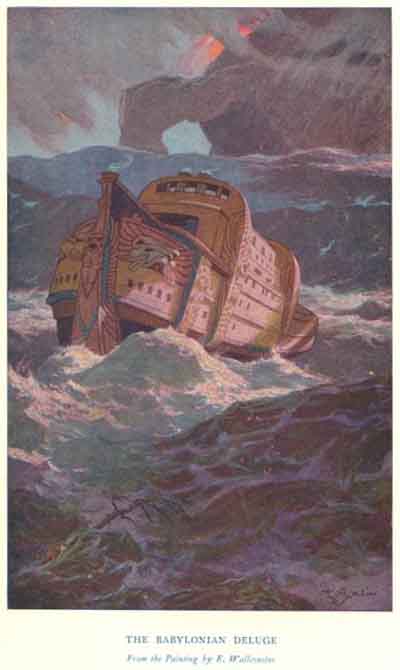
THE BABYLONIAN DELUGE
From the Painting by E. Wallcousins.
“In time Ishtar, the lady of the gods, cried out distressfully, saying: ‘The
elder race hath perished and turned to clay because that I have consented to
evil counsel in the assembly of the gods. Alas! I have allowed my people to
be destroyed. I gave being to man, but where is he? Like the offspring of fish
he cumbers the deep.’
“The earth spirits were weeping with Ishtar: they sat down cowering with
tightened lips and spake not; they mourned in silence.
“Six days and six nights went past, and the tempest raged over the waters
which gradually covered the land. But when the seventh day came, the wind fell,
the whirling waters grew peaceful, and the sea retreated. The storm was over
and the rain of destruction had ceased. I looked forth. I called aloud over
the waters. But all mankind had perished and turned to clay. Where fields had
been I saw marshes only.
“Then I opened wide the window of the ship, and the sunlight suffused my
countenance. I was dazzled and sank down weeping and the tears streamed over
my face. Everywhere I looked I saw water.
“At length, land began to appear. The ship drifted towards the country of
Nitsir, and then it was held fast by the mountain of Nitsir. Six days went past
and the ship remained stedfast. On the seventh day I sent forth a dove, and
she flew away and searched this way and that, but found no resting place, so
she returned. I then sent forth a swallow, and she returned likewise. Next I
sent forth a raven, and she flew away. She saw that the waters were shrinking,
and gorged and croaked and waded, but did not come back. Then I brought forth
all the animals into the air of heaven.
“An offering I made on the mountain. I poured out a libation. I set up incense
vessels seven by seven on heaped-up reeds and used cedar wood with incense.
The gods smelt the sweet savour, and they clustered like flies about the sacrificer.
“Thereafter Ishtar (Sirtu) drew nigh. Lifting up the jewels, which the god
Anu had fashioned for her according to her desire, she spake, saying: ‘Oh! these
gods! I vow by the lapis lazuli gems upon my neck that I will never forget!
I will remember these days for ever and ever. Let all the gods come hither to
the offering, save Bel (Enlil) alone, because that he ignored my counsel, and
sent a great deluge which destroyed my people.’
“But Bel Enlil came also, and when he beheld the ship he paused. His heart
was filled with wrath against the gods and the spirits of heaven. Angrily he
spake and said: ‘Hath one escaped? It was decreed that no human being should
survive the deluge.’
“Ninip, son of Bel, spoke, saying: ‘Who hath done this save Ea alone? He
knoweth all things.’
“Ea, god of the deep, opened his mouth and said unto the warrior Bel: ‘Thou
art the lord of the gods, O warrior. But thou wouldst not hearken to my counsel
and caused the deluge to be. Now punish the sinner for his sins and the evil
doer for his evil deed, but be merciful and do not destroy all mankind. May
there never again be a flood. Let the lion come and men will decrease. May there
never again be a flood. Let the leopard come and men will decrease. May there
never again be a flood. Let famine come upon the land; let Ura, god of pestilence,
come and snatch off mankind. . . . I did not reveal the secret purpose of the
mighty gods, but I caused Atra-chasis (Pir-napishtim) to dream a dream in which
he had knowledge of what the gods had decreed.’
“Having pondered a time over these words, Bel entered the ship alone. He
grasped my hand land led me forth, even me, and he led forth my wife also, and
caused her to kneel down beside me. Then he stood between us and gave his blessing.
He spoke, saying: ‘In time past Pir-napishtim was a man. Henceforth Pir-napishtim
and his wife will be like unto deities, even us. Let them dwell apart beyond
the river mouths.’
“Thereafter Bel carried me hither beyond the mouths of rivers.”
……
Flood myths are found in many mythologies both in the Old World and the New.
The violent and deceitful men of the mythical Bronze Age of Greece were destroyed
by a flood. It is related that Zeus said on one occasion to Hermes: “I will
send a great rain, such as hath not been since the making of the world, and
the whole race of men shall perish. I am weary of their iniquity.”
For receiving with hospitable warmth these two gods in human guise, Deucalion,
an old man, and his wife Pyrrha were spared, however. Zeus instructed his host
to build an ark of oak, and store it well with food. When this was done, the
couple entered the vessel and shut the door. Then Zeus “broke up all the fountains
of the deep, and opened the well springs of heaven, and it rained for forty
days and forty nights continually”. The Bronze folk perished: not even those
who fled to the hilltops could escape. The ark rested on Parnassus, and when
the waters ebbed the old couple descended the mountain and took up their abode
in a cave.1
In Indian mythology the world is destroyed by a flood at the end of each
Age of the Universe. There are four ages: the Krita or Perfect Age, the Treta
Age, the Dwapara Age, and the Kali or Wicked Age. These correspond closely to
the Greek and Celtic ages.1 There are also references in Sanskrit literature to the destruction of the world
because too many human beings lived upon it. “When the increase of population
had been so frightful,” a sage related, “the Earth, oppressed with the excessive
burden, sank down for a hundred Yojanas. Suffering pain in all her limbs, and
being deprived of her senses by excessive pressure, the Earth in distress sought
the protection of Narayana, the foremost of the gods.”2
Manu’s account of the flood has been already referred to (Chapter
II ). The god in fish shape informed him: “The time is ripe for purging the
world. . . . Build a strong and massive ark, and furnish it with a long rope.
. . .” When the waters rose the horned fish towed the ark over the roaring sea,
until it grounded on the highest peak of the Himavat, which is still called
Naubandha (the harbour). Manu was accompanied by seven rishis.3
In the Celtic (Irish) account of the flood, Cessair, granddaughter of Noah,
was refused a chamber for herself in the ark, and fled to the western borders
of the world as advised by her idol.4 Her fleet consisted of three ships, but two foundered before Ireland was reached.
The survivors in addition to Cessair were, her father Bith, two other men, Fintan
and Ladru, and fifty women. All of these perished on the hills except Fintan,
who slept on the crest of a great billow, and lived to see Partholon, the giant,
arriving from Greece.
There is a deluge also in Egyptian mythology. When Ra, the sun god, grew
old as an earthly king, men began to mutter words against him. He called the
gods together and said: “I will not slay them (his subjects) until I have heard
what ye say concerning them.” Nu, his father, who was the god of primeval waters,
advised the wholesale destruction of mankind.
Said Ra: “Behold men flee unto the hills; their heart is full of fear because
of that which they said.”
The goddess Hathor-Sekhet, the Eye of Ra, then went forth and slew mankind
on the hills. Thereafter Ra, desiring to protect the remnant of humanity, caused
a great offering to be made to the goddess, consisting of corn beer mixed with
herbs and human blood. This drink was poured out during the night. “And the
goddess came in the morning; she found the fields inundated, she rejoiced thereat,
she drank thereof; her heart was rejoiced, she went about drunken and took no
more cognizance of men.”1
It is obvious that the Egyptian myth refers to the annual inundation of the
Nile, the “human blood” in the “beer” being the blood of the slain corn god,
or of his earthly representative. It is probable that the flood legends of North
and South America similarly reflected local phenomena, although the possibility
that they were of Asiatic origin, like the American Mongoloid tribes, cannot
be overlooked. Whether or not Mexican civilization, which was flourishing about
the time of the battle of Hastings, received any cultural stimulus from Asia
is a question regarding which it would be unsafe to dogmatize, owing to the
meagre character of the available data.
The Mexican deluge was caused by the “water sun”, which suddenly discharged
the moisture it had been drawing from the earth in the form of vapour through
long ages. All life was destroyed.
A flood legend among the Nahua tribes resembles closely the Babylonian story
as told by Pir-napishtim. The god Titlacahuan instructed a man named Nata to
make a boat by hollowing out a cypress tree, so as to escape the coming deluge
with his wife Nena. This pair escaped destruction. They offered up a fish sacrifice
in the boat and enraged the deity who visited them, displaying as much indignation
as did Bel when he discovered that Pir-napishtim had survived the great disaster.
Nata and Nena had been instructed to take with them one ear of maize only, which
suggests that they were harvest spirits.
In Brazil, Monan, the chief god, sent a great fire to burn up the world and
its wicked inhabitants. To extinguish the flames a magician caused so much rain
to fall that the earth was flooded.
The Californian Indians had a flood legend, and believed that the early race
was diminutive; and the Athapascan Indians of the north-west professed to be
descendants of a family who escaped the deluge. Indeed, deluge myths were widespread
in the “New World”.
The American belief that the first beings who were created were unable to
live on earth was shared by the Babylonians. According to Berosus the first
creation was a failure, because the animals could not bear the light and they
all died.1 Here we meet with
the germs of the Doctrine of the World’s Ages, which reached its highest development
in Indian, Greek, and Celtic (Irish) mythologies.
The Biblical account of the flood is familiar to readers. “It forms”, says
Professor Pinches, “a good subject for comparison with the Babylonian account,
with which it agrees so closely in all the main points, and from which it differs
so much in many essential details.”1
The drift of Babylonian culture was not only directed westward towards the
coast of Palestine, and from thence to Greece during the Phnician period, but
also eastward through Elam to the Iranian plateau and India. Reference has already
been made to the resemblances between early Vedic and Sumerian mythologies.
When the “new songs” of the Aryan invaders of India were being composed, the
sky and ocean god, Varuna, who resembles Ea-Oannes, and Mitra, who links with
Shamash, were already declining in splendour. Other cultural influences were
at work. Certain of the Aryan tribes, for instance, buried their dead in Varuna’s
“house of clay”, while a growing proportion cremated their dead and worshipped
Agni, the fire god. At the close of the Vedic period there were fresh invasions
into middle India, and the “late comers” introduced new beliefs, including the
doctrines of the Transmigration of Souls and of the Ages of the Universe. Goddesses
also rose into prominence, and the Vedic gods became minor deities, and subject
to Brahma, Vishnu, and Shiva. These “late comers” had undoubtedly been influenced
by Babylonian ideas before they entered India. In their Doctrine of the World’s
Ages or Yugas, for instance, we are forcibly reminded of the Euphratean ideas
regarding space and time. Mr. Robert Brown, junr., who is an authority in this
connection, shows that the system by which the “Day of Brahma” was calculated
in India resembles closely an astronomical system which obtained in Babylonia,
where apparently the theory of cosmic periods had origin.1
The various alien peoples, however, who came under the spell of Babylonian
modes of thought did not remain in a state of intellectual bondage. Thought
was stimulated rather than arrested by religious borrowing, and the development
of ideas regarding the mysteries of life and death proceeded apace in areas
over which the ritualistic and restraining priesthood of Babylonia exercised
no sway. As much may be inferred from the contrasting conceptions of the Patriarchs
of Vedic and Sumerian mythologies. Pir-napishtim, the Babylonian Noah, and the
semi-divine Gilgamesh appear to be represented in Vedic mythology by Yama, god
of the dead. Yama was “the first man”, and, like Gilgamesh, he set out on a
journey over mountains and across water to discover Paradise. He is lauded in
the Vedic hymns as the explorer of “the path” or “way” to the “Land of the Pitris”
(Fathers), the Paradise to which the Indian uncremated dead walked on foot.
Yama never lost his original character. He is a traveller in the Epics as in
the Vedas.2
Him who along the mighty heights departed,
Him who searched and spied the path for many,
Son of Vivasvat, gatherer of the people,
Yama, the King, with sacrifices worship.
Rigveda, x, 14, 1.3
To Yama, mighty King, be gifts and homage paid,
He was the first of men that died, the first to brave
Death’s rapid rushing stream, the first to point the road
To heaven, and welcome others to that bright abode.
Sir M. Monier Williams’ Translation.4
Yama and his sister Yamwere the first human pair.
They are identical with the Persian Celestial twins, Yima and Yimeh. Yima
resembles Mitra (Mithra); Varuna, the twin brother of Mitra, in fact, carries
the noose associated with the god of death.1
The Indian Yama, who was also called Pitripati, “lord of the fathers”, takes
Mitra’s place in the Paradise of Ancestors beside Varuna, god of the sky and
the deep. He sits below a tree, playing on a flute and drinking the Soma drink
which gives immortality. When the descendants of Yama reached Paradise they
assumed shining forms “refined and from all taint set free”.2
In Persian mythology “Yima”, says Professor Moulton, “reigns over a community
which may well have been composed of his own descendants, for he lived yet longer
than Adam. To render them immortal, he gives them to eat forbidden food, being
deceived by the Daevas (demons). What was this forbidden food? May we connect
it with another legend whereby, at the Regeneration, Mithra is to make men immortal
by giving them to eat the fat of the Ur-Kuh, the primeval cow from whose
slain body, according to the Aryan legends adopted by Mithraism, mankind was
first created?”
Yima is punished for “presumptuously grasping at immortality for himself
and mankind, on the suggestion of an evil power, instead of waiting Ahura’s
good time”. Professor Moulton wonders if this story, which he endeavours to
reconstruct, “owed anything to Babylon?”
Yima, like the Babylonian Pir-napishtim, is also a revealer of the secrets
of creation. He was appointed to be “Guardian, Overseer, Watcher over my Creation”
by Ahura, the supreme god. Three hundred years went past
Then the earth became abounding,
Full of flocks and full of cattle,
Full of men, of birds, dogs likewise,
Full of fires all bright and blazing,
Nor did men, flocks, herds of cattle,
Longer find them places in it.
Jackson’s Translation.
The earth was thereafter cloven with a golden arrow. Yima then built a refuge
in which mankind and the domesticated animals might find shelter during a terrible
winter. “The picture”, says Professor Moulton, “strongly tempts us to recognize
the influence of the Babylonian Flood Legend.”1 The “Fimbul winter” of Germanic mythology is also recalled. Odin asks in one
of the Icelandic Eddic poems:
What beings shall live when the long dread winter
Comes oer the people of earth?2
In another Eddic poem, the Voluspa, the Vala tells of a Sword Age, an Axe
Age, a Wind Age, and a Wolf Age which is to come “ere the world sinks”. After
the battle of the gods and demons,
The sun is darkened, earth sinks in the sea.
In time, however, a new world appears.
I see uprising a second time
Earth from the Ocean, green anew;
The waters fall, on high the eagle
Flies o’er the fell and catches fish.
When the surviving gods return, they will talk, according to the Vala (prophetess),
of “the great world serpent” (Tiamat). The fields will be sown and “Balder will
come”1 –apparently as Tammuz
came. The association of Balder with corn suggests that, like Nata of the Nahua
tribes, he was a harvest spirit, among other things.
Leaving, meantime, the many problems which arise from consideration of the
Deluge legends and their connection with primitive agricultural myths, the attention
of readers may be directed to the Babylonian conception of the Otherworld.
Pir-napishtim, who escaped destruction at the Flood, resides in an Island
Paradise, which resembles the Greek “Islands of the Blessed”, and the Irish
“Tir nan og” or “Land of the Young”, situated in the western ocean, and identical
with the British2
island-valley of Avilion,
Where falls not hail, or rain, or any snow,
Nor ever wind blows loudly, but it lies
Deep meadowd, happy, fair with orchard lawns
And bowery hollows crowned with summer sea.3
Only two human beings were permitted to reside on the Babylonian island paradise,
however. These were Pir-napishtim and his wife. Apparently Gilgamesh could not
join them there. His gods did not transport heroes and other favoured individuals
to a happy isle or isles like those of the Greeks and Celts and Aryo-Indians.
There was no Heaven for the Babylonian dead. All mankind were doomed to enter
the gloomy Hades of the Underworld, “the land of darkness and the shadow of
death; a land of darkness, as darkness itself; and of the shadow of death, without
any order, and where the light is darkness”, as Job exclaimed in the hour of
despair, lamenting his fate.4
This gloomy habitation of the dead resembles the Greek Hades, the Teutonic
Nifelhel, and the Indian “Put”. No detailed description of it has been found.
The references, however, in the “Descent of Ishtar” and the Gilgamesh epic suggest
that it resembled the hidden regions of the Egyptians, in which souls were tortured
by demons who stabbed them, plunged them in pools of fire, and thrust them into
cold outer darkness where they gnashed their teeth, or into places of horror
swarming with poisonous reptiles.
Ishtar was similarly tortured by the plague demon, Namtar, when she boldly
entered the Babylonian Underworld to search for Tammuz. Other sufferings were,
no doubt, in store for her, resembling those, perhaps, with which the giant
maid in the Eddic poem “Skirnismal” was threatened when she refused to marry
Frey, the god of fertility and harvest:
Trolls shall torment thee from morn till eve
In the realms of the Jotun race,
Each day to the dwellings of Frost giants must thou
Creep helpless, creep hopeless of love;
Thou shalt weeping have in the stead of joy,
And sore burden bear with tears. . . .
May madness and shrieking, bondage and yearning
Burden thee with bondage and tears.1
In like manner, too, the inhabitants of the Indian Hell suffered endless
and complicated tortures.2
The Persephone of the Babylonian Underworld was Eresh-ki-gal, who was also
called Allatu. A myth, which was found among the Egyptian Tel-el-Amarna “Letters”,
sets forth that on one occasion the Babylonian gods held a feast. All the deities
attended it, except Eresh-ki-gal.
She was unable to leave her gloomy Underworld, and sent her messenger, the
plague demon Namtar, to obtain her share. The various deities honoured Namtar,
except Nergal, by standing up to receive him. When Eresh-ki-gal was informed
of this slight she became very angry, and demanded that Nergal should be delivered
up to her so that he might be put to death. The storm god at once hastened to
the Underworld, accompanied by his own group of fierce demons, whom he placed
as guardians at the various doors so as to prevent the escape of Eresh-ki-gal.
Then he went boldly towards the goddess, clutched her by the hair, and dragged
her from her throne. After a brief struggle, she found herself over-powered.
Nergal made ready to cut off her head, but she cried for mercy and said: “Do
not kill me, my brother! Let me speak to thee.”
This appeal indicated that she desired to ransom her life–like the hags
in the European folk tales–so Nergal unloosed his hold.
Then Eresh-ki-gal continued: “Be thou my husband and I will be thy wife.
On thee I confer sovereignty over the wide earth, giving thee the tablet of
wisdom. Thou shalt be my lord and I will be thy lady.”
Nergal accepted these terms by kissing the goddess. Affectionately drying
her tears, he spoke, saying: “Thou shalt now have from me what thou hast demanded
during these past months.”
In other words, Nergal promises to honour her as she desired, after becoming
her husband and equal.
In the “Descent of Ishtar” the Babylonian Underworld is called Cuthah. This
city had a famous cemetery, like Abydos in Egypt, where many pious and orthodox
worshippers sought sepulture. The local god was Nergal, who symbolized the destructive
power of the sun and the sand storm; he was a gloomy, vengeful deity, attended
by the spirits of tempest, weariness, pestilence, and disease, and was propitiated
because he was dreaded.
In Nether Cuthah, as Ea-bani informed Gilgamesh, the worm devoured the dead
amidst the dust and thick darkness.
It is evident that this Underworld was modelled on the grave. In early times
men believed that the spirits of the dead hovered in or about the place of sepulture.
They were therefore provided with “houses” to protect them, in the same manner
as the living were protected in their houses above the ground.
The enemies of the human ghosts were the earth spirits. Weapons were laid
beside the dead in their graves so that they might wage war against demons when
necessary. The corpse was also charmed, against attack, by the magical and protecting
ornaments which were worn by the living–necklaces, armlets, ear-rings, &c.
Even face paint was provided, probably as a charm against the evil eye and other
subtle influences.
So long as corpses were left in their graves, the spirits of the dead were,
it would appear, believed to be safe. But they required food and refreshment.
Food vessels and drinking urns were therefore included in the funerary furniture,
and the dead were given food offerings at regular intervals. Once a year the
living held feasts in the burial ground, and invited the ghosts to share in
the repast. This custom was observed in Babylonia, and is not yet obsolete in
Egypt; Moslems and Coptic Christians alike hold annual all-night feasts in their
cemeteries.
The Japanese “Land of Yomi” is similarly an underworld, or great grave, where
ghosts mingle with the demons of disease and destruction. Souls reach it by
“the pass of Yomi”. The Mikado, however, may be privileged to ascend to heaven
and join the gods in the “Eternal Land”.
Among the ancient Romans the primitive belief survived that the spirit of
the dead “just sank into the earth where it rested, and returned from time to
time to the upper world through certain openings in the ground (mundi), whose
solemn uncovering was one of the regular observances of the festal calendar”.1
According to Babylonian belief, the dead who were not properly buried roamed
through the streets searching for food, eating refuse and drinking impure water.
Prior to the period of ceremonial burials, the dead were interred in the
houses in which they had lived–a custom which has made it possible for present-day
scientists to accumulate much valuable data regarding primitive races and their
habits of life. The Pallithic cave-dwellers of Europe were buried in their
caves. These were then deserted and became the haunts of wild animals. After
a long interval a deserted cave was occupied by strangers. In certain characteristic
caves the various layers containing human remains represent distinct periods
of the vast Pleistocene Age.
When Mediterranean man moved northward through Europe, he utilized some of
these caves, and constructed in them well-built graves for his dead, digging
down through older layers. In thus making a “house” within a “house”, he has
provided us with a link between an old custom and a new. Apparently he was influenced
by local practices and beliefs, for he met and mingled in certain localities
with the men of the Late Pallithic Age.
The primitive house-burial rite is referred to in the Ethiopic version of
the life of Alexander the Great. The “Two-horned”, as the hero was called, conversed
with Brahmans when he reached India. He spoke to one of them, “saying: ‘Have
ye no tombs wherein to bury any man among ye who may die?’ And an interpreter
made answer to him, saying: ‘Man and woman and child grow up, and arrive at
maturity, and become old, and when any one of them dieth we bury him in the
place wherein he lived; thus our graves are our houses. And our God knoweth
that we desire this more than the lust for food and meat which all men have:
this is our life and manner of living in the darkness of our tombs.'” When Alexander
desired to make a gift to these Brahmans, and asked them what they desired most,
their answer was, “Give us immortality”.1
In the Gilgamesh epic the only ray of hope which relieves the gloomy closing
passages is Ea-bani’s suggestion that the sufferings endured by the dead may
be alleviated by the performance of strict burial rites. Commenting on this
point Professor Jastrow says: “A proper burial with an affectionate care of
the corpse ensures at least a quiet repose.
Such a one rests on a couch and drinks pure water;
But he whose shade has no rest in the earth, as I have seen and you will see,
His shade has no rest in the earth
Whose shade no one cares for . . .
What is left over in the pot, remains of rood
That are thrown in the street, he eats.”2
Gilgamesh Epic.
By disseminating the belief that the dead must be buried with much ceremony,
the priests secured great power over the people, and extracted large fees.
In Egypt, on the other hand, the teachers of the sun cult sold charms and
received rewards to perform ceremonies so that chosen worshippers might enter
the sun-barque of Ra; while the Osirian priests promised the just and righteous
that they would reach an agricultural Paradise where they could live and work
as on earth, but receive a greater return for their labour, the harvests of
the Otherworld being of unequalled abundance.
In the sacred books of India a number of Paradises are referred to. No human
beings, however, entered the Paradise of Varuna, who resembles the Sumerian
Ea-Oannes. The souls of the dead found rest and enjoyment in the Paradise of
Yama, while “those kings that yield up their lives, without turning their backs
on the field of battle, attain”, as the sage told a hero, “to the mansion of
Indra”, which recalls the Valhal of Odin. It will thus be seen that belief in
immortality was a tenet of the Indian cults of Indra and Yama.
It is possible that the Gilgamesh epic in one of its forms concluded when
the hero reached the island of Pir-napishtim, like the Indian Yama who “searched
and spied the path for many”. The Indian “Land of the Pitris” (Ancestors), over
which Yama presided, may be compared to the Egyptian heaven of Osiris. It contains,
we are told, “all kinds of enjoyable articles”, and also “sweet, juicy, agreeable
and delicious edibles . . . floral wreaths of the most delicious fragrance,
and trees that yield fruits that are desired of them”. Thither go “all sinners
among human beings, as also (those) that have died during the winter solstice”>1 –a
suggestion that this Paradise was not unconnected with the Tammuz-like
deity who took up his abode in the spirit land during the barren season.
The view may be urged that in the Gilgamesh epic we have a development of
the Tammuz legend in its heroic form. Like Ishtar, when she descended to Hades,
the King of Erech could not return to earth until he had been sprinkled by the
water of life. No doubt, an incident of this character occurred also in the
original Tammuz legend. The life of the god had to be renewed before he could
return. Did he slumber, like one of the Seven Sleepers, in Ea’s house, and not
awake again until he arrived as a child in his crescent moon boat–“the sunken
boat” of the hymns–like Scef, who came over the waves to the land of the Scyldings?
It seems remarkable that the doctrine of Eternal Bliss, which obtained in
Egypt on the one hand and in India on the other, should never have been developed
among the Babylonians. Of course, our knowledge in this connection is derived
from the orthodox religious texts. Perhaps the great thinkers, whose influence
can be traced in the tendencies towards monotheism which became marked at various
periods, believed in a Heaven for the just and good. If they did, their teachings
must have been suppressed by the mercenary priests. It was extremely profitable
for these priests to perpetuate the belief that the spirits of the dead were
consigned to a gloomy Hades, where the degree of suffering which they endured
depended on the manner in which their bodies were disposed or upon earth. An
orthodox funeral ceremony was costly at all times. This is made evident by the
inscriptions which record the social reforms of Urukagina, the ill-fated patesi
of Lagash. When he came to the throne he cut down the burial fees by more than
a half. “In the case of an ordinary burial,” writes Mr. King, “when a corpse
was laid in a grave, it had been the custom for the presiding priest to demand
as a fee for himself seven urns of wine or strong drink, four hundred and twenty
loaves of bread, one hundred and twenty measures of corn, a garment, a kid,
a bed, and a seat.” The reformer reduced the perquisites to “three urns of wine,
eighty loaves of bread, a bed, and a kid, while the fee of his (the priest’s)
assistant was cut down from sixty to thirty measures of corn”.1
The conservative element in Babylonian religion is reflected by the burial
customs. These did not change greatly after the Neolithic period. Prehistoric
Sumerian graves resemble closely those of pre-Dynastic Egypt. The bodies of
the dead were laid on their sides in crouching posture, with a “beaker”, or
“drinking cup” urn, beside the right hand. Other vessels were placed near the
head. In this connection it may be noted that the magic food prepared for Gilgamesh
by Pir-napishtim’s wife, when he lay asleep, was also placed near his head.
The corpse was always decked with various ornaments, including rings, necklaces,
and armlets. As has been indicated, these were worn by the living as charms,
and, no doubt, they served the same purpose for the dead. This charm-wearing
custom was condemned by the Hebrew teachers. On one occasion Jacob commanded
his household to “put away the strange gods which were in their hand, and all
the ear-rings which were in their ears; and Jacob buried them under the oak
which was by Shechem”.2 To
Jacob, personal ornaments had quite evidently an idolatrous significance.
“A very typical class of grave furniture”, writes Mr. King, “consisted of
palettes, or colour dishes, made of alabaster, often of graceful shape, and
sometimes standing on four feet. . . . There is no doubt as to their use, for
colour still remains in many of them, generally black and yellow, but sometimes
a light rose and light green.” Palettes for face paint have also been found
in many early Egyptian graves.
The gods had their faces painted like the living and the dead and were similarly
adorned with charms. In the course of the daily service in the Egyptian temples
an important ceremony was “dressing the god with white, green, bright-red, and
dark-red sashes, and supplying two kinds of ointment and black and green eye
paint”.1 In the word-picture
of the Aryo-Indian Varuna’s heaven in the Mahhatathe deity is depicted
“attired in celestial robes and decked with celestial ornaments and jewels”.
His attendants, the Adityas, appear “adorned with celestial garlands and perfumed
with celestial scents and besmeared with paste of celestial fragrance”.2 Apparently the “paste”, like the face paint of the Babylonians and Egyptians,
had protective qualities. The Picts of Scotland may have similarly painted themselves
to charm their bodies against magical influences and the weapons of their enemies.
A painted man was probably regarded as one who was likely to have good luck,
being guarded against bad luck.
Weapons and implements were also laid in the Sumerian graves, indicating
a belief that the spirits of the dead could not only protect themselves against
their enemies but also provide themselves with food. The funerary gifts of fish-hooks
suggests that spirits were expected to catch fish and thus obtain clean food,
instead of returning to disturb the living as they searched for the remnants
of the feast, like the Scottish Gunna,
perched alone
On a chilly old grey stone,
Nibbling, nibbling at a bone
That we’ll maybe throw away.
Some bodies which were laid in Sumerian graves were wrapped up in reed matting,
a custom which suggests that the reeds afforded protection or imparted magical
powers. Magical ceremonies were performed in Babylonian reed huts. As we have
seen, Ea revealed the “purpose” of the gods, when they resolved to send a flood,
by addressing the reed hut in which Pir-napishtim lay asleep. Possibly it was
believed that the dead might also have visions in their dreams which would reveal
the “purpose” of demons who were preparing to attack them. In Syria it was customary
to wrap the dead in a sheep skin.1 As priests and gods were clad in the skins of animals from which their powers
were derived, it is probable that the dead were similarly supposed to receive
inspiration in their skin coverings. The Highland seer was wrapped in a bull’s
skin and left all night beside a stream so as to obtain knowledge of the future.
This was a form of the Taghairm ceremony, which is referred to by Scott in his
“Lady of the Lake”.2 The belief
in the magical influence of sacred clothing gave origin to the priestly robes.
When David desired to ascertain what Saul intended to do he said, “Bring hither
the ephod”.
Then he came to know that his enemy had resolved to attack Keilah.1 Elisha became a prophet when he received Elijah’s mantle.2
Sometimes the bodies of the Sumerians were placed in sarcophagi of clay.
The earlier type was of “bath-tub” shape, round and flat-bottomed, with a rounded
lid, while the later was the “slipper-shaped coffin”, which was ornamented with
charms. There is a close resemblance between the “bath-tub” coffins of Sumeria
and the Egyptian pottery coffins of oval shape found in Third and Fourth Dynasty
tombs in rock chambers near Nuerat. Certain designs on wooden coffins, and tombs
as early as the First Dynasty, have direct analogies in Babylonia.3
No great tombs were erected in Sumeria. The coffins were usually laid in
brick vaults below dwellings, or below temples, or in trenches outside the city
walls. On the “stele of victory”, which belongs to the period of Eannatum, patesi
of Lagash, the dead bodies on the battlefield are piled up in pairs quite naked,
and earth is being heaped over them; this is a specimen of mound burial.
According to Herodotus the Babylonians “buried their dead in honey, and had
funeral lamentations like the Egyptians”.4 The custom of preserving the body in this manner does not appear to have been
an ancient one, and may have resulted from cultural contact with the Nile valley
during the late Assyrian period. So long as the bones were undisturbed, the
spirit was supposed to be assured of rest in the Underworld. This archaic belief
was widespread, and finds an echo in the quaint lines over Shakespeare’s grave
in Stratford church:
Good friend, for Jesus’ sake forbeare
To dig the dust enclosed heare;
Blest be the man that spares these stones,
And curst be he that moves my bones.
 click to enlarge
SLIPPER-SHAPED COFFIN MADE OF GLAZED EARTHENWARE
(British Museum)
Photo. Mansell
In Babylonia the return of the spirits of the dead was greatly dreaded. Ishtar
once uttered the terrible threat: “I will cause the dead to rise; they will
then eat and live. The dead will be more numerous than the living.” When a foreign
country was invaded, it was a common custom to break open the tombs and scatter
the bones they contained. Probably it was believed, when such acts of vandalism
were committed, that the offended spirits would plague their kinsfolk. Ghosts
always haunted the homes they once lived in, and were as malignant as demons.
It is significant to find in this connection that the bodies of enemies who
were slain in battle were not given decent burial, but mutilated and left for
birds and beasts of prey to devour.
The demons that plagued the dead might also attack the living. A fragmentary
narrative, which used to be referred to as the “Cuthean Legend of Creation”,1 and has been shown by Mr. L. W. King to have no connection with the struggle
between Merodach and the dragon,2 deals with a war waged by an ancient king against a horde of evil spirits, led
by “the lord of heights, lord of the Anunaki (earth spirits)”. Some of the supernatural
warriors had bodies like birds; others had “raven faces”, and all had been “suckled
by Tiamat”.
For three years the king sent out great armies to attack the demons, but
“none returned alive”. Then he decided to go forth himself to save his country
from destruction. So he prepared for the conflict, and took the precaution of
performing elaborate and therefore costly religious rites so as to secure the
co-operation of the gods. His expedition was successful, for he routed the supernatural
army. On his return home, he recorded his great victory on tablets which were
placed in the shrine of Nergal at Cuthah.
This myth may be an echo of Nergal’s raid against Eresh-ki-gal. Or, being
associated with Cuthah, it may have been composed to encourage burial in that
city’s sacred cemetery, which had been cleared by the famous old king of the
evil demons which tormented the dead and made seasonal attacks against the living.
Footnotes
190:1 Ea addresses the
hut in which his human favourite, Pir-napishtim, slept. His message was conveyed
to this man in a dream.
191:1 The second sentence
of Ea’s speech is conjectural, as the lines are mutilated.
195:1 The Muses’ Pageant,
W. M. L. Hutchinson, pp. 5 et seq.
196:1 Indian Myth and
Legend, pp. 107 et seq.
196:2 Vana Parvasection of the Mahhata(Roy’s trans.), p. 425.
196:3 Indian Myth
and Legend, p. 141.
196:4 Book of Leinster,
and Keating’s History of Ireland, p. 150 (1811 ed.).
197:1 Religion of
the Ancient Egyptians, H. Wiedemann, pp. 58 et seq.
198:1 Pinches’ The
Religion of Babylonia and Assyria, p. 42.
199:1 The problems involved
are discussed from different points of view by Mr. L. W. King in Babylonian
Religion(Books on Egypt and Chald, vol. iv), Professor Pinches in The Old Testament in the Light of the Historical Records and Legends of Assyria
and Babylonia, and other vols.
200:1 Primitive Constellations,
vol. i, pp. 334-5.
200:2 Indian Myth
and Legend, chap. iii.
200:3 Professor Macdonell’s
translation.
200:4 Indian Wisdom.
201:1 “Varuna, the deity
bearing the noose as his weapon”, Sabha Parvasection of the Mahhata(Roy’s trans.), p. 29.
201:2 Indian Myth and
Legend, pp. 38-42.
202:1 Early Religious
Poetry of Persia, J. H. Moulton, pp. 41 et seq. and 154 et seq.
202:2 The Elder Edda,
O. Bray, p. 55.
203:1 The Elder Edda,
O. Bray, pp. 291 et seq.
203:2 Celtic Myth
and Legend, pp. 133 et seq.
203:3 Tennyson’s The
Passing of Arthur.
203:4 Job, x,
1-22.
204:1 The Elder Edda,
O. Bray, pp. 150-1.
204:2 Indian Myth
and Legend, p. 326.
207:1 The Religion
of Ancient Rome, Cyril Bailey, p. 50.
208:1 The Life and
Exploits of Alexander the Great(Ethiopic version of the Pseudo Callisthenes),
pp. 133-4. The conversation possibly never took place, but it is of interest
in so far as it reflects beliefs which were familiar to the author of this ancient
work. His Brahmans evidently believed that immortality was denied to ordinary
men, and reserved only for the king, who was the representative of the deity,
of course.
208:2 Aspects of Religious
Belief and Practice in Babylonia and Assyria, Morris Jastrow, pp. 358-9.
209:1 The Mahhata(Sabha Parvasection), Roy ‘s translation, pp. 25-7.
211:1 A History of
Sumer and Akkad, L. W. King, pp. 181-2.
211:2 Genesis,
xxxv, 2-4.
212:1 The Religion
of Ancient Egypt, W. M. Flinders Petrie, p. 72.
212:2 Sabha Parvasection of the Mahhata(Roy’s trans.), p. 29.
213:1 Egyptian Myth
and Legend, p. 214.
213:2 Canto iv:–Last eventide
Brian an augury hath tried. . . .
The Taghairm called; by which afar
Our sires foresaw the events of war.
Duncraggan’s milk-white bull they slew. . .
214:1 1 Samuel,
xxiii, 9-11.
214:2 1 Kings,
xix, 19 and 2 Kings, ii, 13-15.
214:3 The Burial Customs
of Ancient Egypt, John Garstang, pp. 28, 29 (London, 1907).
214:4 Herod.,
book i, 198.
215:1 Records of the
Past(old series), xi, pp. 109 et seq., and (new series), vol. i,
pp. 149 et seq.
215:2 L. W. King’s The Seven Tablets of Creation.
Next: Chapter X. Buildings and Laws and Customs
of Babylon

Leave A Comment