
CHAPTER XI
The Golden Age of Babylonia
Rise of the Sun God–Amorites and Elamites struggle for
Ascendancy–The Conquering Ancestors of Hammurabi–Sumerian Cities Destroyed–Widespread
Race Movements–Phnician Migration from Persian Gulf–Wanderings of Abraham
and Lot–Biblical References to Hittites and Amorites–Battles of Four Kings
with Five–Amraphel, Arioch, and Tidal–Hammurabi’s Brilliant Reign–Elamite
Power Stamped Out–Babylon’s Great General and Statesman–The Growth of Commerce,
Agriculture, and Education–An Ancient School–Business and Private Correspondence–A
Love Letter–Postal System–Hammurabi’s Successors–The Earliest Kassites–The
Sealand Dynasty–Hittite Raid on Babylon and Hyksos Invasion of Egypt.
SUN worship came into prominence in its most fully developed form during
the obscure period which followed the decline of the Dynasty of Isin. This was
probably due to the changed political conditions which brought about the ascendancy
for a time of Larsa, the seat of the Sumerian sun cult, and of Sippar, the seat
of the Akkadian sun cult. Larsa was selected as the capital of the Elamite conquerors,
while their rivals, the Amorites, appear to have first established their power
at Sippar.
Babbar, the sun god of Sippar, whose Semitic name was Shamash, must have
been credited with the early successes of the Amorites, who became domiciled
under his care, and it was possibly on that account that the ruling family subsequently
devoted so much attention to his worship in Merodach’s city of Babylon, where
a sun temple was erected, and Shamash received devout recognition as an abstract
deity of righteousness and law, who reflected the ideals of well organized and
firmly governed communities.
The first Amoritic king was Sumu-abum, but little is known regarding him
except that he reigned at Sippar. He was succeeded by Sumu-la-ilu, a deified
monarch, who moved from Sippar to Babylon, the great wall of which he either
repaired or entirely reconstructed in his fifth year. With these two monarchs
began the brilliant Hammurabi, or First Dynasty of Babylonia, which endured
for three centuries. Except Sumu-abum, who seems to stand alone, all its kings
belonged to the same family, and son succeeded father in unbroken succession.
Sumu-la-ilu was evidently a great general and conqueror of the type of Thothmes
III of Egypt. His empire, it is believed, included the rising city states of
Assyria, and extended southward as far as ancient Lagash.
Of special interest on religious as well as political grounds was his association
with Kish. That city had become the stronghold of a rival family of Amoritic
kings, some of whom were powerful enough to assert their independence. They
formed the Third Dynasty of Kish. The local god was Zamama, the Tammuz-like
deity, who, like Nin-Girsu of Lagash, was subsequently identified with Merodach
of Babylon. But prominence was also given to the moon god Nannar, to whom a
temple had been erected, a fact which suggests that sun worship was not more
pronounced among the Semites than the Arabians, and may not, indeed, have been
of Semitic origin at all. Perhaps the lunar temple was a relic of the influential
Dynasty of Ur.
Sumu-la-ilu attacked and captured Kish, but did not slay Bunutakhtunila,
its king, who became his vassal. Under the overlordship of Sumu-la-ilu, the
next ruler of Kish, whose name was Immerum, gave prominence to the public worship
of Shamash. Politics and religion went evidently hand in hand.
Sumu-la-ilu strengthened the defences of Sippar, restored the wall and temple
of Cuthah, and promoted the worship of Merodach and his consort Zerpanitumat Babylon. He was undoubtedly one of the forceful personalities of his dynasty.
His son, Zabium, had a short but successful reign, and appears to have continued
the policy of his father in consolidating the power of Babylon and securing
the allegiance of subject cities. He enlarged Merodach’s temple, E-sagila, restored
the Kish temple of Zamama, and placed a golden image of himself in the temple
of the sun god at Sippar. Apil-Sin, his son, surrounded Babylon with a new wall,
erected a temple to Ishtar, and presented a throne of gold and silver to Shamash
in that city, while he also strengthened Borsippa, renewed Nergal’s temple at
Cuthah, and dug canals.
The next monarch was Sin-muballit, son of Apil-Sin and father of Hammurabi.
He engaged himself in extending and strengthening the area controlled by Babylon
by building city fortifications and improving the irrigation system. It is recorded
that he honoured Shamash with the gift of a shrine and a golden altar adorned
with jewels. Like Sumu-la-ilu, he was a great battle lord, and was specially
concerned in challenging the supremacy of Elam in Sumeria and in the western
land of the Amorites.
For a brief period a great conqueror, named Rim-Anum, had established an
empire which extended from Kish to Larsa, but little is known regarding him.
Then several kings flourished at Larsa who claimed to have ruled over Ur. The
first monarch with an Elamite name who became connected with Larsa was Kudur-Mabug,
son of Shimti-Shilkhak, the father of Warad-Sin and Rim-Sin.
It was from one of these Elamite monarchs that Sin-muballit captured Isin,
and probably the Elamites were also the leaders of the army of Ur which he had
routed before that event took place. He was not successful, however, in driving
the Elamites from the land, and possibly he arranged with them a treaty of peace
or perhaps of alliance.
Much controversy has been waged over the historical problems connected with
this disturbed age. The records are exceedingly scanty, because the kings were
not in the habit of commemorating battles which proved disastrous to them, and
their fragmentary references to successes are not sufficient to indicate what
permanent results accrued from their various campaigns. All we know for certain
is that for a considerable period, extending perhaps over a century, a tremendous
and disastrous struggle was waged at intervals, which desolated middle Babylonia.
At least five great cities were destroyed by fire, as is testified by the evidence
accumulated by excavators. These were Lagash, Umma, Shurruppak, Kisurra, and
Adab. The ancient metropolis of Lagash, whose glory had been revived by Gudea
and his kinsmen, fell soon after the rise of Larsa, and lay in ruins until the
second century B.C., when, during the Seleucid Period, it was again occupied
for a time. From its mound at Tello, and the buried ruins of the other cities,
most of the relics of ancient Sumerian civilization have been recovered.
It was probably during one of the intervals of this stormy period that the
rival kings in Babylonia joined forces against a common enemy and invaded the
Western Land. Probably there was much unrest there. Great ethnic disturbances
were in progress which were changing the political complexion of Western Asia.
In addition to the outpourings of Arabian peoples into Palestine and Syria,
which propelled other tribes to invade Mesopotamia, northern Babylonia, and
Assyria, there was also much unrest all over the wide area to north and west
of Elam. Indeed, the Elamite migration into southern Babylonia may not have
been unconnected with the southward drift of roving bands from Media and the
Iranian plateau.
It is believed that these migrations were primarily due to changing climatic
conditions, a prolonged “Dry Cycle” having caused a shortage of herbage, with
the result that pastoral peoples were compelled to go farther and farther afield
in quest of “fresh woods and pastures new”. Innumerable currents and cross currents
were set in motion once these race movements swept towards settled districts
either to flood them with human waves, or surround them like islands in the
midst of tempest-lashed seas, fretting the frontiers with restless fury, and
ever groping for an inlet through which to flow with irresistible force.
The Elamite occupation of Southern Babylonia appears to have propelled migrations
of not inconsiderable numbers of its inhabitants. No doubt the various sections
moved towards districts which were suitable for their habits of life. Agriculturists,
for instance, must have shown preference for those areas which were capable
of agricultural development, while pastoral folks sought grassy steppes and
valleys, and seafarers the shores of alien seas.
Northern Babylonia and Assyria probably attracted the tillers of the soil.
But the movements of seafarers must have followed a different route. It is possible
that about this time the Phnicians began to migrate towards the “Upper Sea”.
According to their own traditions their racial cradle was on the northern shore
of the Persian Gulf. So far as we know, they first made their appearance on
the Mediterranean coast about 2000 B.C., where they subsequently entered into
competition as sea traders with the mariners of ancient Crete. Apparently the
pastoral nomads pressed northward through Mesopotamia and towards Canaan. As
much is suggested by the Biblical narrative which deals with the wanderings
of Terah, Abraham, and Lot. Taking with them their “flocks and herds and tents”,
and accompanied by wives, and families, and servants, they migrated, it is stated,
from the Sumerian city of Ur northwards to Haran “and dwelt there”. After Terah’s
death the tribe wandered through Canaan and kept moving southward, unable, it
would seem, to settle permanently in any particular district. At length “there
was a famine in the land”–an interesting reference to the “Dry Cycle”–and
the wanderers found it necessary to take refuge for a time in Egypt. There they
appear to have prospered. Indeed, so greatly did their flocks and herds increase
that when they returned to Canaan they found that “the land was not able to
bear them”, although the conditions had improved somewhat during the interval.
“There was”, as a result, “strife between the herdmen of Abram’s cattle and
the herdmen of Lot’s cattle.”
It is evident that the area which these pastoral flocks were allowed to occupy
must have been strictly circumscribed, for more than once it is stated significantly
that “the Canaanite and the Perizzite dwelled in the land”. The two kinsmen
found it necessary, therefore, to part company. Lot elected to go towards Sodom
in the plain of Jordan, and Abraham then moved towards the plain of Mamre, the
Amorite, in the Hebron district.1 With Mamre, and his brothers, Eshcol and Aner, the Hebrew patriarch formed a
confederacy for mutual protection.1
Other tribes which were in Palestine at this period included the Horites,
the Rephaims, the Zuzims, the Zamzummims, and the Emims. These were probably
representatives of the older stocks. Like the Amorites, the Hittites or “children
of Heth” were evidently “late corners”, and conquerors. When Abraham purchased
the burial cave at Hebron, the landowner with whom he had to deal was one Ephron,
son of Zohar, the Hittite.2 This illuminating statement agrees with what we know regarding Hittite expansion
about 2000 B.C. The “Hatti” or “Khatti” had constituted military aristocracies
throughout Syria and extended their influence by forming alliances. Many of
their settlers were owners of estates, and traders who intermarried with the
indigenous peoples and the Arabian invaders. As has been indicated (Chapter
1 ), the large-nosed Armenoid section of the Hittite confederacy appear to
have contributed to the racial blend known vaguely as the Semitic. Probably
the particular group of Amorites with whom Abraham became associated had those
pronounced Armenoid traits which can still be traced in representatives of the
Hebrew people. Of special interest in this connection is Ezekiel’s declaration
regarding the ethnics of Jerusalem: “Thy birth and thy nativity”, he said, “is
of the land of Canaan; thy father was an Amorite, and thy mother an Hittite.”3
It was during Abraham’s residence in Hebron that the Western Land was raided
by a confederacy of Babylonian and Elamite battle lords. The Biblical narrative
which deals with this episode is of particular interest and has long engaged
the attention of European scholars:
“And it came to pass in the days of Amraphel (Hammurabi) king of Shinar (Sumer),
Arioch (Eri-aku or Warad-Sin) king of Ellasar (Larsa), Chedor-laomer (Kudur-Mabug)
king of Elam, and Tidal (Tudhula) king of nations; that these made war with
Bera king of Sodom, and with Birsha king of Gomorrah, Shinab king of Admah,
and Shemeber king of Zeboiim, and the king of Bela, which is Zoar. All these
joined together in the vale of Siddim, which is the salt sea. Twelve years they
served Chedor-laomer, and in the thirteenth year they rebelled.”1 Apparently the Elamites had conquered part of Syria after entering southern
Babylonia.
Chedor-laomer and his allies routed the Rephaims, the Zuzims, the Emims,
the Horites and others, and having sacked Sodom and Gomorrah, carried away Lot
and “his goods”. On hearing of this disaster, Abraham collected a force of three
hundred and eighteen men, all of whom were no doubt accustomed to guerrilla
warfare, and delivered a night attack on the tail of the victorious army which
was withdrawing through the area afterwards allotted to the Hebrew tribe of
Dan. The surprise was complete; Abraham “smote” the enemy and “pursued them
unto Hobah, which is on the left hand of Damascus. And he brought back all the
goods, and also brought again his brother Lot, and his goods, and the women
also, and the people.”2
The identification of Hammurabi with Amraphel is now generally accepted.
At first the guttural “h”, which gives the English rendering “Khammurabi”, presented
a serious difficulty, but in time the form “Ammurapi” which appears on a tablet
became known, and the conclusion was reached that the softer “h” sound was used
and not the guttural. The “l” in the Biblical Amraphel has suggested “Ammurapi-ilu”,
“Hammurabi, the god”, but it has been argued, on the other hand, that the change
may have been due to western habitual phonetic conditions, or perhaps the slight
alteration of an alphabetical sign. Chedor-laomer, identified with Kudur-Mabug,
may have had several local names. One of his sons, either Warad-Sin or Rim-Sin,
but probably the former, had his name Semitized as Eri-Aku, and this variant
appears in inscriptions. “Tidal, king of nations”, has not been identified.
The suggestion that he was “King of the Gutium” remains in the realm of suggestion.
Two late tablets have fragmentary inscriptions which read like legends with
some historical basis. One mentions Kudur-lahmal (?Chedor-laomer) and the other
gives the form “Kudur-lahgumal”, and calls him “King of the land of Elam”. Eri-Eaku
(?Eri-aku) and Tudhula (?Tidal) are also mentioned. Attacks had been delivered
on Babylon, and the city and its great temple E-sagila were flooded. It is asserted
that the Elamites “exercised sovereignty in Babylon” for a period. These interesting
tablets have been published by Professor Pinches.
The fact that the four leaders of the expedition to Canaan are all referred
to as “kings” in the Biblical narrative need not present any difficulty. Princes
and other subject rulers who governed under an overlord might be and, as a matter
of fact, were referred to as kings. “I am a king, son of a king”, an unidentified
monarch recorded on one of the two tablets just referred to. Kudur-Mabug, King
of Elam, during his lifetime called his son Warad-Sin (Eri-Aku = Arioch) “King
of Larsa”. It is of interest to note, too, in connection with the Biblical narrative
regarding the invasion of Syria and Palestine, that he styled himself “overseer
of the Amurru (Amorites)”.
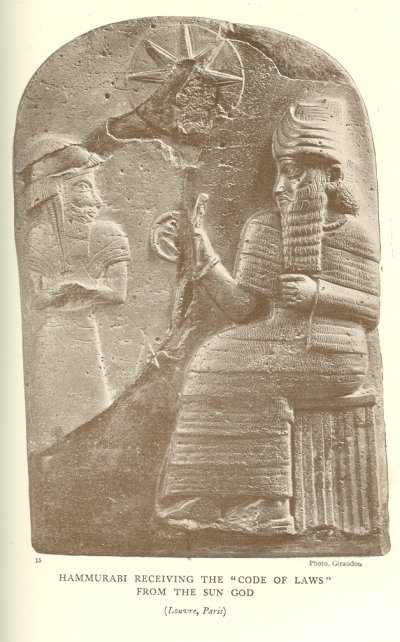
HAMMURABI RECEIVING THE ”CODE OF LAWS” FROM THE SUN GOD
(Louvre, Paris)
Photo. Giraudon
No traces have yet been found in Palestine of its conquest by the Elamites,
nor have the excavators been able to substantiate the claim of Lugal-zaggizi
of a previous age to have extended his empire to the shores of the Mediterranean.
Any relics which these and other eastern conquerors may have left were possibly
destroyed by the Egyptians and Hittites.
When Hammurabi came to the throne he had apparently to recognize the overlordship
of the Elamite king or his royal son at Larsa. Although Sin-muballit had captured
Isin, it was retaken, probably after the death of the Babylonian war-lord, by
Rim-Sin, who succeeded his brother Warad-Sin, and for a time held sway in Lagash,
Nippur, and Erech, as well as Larsa.
It was not until the thirty-first year of his reign that Hammurabi achieved
ascendancy over his powerful rival. Having repulsed an Elamite raid, which was
probably intended to destroy the growing power of Babylon, he “smote down Rim-Sin”,
whose power he reduced almost to vanishing point. For about twenty years afterwards
that subdued monarch lived in comparative obscurity; then he led a force of
allies against Hammurabi’s son and successor, Samsu-iluna, who defeated him
and put him to death, capturing, in the course of his campaign, the revolting
cities of Emutbalum, Erech, and Isin. So was the last smouldering ember of Elamite
power stamped out in Babylonia.
Hammurabi, statesman and general, is one of the great personalities of the
ancient world. No more celebrated monarch ever held sway in Western Asia. He
was proud of his military achievements, but preferred to be remembered as a
servant of the gods, a just ruler, a father of his people, and “the shepherd
that gives peace”. In the epilogue to his code of laws he refers to “the burden
of royalty”, and declares that he “cut off the enemy” and “lorded it over the
conquered” so that his subjects might have security. Indeed, his anxiety for
their welfare was the most pronounced feature of his character. “I carried all
the people of Sumer and Akkad in my bosom”, he declared in his epilogue. “By
my protection, I guided in peace its brothers. By my wisdom I provided for them.”
He set up his stele, on which the legal code was inscribed, so “that the great
should not oppress the weak” and “to counsel the widow and orphan”, and “to
succour the injured . . . The king that is gentle, king of the city, exalted
am I.”1
Hammurabi was no mere framer of laws but a practical administrator as well.
He acted as supreme judge, and his subjects could appeal to him as the Romans
could to Car. Nor was any case too trivial for his attention. The humblest
man was assured that justice would be done if his grievance were laid before
the king. Hammurabi was no respecter of persons, and treated alike all his subjects
high and low. He punished corrupt judges, protected citizens against unjust
governors, reviewed the transactions of moneylenders with determination to curb
extortionate demands, and kept a watchful eye on the operations of taxgatherers.
There can be little doubt but that he won the hearts of his subjects, who
enjoyed the blessings of just administration under a well-ordained political
system. He must also have endeared himself to them as an exemplary exponent
of religious tolerance. He respected the various deities in whom the various
groups of people reposed their faith, restored despoiled temples, and reendowed
them with characteristic generosity. By so doing he not only afforded the pious
full freedom and opportunity to perform their religious ordinances, but also
promoted the material welfare of his subjects, for the temples were centres
of culture and the priests were the teachers of the young. Excavators have discovered
at Sippar traces of a school which dates from the Hammurabi Dynasty. Pupils
learned to read and write, and received instruction in arithmetic and mensuration.
They copied historical tablets, practised the art of composition, and studied
geography.
Although there were many professional scribes, a not inconsiderable proportion
of the people of both sexes were able to write private and business letters.
Sons wrote from a distance to their fathers when in need of money then as now,
and with the same air of undeserved martyrdom and subdued but confident appeal.
One son indited a long complaint regarding the quality of the food he was given
in his lodgings. Lovers appealed to forgetful ladies, showing great concern
regarding their health. “Inform me how it fares with thee,” one wrote four thousand
years ago. “I went up to Babylon so that I might meet thee, but did not, and
was much depressed. Let me know why thou didst go away so that I may be made
glad. And do come hither. Ever have care of thy health, remembering me.” Even
begging-letter writers were not unknown. An ancient representative of this class
once wrote to his employer from prison. He expressed astonishment that he had
been arrested, and, having protested his innocence, he made touching appeal
for little luxuries which were denied to him, adding that the last consignment
which had been forwarded had never reached him.
Letters were often sent by messengers who were named, but there also appears
to have been some sort of postal system. Letter carriers, however, could not
have performed their duties without the assistance of beasts of burden. Papyri
were not used as in Egypt. Nor was ink required. Babylonian letters were shapely
little bricks resembling cushions. The angular alphabetical characters, bristling
with thorn-like projections, were impressed with a wedge-shaped stylus on tablets
of soft clay which were afterwards carefully baked in an oven. Then the letters
were placed in baked clay envelopes, sealed and addressed, or wrapped in pieces
of sacking transfixed by seals. If the ancient people had a festive season which
was regarded, like the European Yuletide or the Indian Durga fortnight, as an
occasion suitable for the general exchange of expressions of good-will, the
Babylonian streets and highways must have been greatly congested by the postal
traffic, while muscular postmen worked overtime distributing the contents of
heavy and bulky letter sacks. Door to door deliveries would certainly have presented
difficulties. Wood being dear, everyone could not afford doors, and some houses
were entered by stairways leading to the flat and partly open roofs.
King Hammurabi had to deal daily with a voluminous correspondence. He received
reports from governors in all parts of his realm, legal documents containing
appeals, and private communications from relatives and others. He paid minute
attention to details, and was probably one of the busiest men in Babylonia.
Every day while at home, after worshipping Merodach at E-sagila, he dictated
letters to his scribes, gave audiences to officials, heard legal appeals and
issued interlocutors, and dealt with the reports regarding his private estates.
He looks a typical man of affairs in sculptured representations–shrewd, resolute,
and unassuming, feeling “the burden of royalty”, but ever ready and well qualified
to discharge his duties with thoroughness and insight. His grasp of detail was
equalled only by his power to conceive of great enterprises which appealed to
his imagination. It was a work of genius on his part to weld together that great
empire of miscellaneous states extending from southern Babylonia to Assyria,
and from the borders of Elam to the Mediterranean coast, by a universal legal
Code which secured tranquillity and equal rights to all, promoted business,
and set before his subjects the ideals of right thinking and right living.
Hammurabi recognized that conquest was of little avail unless followed by
the establishment of a just and well-arranged political system, and the inauguration
of practical measures to secure the domestic, industrial, and commercial welfare
of the people as a whole. He engaged himself greatly, therefore, in developing
the natural resources of each particular district. The network of irrigating
canals was extended in the homeland so that agriculture might prosper: these
canals also promoted trade, for they were utilized for travelling by boat and
for the distribution of commodities. As a result of his activities Babylon became
not only the administrative, but also the commercial centre of his Empire–the
London of Western Asia–and it enjoyed a spell of prosperity which was never
surpassed in subsequent times. Yet it never lost its pre-eminent position despite
the attempts of rival states, jealous of its glory and influence, to suspend
its activities. It had been too firmly established during the Hammurabi Age,
which was the Golden Age of Babylonia, as the heartlike distributor and controller
of business life through a vast network of veins and arteries, to be displaced
by any other Mesopotamian city to pleasure even a mighty monarch. For two thousand
years, from the time of Hammurabi until the dawn of the Christian era, the city
of Babylon remained amidst many political changes the metropolis of Western
Asiatic commerce and culture, and none was more eloquent in its praises than
the scholarly pilgrim from Greece who wondered at its magnificence and reverenced
its antiquities.
Hammurabi’s reign was long as it was prosperous. There is no general agreement
as to when he ascended the throne–some say in 2123 B.C., others hold that it
was after 2000 B.C.–but it is certain that he presided over the destinies of
Babylon for the long period of forty-three years.
There are interesting references to the military successes of his reign in
the prologue to the legal Code. It is related that when he “avenged Larsa”,
the seat of Rim-Sin, he restored there the temple of the sun god. Other temples
were built up at various ancient centres, so that these cultural organizations
might contribute to the welfare of the localities over which they held sway.
At Nippur he thus honoured Enlil, at Eridu the god Ea, at Ur the god Sin, at
Erech the god Anu and the goddess Nana (Ishtar), at Kish the god Zamama and
the goddess Ma-ma, at Cuthah the god Nergal, at Lagash the god Nin-Girsu, while
at Adab and Akkad, “celebrated for its wide squares”, and other centres he carried
out religious and public works. In Assyria he restored the colossus of Ashur,
which had evidently been carried away by a conqueror, and he developed the canal
system of Nineveh.
Apparently Lagash and Adab had not been completely deserted during his reign,
although their ruins have not yielded evidence that they flourished after their
fall during the long struggle with the aggressive and plundering Elamites.
Hammurabi referred to himself in the Prologue as “a king who commanded obedience
in all the four quarters”. He was the sort of benevolent despot whom Carlyle
on one occasion clamoured vainly for–not an Oriental despot in the commonly
accepted sense of the term. As a German writer puts it, his despotism was a
form of Patriarchal Absolutism. “When Marduk (Merodach)”, as the great king
recorded, “brought me to direct all people, and commissioned me to give judgment,
I laid down justice and right in the provinces, I made all flesh to prosper.”1 That was the keynote of his long life; he regarded himself as the earthly representative
of the Ruler of all–Merodach, “the lord god of right”, who carried out the
decrees of Anu, the sky god of Destiny.
The next king, Samsu-iluna, reigned nearly as long as his illustrious father,
and similarly lived a strenuous and pious life. Soon after he came to the throne
the forces of disorder were let loose, but, as has been stated, he crushed and
slew his most formidable opponent, Rim-Sin, the Elamite king, who had gathered
together an army of allies. During his reign a Kassite invasion was repulsed.
The earliest Kassites, a people of uncertain racial affinities, began to settle
in the land during Hammurabi’s lifetime. Some writers connect them with the
Hittites, and others with the Iranians, vaguely termed as Indo-European or Indo-Germanic
folk. Ethnologists as a rule regard them as identical with the Coss, whom
the Greeks found settled between Babylon and Media, east of the Tigris and north
of Elam. The Hittites came south as raiders about a century later. It is possible
that the invading Kassites had overrun Elam and composed part of Rim-Sin’s army.
After settled conditions were secured many of them remained in Babylonia, where
they engaged like their pioneers in agricultural pursuits. No doubt they were
welcomed in that capacity, for owing to the continuous spread of culture and
the development of commerce, rural labour had become scarce and dear. Farmers
had a long-standing complaint, “The harvest truly is plenteous, but the labourers
are few”.1 “Despite the existence
of slaves, who were for the most part domestic servants, there was”, writes
Mr. Johns, “considerable demand for free labour in ancient Babylonia. This is
clear from the large number of contracts relating to hire which have come down
to us. . . . As a rule, the man was hired for the harvest and was free directly
after. But there are many examples in which the term of service was different–one
month, half a year, or a whole year. . . . Harvest labour was probably far dearer
than any other, because of its importance, the skill and exertion demanded,
and the fact that so many were seeking for it at once.” When a farm worker was
engaged he received a shekel for “earnest money” or arles, and was penalized
for non-appearance or late arrival.2
So great was the political upheaval caused by Rim-Sin and his allies and
imitators in southern Babylonia, that it was not until the seventeenth year
of his reign that Samsu-iluna had recaptured Erech and Ur and restored their
walls. Among other cities which had to be chastised was ancient Akkad, where
a rival monarch endeavoured to establish himself. Several years were afterwards
spent in building new fortifications, setting up memorials in temples, and cutting
and clearing canals. On more than one occasion during the latter part of his
reign he had to deal with aggressive bands of Amorites.
The greatest danger to the Empire, however, was threatened by a new kingdom
which had been formed in Bit-Jakin, a part of Sealand which was afterwards controlled
by the mysterious Chaldeans. Here may have collected evicted and rebel bands
of Elamites and Sumerians and various “gentlemen of fortune” who were opposed
to the Hammurabi regime. After the fall of Rim-Sin it became powerful under
a king called Ilu-ma-ilu. Samsu-iluna conducted at least two campaigns against
his rival, but without much success. Indeed, he was in the end compelled to
retreat with considerable loss owing to the difficult character of that marshy
country.
Abeshu, the next Babylonian king, endeavoured to shatter the cause of the
Sealanders, and made it possible for himself to strike at them by damming up
the Tigris canal. He achieved a victory, but the wily Ilu-ma-ilu eluded him,
and after a reign of sixty years was succeeded by his son, Kiannib. The Sealand
Dynasty, of which little is known, lasted for over three and a half centuries,
and certain of its later monarchs were able to extend their sway over part of
Babylonia, but its power was strictly circumscribed so long as Hammurabi’s descendants
held sway.
During Abeshu’s reign of twenty-eight years, of which but scanty records
survive, he appears to have proved an able statesman and general. He founded
a new city called Lukhaia, and appears to have repulsed a Kassite raid.
His son, Ammiditana, who succeeded him, apparently inherited a prosperous
and well-organized Empire, for during the first fifteen years of his reign he
attended chiefly to the adornment of temples and other pious undertakings. He
was a patron of the arts with archlogical leanings, and displayed traits which
suggest that he inclined, like Sumu-la-ilu, to ancestor worship. Entemena, the
pious patesi of Lagash, whose memory is associated with the famous silver vase
decorated with the lion-headed eagle form of Nin-Girsu, had been raised to the
dignity of a god, and Ammiditana caused his statue to be erected so that offerings
might be made to it. He set up several images of himself also, and celebrated
the centenary of the accession to the throne of his grandfather, Samsu-iluna,
“the warrior lord”, by unveiling his statue with much ceremony at Kish. About
the middle of his reign he put down a Sumerian rising, and towards its close
had to capture a city which is believed to be Isin, but the reference is too
obscure to indicate what political significance attached to this incident. His
son, Ammizaduga, reigned for over twenty years quite peacefully so far as is
known, and was succeeded by Samsuditana, whose rule extended over a quarter
of a century. Like Ammiditana, these two monarchs set up images of themselves
as well as of the gods, so that they might be worshipped, no doubt. They also
promoted the interests of agriculture and commerce, and incidentally increased
the revenue from taxation by paying much attention to the canals and extending
the cultivatable areas.
But the days of the brilliant Hammurabi Dynasty were drawing to a close.
It endured for about a century longer than the Twelfth Dynasty of Egypt, which
came to an end, according to the Berlin calculations, in 1788 B.C. Apparently
some of the Hammurabi and Amenemhet kings were contemporaries, but there is
no evidence that they came into direct touch with one another. It was not until
at about two centuries after Hammurabi’s day that Egypt first invaded Syria,
with which, however, it had for a long period previously conducted a brisk trade.
Evidently the influence of the Hittites and their Amoritic allies predominated
between Mesopotamia and the Delta frontier of Egypt, and it is significant to
find in this connection that the “Khatti” or “Hatti” were referred to for the
first time in Egypt during the Twelfth Dynasty, and in Babylonia during the
Hammurabi Dynasty, sometime shortly before or after 2000 B.C. About 1800 B.C.
a Hittite raid resulted in overthrow of the last king of the Hammurabi family
at Babylon. The Hyksos invasion of Egypt took place after 1788 B.C.
Footnotes
245:1 Genesis,
xii and xiii.
246:1 Genesis,
xiv, 13.
246:2 Ibid., xxiii.
246:3 Ezekiel,
xvi, 3.
247:1 Genesis,
xiv, 1-4.
247:2 Ibid., 5-24.
250:1 Babylonian and
Assyrian Laws, Contracts, and Letters, C. H. W. Johns, pp. 392 et seq.
255:1 Translation by
Johns in Babylonian and Assyrian Laws, Contracts, and Letters, pp. 390
et seq.
256:1 Matthew,
ix, 37.
256:2 Johns’s Babylonian
and Assyrian Laws, &c., pp. 371-2.
Next: Chapter XII. Rise of the Hittites, Mitannians,
Kassites, Hyksos, and Assyrians

Leave A Comment