
CHAPTER XII
Rise of the Hittites, Mitannians, Kassites, Hyksos, and Assyrians
The War God of Mountaineers–Antiquity of Hittite Civilization–Prehistoric
Movements of “Broad Heads”–Evidence of Babylon and Egypt–Hittites and Mongolians–Biblical
References to Hittites in Canaan–Jacob’s Mother and her Daughters-in-law–Great
Father and Great Mother Cults–History in Mythology–The Kingdom of Mitanni–Its
Aryan Aristocracy–The Hyksos Problem–The Horse in Warfare–Hittites and Mitannians–Kassites
and Mitannians–Hyksos Empire in Asia–Kassites overthrow Sealand Dynasty–Egyptian
Campaigns in Syria–Assyria in the Making–Ethnics of Genesis–Nimrod as Merodach–Early
Conquerors of Assyria–Mitannian Overlords–Tell-el-Amarna Letters–Fall of
Mitanni–Rise of Hittite and Assyrian Empires–Egypt in Eclipse–Assyrian and
Babylonian Rivalries.
WHEN the Hammurabi Dynasty, like the Twelfth Dynasty of Egypt, is found to
be suffering languid decline, the gaps in the dulled historical records are
filled with the echoes of the thunder god, whose hammer beating resounds among
the northern mountains. As this deity comes each year in Western Asia when vegetation
has withered and after fruits have dropped from trees, bringing tempests and
black rainclouds to issue in a new season of growth and fresh activity, so he
descended from the hills in the second millennium before the Christian era as
the battle lord of invaders and the stormy herald of a new age which was to
dawn upon the ancient world.
He was the war god of the Hittites as well as of the northern Amorites, the Mitannians, and the Kassites; and he led the Aryans
from the Iranian steppes towards the verdurous valley of the Punjab. His worshippers
engraved his image with grateful hands on the beetling cliffs of Cappadocian
chasms in Asia Minor, where his sway was steadfast and pre-eminent for long
centuries. In one locality he appears mounted on a bull wearing a fringed and
belted tunic with short sleeves, a conical helmet, and upturned shoes, while
he grasps in one hand the lightning symbol, and in the other a triangular bow
resting on his right shoulder. In another locality he is the bringer of grapes
and barley sheaves. But his most familiar form is the bearded and thick-set
mountaineer, armed with a ponderous thunder hammer, a flashing trident, and
a long two-edged sword with a hemispherical knob on the hilt, which dangles
from his belt, while an antelope or goat wearing a pointed tiara prances beside
him. This deity is identical with bluff, impetuous Thor of northern Europe,
Indra of the Himalayas, Tarku of Phrygia, and Teshup or Teshub of Armenia and
northern Mesopotamia, Sandan, the Hercules of Cilicia, Adad or Hadad of Amurru
and Assyria, and Ramman, who at an early period penetrated Akkad and Sumer in
various forms. His Hittite name is uncertain, but in the time of Rameses II
he was identified with Sutekh (Set). He passed into southern Europe as Zeus,
and became “the lord” of the deities of the ean and Crete.
The Hittites who entered Babylon about 1800 B.C., and overthrew the last
king of the Hammurabi Dynasty, may have been plundering raiders, like the European
Gauls of a later age, or a well-organized force of a strong, consolidated power,
which endured for a period of uncertain duration. They were probably the latter,
for although they carried off Merodach and Zerpanitu, these idols were not thrust into the melting pot, but retained apparently for political
reasons.
These early Hittites are “a people of the mist”. More than once in ancient
history casual reference is made to them; but on most of these occasions they
soon vanish suddenly behind their northern mountains. The explanation appears
to be that at various periods great leaders arose who were able to weld together
the various tribes, and make their presence felt in Western Asia. But when once
the organization broke down, either on account of internal rivalries or the
influence of an outside power, they lapsed back again into a state of political
insignificance in the affairs of the ancient world. It is possible that about
1800 B.C. the Hittite confederacy was controlled by an ambitious king who had
dreams of a great empire, and was accordingly pursuing a career of conquest.
Judging from what we know of the northern worshippers of the hammer god in
later times, it would appear that when they were referred to as the Hatti or
Khatti, the tribe of that name was the dominating power in Asia Minor and north
Syria. The Hatti are usually identified with the broad-headed mountaineers of
Alpine or Armenoid type–the ancestors of the modern Armenians. Their ancient
capital was at Boghaz-Kai, the site of Pteria, which was destroyed, according
to the Greeks, by Crsus, the last King of Lydia, in the sixth century B.C.
It was strongly situated in an excellent pastoral district on the high, breezy
plateau of Cappadocia, surrounded by high mountains, and approached through
narrow river gorges, which in winter were blocked with snow.
Hittite civilization was of great antiquity. Excavations which have been
conducted at an undisturbed artificial mound at Sakje-Geuzi have revealed evidences of a continuous culture which
began to flourish before 3000 B.C.1 In one of the lower layers occurred that particular type of Neolithic yellow-painted
pottery, with black geometric designs, which resembles other specimens of painted
fabrics found in Turkestan by the Pumpelly expedition; in Susa, the capital
of Elam, and its vicinity, by De Morgan; in the Balkan peninsula by Schliemann;
in a First Dynasty tomb at Abydos in Egypt by Petrie; and in the late Neolithic
and early Bronze Age (Minoan) strata of Crete by Evans. It may be that these
interesting relics were connected with the prehistoric drift westward of the
broad-headed pastoral peoples who ultimately formed the Hittite military aristocracy.
According to Professor Elliot Smith, broad-headed aliens from Asia Minor
first reached Egypt at the dawn of history. There they blended with the indigenous
tribes of the Mediterranean or Brown Race. A mesocephalic skull then became
common. It is referred to as the Giza type, and has been traced by Professor
Elliot Smith from Egypt to the Punjab, but not farther into India.2
During the early dynasties this skull with alien traits was confined chiefly
to the Delta region and the vicinity of Memphis, the city of the pyramid builders.
It is not improbable that the Memphite god Ptah may have been introduced into
Egypt by the invading broad heads. This deity is a world artisan like Indra,
and is similarly associated with dwarfish artisans; he hammers out the copper
sky, and therefore links with the various thunder gods–Tarku, Teshup, Adad,
Ramman, &c., of the Asian mountaineers. Thunderstorms were of too rare occurrence
in Egypt to be connected with the food supply, which has always depended on the river Nile. Ptah’s purely Egyptian characteristics
appear to have been acquired after fusion with Osiris-Seb, the Nilotic gods
of inundation, earth, and vegetation. The ancient god Set (Sutekh), who became
a demon, and was ultimately re-exalted as a great deity during the Nineteenth
Dynasty, may also have had some connection with the prehistoric Hatti.
Professor Elliot Smith, who has found alien traits in the mummies of the
Rameses kings, is convinced that the broad-headed folks who entered Europe by
way of Asia Minor, and Egypt through the Delta, at the close of the Neolithic
Age, represent “two streams of the same Asiatic folk”.1 The opinion of such an authority cannot be lightly set aside.
The earliest Egyptian reference to the Kheta, as the Hittites were called,
was made in the reign of the first Amenemhet of the Twelfth Dynasty, who began
to reign about 2000 B.C. Some authorities, including Maspero,2 are of opinion that the allusion to the Hatti which is found in the Babylonian
Book of Omensbelongs to the earlier age of Sargon of Akkad and Naram-Sin,
but Sayce favours the age of Hammurabi. Others would connect the Gutium, or
men of Kutu, with the Kheta or Hatti. Sayce has expressed the opinion that the
Biblical Tidal, identified with Tudkhul or Tudhula, “king of nations”, the ally
of Arioch, Amraphel, and Chedor-laomer, was a Hittite king, the “nations” being
the confederacy of Asia Minor tribes controlled by the Hatti. “In the fragments
of the Babylonian story of Chedor-laomer published by Dr. Pinches”, says Professor
Sayce, “the name of Tidcal is written Tudkhul, and he is described
as King of the Umman Manda, or Nations of the North, of which the Hebrew Goyyimis a literal translation. Now the name
is Hittite. In the account of the campaign of Rameses II against the Hittites
it appears as Tidcal, and one of the Hittite kings of Boghaz-K bears the same
name, which is written as Dud-khaliya in cuneiform.1
One of the racial types among the Hittites wore pigtails. These head adornments
appear on figures in certain Cappadocian sculptures and on Hittite warriors
in the pictorial records of a north Syrian campaign of Rameses II at Thebes.
It is suggestive, therefore, to find that on the stele of Naram-Sin of Akkad,
the mountaineers who are conquered by that battle lord wear pig-tails also.
Their split robes are unlike the short fringed tunics of the Hittite gods, but
resemble the long split mantles worn over their tunics by high dignitaries like
King Tarku-dimme, who figures on a famous silver boss of an ancient Hittite
dagger. Naram-Sin inherited the Empire of Sargon of Akkad, which extended to
the Mediterranean Sea. If his enemies were not natives of Cappadocia, they may
have been the congeners of the Hittite pigtailed type in another wooded and
mountainous country.
It has been suggested that these wearers of pigtails were Mongolians. But
although high cheek bones and oblique eyes occurred in ancient times, and still
occur, in parts of Asia Minor, suggesting occasional Mongolian admixture with
Ural-Altaic broad heads, the Hittite pig-tailed warriors must not be confused
with the true small-nosed Mongols of north-eastern Asia. The Egyptian sculptors
depicted them with long and prominent noses, which emphasize their strong Armenoid
affinities.
Other tribes in the Hittite confederacy included the representatives of the earliest settlers from North Africa of Mediterranean
racial stock. These have been identified with the Canaanites, and especially
the agriculturists among them, for the Palestinian Hittites are also referred
to as Canaanites in the Bible, and in one particular connection under circumstances
which afford an interesting glimpse of domestic life in those far-off times.
When Esau, Isaac’s eldest son, was forty years of age, “he took to wife Judith
the daughter of Beeri the Hittite, and Bashemath the daughter of Elon the Hittite”1 .
Apparently the Hittite ladies considered themselves to be of higher caste than
the indigenous peoples and the settlers from other countries, for when Ezekiel
declared that the mother of Jerusalem was a Hittite he said: “Thou art thy mother’s
daughter, that lotheth her husband and her children.”2 Esau’s marriage was “a grief of mind unto Isaac and to Rebekah”.1 The Hebrew mother seems to have entertained fears that her favourite son Jacob
would fall a victim to the allurements of other representatives of the same
stock as her superior and troublesome daughters-in-law, for she said to Isaac:
“I am weary of my life because of the daughters of Heth; if Jacob take a wife
of the daughters of Heth, such as these which are of the daughters of the land,
what good shall my life do me?”3 Isaac sent for Jacob, “and charged him, and said unto him, Thou shalt not take
a wife of the daughters of Canaan. Arise, go to Padan-aram, to the house of
Bethuel, thy mother’s father; and take thee a wife from thence of the daughters
of Laban, thy mother’s brother.”4 From these quotations two obvious deductions may be drawn: the Hebrews regarded
the Hittites “of the land” as one with the Canaanites, the stocks having probably been so well fused, and the worried Rebekah had the choosing of Jacob’s wife
or wives from among her own relations in Mesopotamia who were of Sumerian stock
and kindred of Abraham.1 It is not surprising to find traces of Sumerian pride among the descendants
of the evicted citizens of ancient Ur, especially when brought into association
with the pretentious Hittites.
Evidence of racial blending in Asia Minor is also afforded by Hittite mythology.
In the fertile agricultural valleys and round the shores of that great Eur-Asian
“land bridge” the indigenous stock was also of the Mediterranean race, as Sergi
and other ethnologists have demonstrated. The Great Mother goddess was worshipped
from the earliest times, and she bore various local names. At Comana in Pontus
she was known to the Greeks as Ma, a name which may have been as old as that
of the Sumerian Mama (the creatrix), or Mamitu (goddess of destiny);
in Armenia she was Anaitis; in Cilicia she was Ate (Atheh of Tarsus); while
in Phrygia she was best known as Cybele, mother of Attis, who links with Ishtar
as mother and wife of Tammuz, Aphrodite as mother and wife of Adonis, and Isis
as mother and wife of Osiris. The Great Mother was in Phoenicia called Astarte;
she was a form of Ishtar, and identical with the Biblical Ashtoreth. In the
Syrian city of Hierapolis she bore the name of Atargatis, which Meyer, with
whom Frazer agrees, considers to be the Greek rendering of the Aramaic Athar-Atheh–the
god Athar and the goddess Atheh. Like the “bearded Aphrodite”, Atargatis may
have been regarded as a bisexual deity. Some of the specialized mother goddesses,
whose outstanding attributes reflected the history and politics of the states
they represented, were imported into Egypt–the land of ancient mother deities–during the Empire period, by the half-foreign Rameses
kings; these included the voluptuous Kadesh and the warlike Anthat. In every
district colonized by the early representatives of the Mediterranean race, the
goddess cult came into prominence, and the gods and the people were reputed
to be descendants of the great Creatrix. This rule obtained as far distant as
Ireland, where the Danann folk and the Danann gods were the children of the
goddess Danu.
Among the Hatti proper–that is, the broad-headed military aristocracy–the
chief deity of the pantheon was the Great Father, the creator, “the lord of
Heaven”, the Baal. As Sutekh, Tarku, Adad, or Ramman, he was the god of thunder,
rain, fertility, and war, and he ultimately acquired solar attributes. A famous
rock sculpture at Boghaz-K depicts a mythological scene which is believed
to represent the Spring marriage of the Great Father and the Great Mother, suggesting
a local fusion of beliefs which resulted from the union of tribes of the god
cult with tribes of the goddess cult. So long as the Hatti tribe remained the
predominant partner in the Hittite confederacy, the supremacy was assured of
the Great Father who symbolized their sway. But when, in the process of time,
the power of the Hatti declined, their chief god “fell . . . from his predominant
place in the religion of the interior”, writes Dr. Garstang. “But the Great
Mother lived on, being the goddess of the land.”1
In addition to the Hittite confederacy of Asia Minor and North Syria, another
great power arose in northern Mesopotamia. This was the Mitanni Kingdom. Little
is known regarding it, except what is derived from indirect sources. Winckler
believes that it was first established by early “waves” of Hatti people who migrated from the east.
The Hittite connection is based chiefly on the following evidence. One of
the gods of the Mitanni rulers was Teshup, who is identical with Tarku, the
Thor of Asia Minor. The raiders who in 1800 B.C. entered Babylon, set fire to
E-sagila, and carried off Merodach and his consort Zerpanitum, were
called the Hatti. The images of these deities were afterwards obtained from
Khani (Mitanni).
At a later period, when we come to know more about Mitanni from the letters
of one of its kings to two Egyptian Pharaohs, and the Winckler tablets from
Boghaz-K, it is found that its military aristocracy spoke an Indo-European
language, as is shown by the names of their kings–Saushatar, Artatama, Sutarna,
Artashshumara, Tushratta, and Mattiuza. They worshipped the following deities:
Mi-it-ra, Uru-w-na, In-da-ra, and Na-sa-at-ti-ia–
Mitra, Varuna, Indra, and Nasatyau (the “Twin Aswins” = Castor and Pollux)–whose
names have been deciphered by Winckler. These gods were also imported into India
by the Vedic Aryans. The Mitanni tribe (the military aristocracy probably) was
called “Kharri”, and some philologists are of opinion that it is identical with
“Arya”, which was “the normal designation in Vedic literature from the Rigveda
onwards of an Aryan of the three upper classes”.1 Mitanni signifies “the river lands”, and the descendants of its inhabitants,
who lived in Cappadocia, were called by the Greeks “Mattienoi”. “They are possibly”,
says Dr. Haddon, “the ancestors of the modern Kurds”,1 a conspicuously long-headed people, proverbial, like the ancient Aryo-Indians
and the Gauls, for their hospitality and their raiding propensities.
It would appear that the Mitannian invasion of northern Mesopotamia and the
Aryan invasion of India represented two streams of diverging migrations from
a common cultural centre, and that the separate groups of wanderers mingled
with other stocks with whom they came into contact. Tribes of Aryan speech were
associated with the Kassite invaders of Babylon, who took possession of northern
Babylonia soon after the disastrous Hittite raid. It is believed that they came
from the east through the highlands of Elam.
For a period, the dating of which is uncertain, the Mitannians were overlords
of part of Assyria, including Nineveh and even Asshur, as well as the district
called “Musri” by the Assyrians, and part of Cappadocia. They also occupied
the cities of Harran and Kadesh. Probably they owed their great military successes
to their cavalry. The horse became common in Babylon during the Kassite Dynasty,
which followed the Hammurabi, and was there called “the ass of the east”, a
name which suggests whence the Kassites and Mitannians came.
The westward movement of the Mitannians in the second millennium B.C. may
have been in progress prior to the Kassite conquest of Babylon and the Hyksos
invasion of Egypt. Their relations in Mesopotamia and Syria with the Hittites
and the Amorites are obscure. Perhaps they were for a time the overlords of
the Hittites. At any rate it is of interest to note that when Thothmes III struck
at the last Hyksos stronghold during his long Syrian campaign of about twenty
years’ duration, his operations were directly against Kadesh on the Orontes, which was then held
by his fierce enemies the Mitannians of Naharina.1
 click to enlarge
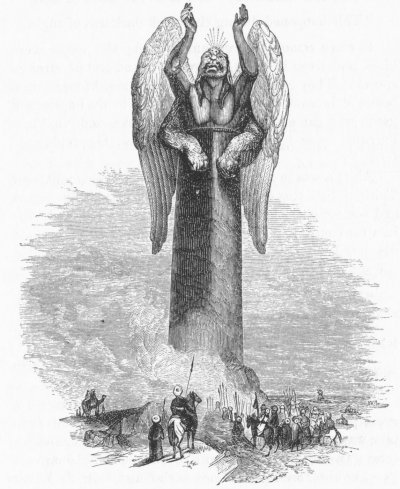
THE HORSE IN WARFARE
Marble slab showing Ashur-natsir-pal and army advancing against a besieged tow.
A battering ram is being drawn on a six-wheeled carriage.
From N.W. Palace of Nimroud: now in the British Museum.
Photo. Mansell
During the Hyksos Age the horse was introduced into Egypt. Indeed the Hyksos
conquest was probably due to the use of the horse, which was domesticated, as
the Pumpelly expedition has ascertained, at a remote period in Turkestan, whence
it may have been obtained by the horse-sacrificing Aryo-Indians and the horse-sacrificing
ancestors of the Siberian Buriats.
If the Mitanni rulers were not overlords of the Hittites about 1800 B.C.,
the two peoples may have been military allies of the Kassites. Some writers
suggest, indeed, that the Kassites came from Mitanni. Another view is that the
Mitannians were the Aryan allies of the Kassites who entered Babylon from the
Elamite highlands, and that they afterwards conquered Mesopotamia and part of
Cappadocia prior to the Hyksos conquest of Egypt. A third solution of the problem
is that the Aryan rulers of the Mitannian Hittites were the overlords of northern
Babylonia, which they included in their Mesopotamian empire for a century before
the Kassites achieved political supremacy in the Tigro-Euphrates valley, and
that they were also the leaders of the Hyksos invasion of Egypt, which they
accomplished with the assistance of their Hittite and Amoritic allies.
The first Kassite king of Babylonia of whom we have knowledge was Gandash.
He adopted the old Akkadian title, “king of the four quarters”, as well as the
title “king of Sumer and Akkad”, first used by the rulers of the Dynasty of
Ur. Nippur appears to have been selected by Gandash as his capital, which suggests
that his war and storm god, Shuqamuna, was identified with Bel Enlil, who as a “world giant” has much in common with the northern hammer gods. After
reigning for sixteen years, Gandash was succeeded by his son, Agum the Great,
who sat on the throne for twenty-two years. The great-grandson of Agum the Great
was Agum II, and not until his reign were the statues of Merodach and his consort
Zerpanitumbrought back to the city of Babylon. This monarch recorded
that, in response to the oracle of Shamash, the sun god, he sent to the distant
land of Khani (Mitanni) for the great deity and his consort. Babylon would therefore
appear to have been deprived of Merodach for about two centuries. The Hittite-Mitanni
raid is dated about 1800 B.C., and the rise of Gandash, the Kassite, about 1700
B.C. At least a century elapsed between the reigns of Gandash and Agum II. These
calculations do not coincide, it will be noted, with the statement in a Babylonian
hymn, that Merodach remained in the land of the Hatti for twenty-four years,
which, however, may be either a priestly fiction or a reference to a later conquest.
The period which followed the fall of the Hammurabi Dynasty of Babylonia is
as obscure as the Hyksos Age of Egypt.
Agum II, the Kassite king, does not state whether or not he waged war against
Mitanni to recover Babylon’s god Merodach. If, however, he was an ally of the
Mitanni ruler, the transference of the deity may have been an ordinary diplomatic
transaction. The possibility may also be suggested that the Hittites of Mitanni
were not displaced by the Aryan military aristocracy until after the Kassites
were firmly established in northern Babylonia between 1700 B.C. and i 600 B.C.
This may account for the statements that Merodach was carried off by the Hatti
and returned from the land of Khani.
The evidence afforded by Egypt is suggestive in this connection. There was a second Hyksos Dynasty in that country. The later
rulers became “Egyptianized” as the Kassites became “Babylonianized”, but they
were all referred to by the exclusive and sullen Egyptians as “barbarians” and
“Asiatics”. They recognized the sun god of Heliopolis, but were also concerned
in promoting the worship of Sutekh, a deity of sky and thunder, with solar attributes,
whom Rameses II identified with the “Baal” of the Hittites. The Mitannians,
as has been stated, recognized a Baal called Teshup, who was identical with
Tarku of the Western Hittites and with their own tribal Indra also. One of the
Hyksos kings, named Ian or Khian, the Ianias of Manetho, was either an overlord
or the ally of an overlord, who swayed a great empire in Asia. His name has
been deciphered on relics found as far apart as Knossos in Crete and Baghdad
on the Tigris, which at the time was situated within the area of Kassite control.
Apparently peaceful conditions prevailed during his reign over a wide extent
of Asia and trade was brisk between far-distant centres of civilization. The
very term Hyksos is suggestive in this connection. According to Breasted it
signifies “rulers of countries”, which compares with the Biblical “Tidal king
of nations”, whom Sayce, as has been indicated, regards as a Hittite monarch.
When the Hittite hieroglyphics have been read and Mesopotamia thoroughly explored,
light may be thrown on the relations of the Mitannians, the Hittites, the Hyksos,
and the Kassites between 1800 B.C. and 1500 B.C. It is evident that a fascinating
volume of ancient history has yet to be written.
The Kassites formed the military aristocracy of Babylonia, which was called
Karduniash, for nearly six centuries. Agum II was the first of their kings who
became thoroughly Babylonianized, and although he still gave recognition to Shuqamuna, the Kassite god of battle, he re-exalted Merodach,
whose statue he had taken back from “Khani”, and decorated E-sagila with gifts
of gold, jewels, rare woods, frescoes, and pictorial tiles; he also re-endowed
the priesthood. During the reign of his successor, Burnaburiash I, the Dynasty
of Sealand came to an end.
Little is known regarding the relations between Elam and Babylonia during
the Kassite period. If the Kassite invaders crossed the Tigris soon after the
raid of the Mitannian Hittites they must have previously overrun a great part
of Elam, but strongly situated Susa may have for a time withstood their attacks.
At first the Kassites held northern Babylonia only, while the ancient Sumerian
area was dominated by the Sealand power, which had gradually regained strength
during the closing years of the Hammurabi Dynasty. No doubt many northern Babylonian
refugees reinforced its army.
The Elamites, or perhaps the Kassites of Elam, appear to have made frequent
attacks on southern Babylonia. At length Ea-gamil, king of Sealand, invaded
Elam with purpose, no doubt, to shatter the power of his restless enemies. He
was either met there, however, by an army from Babylon, or his country was invaded
during his absence. Prince Ulamburiash, son of Burnaburiash I, defeated Ea-gamil
and brought to an end the Sealand Dynasty which had been founded by Ilu-ma-ilu,
the contemporary and enemy of Samsu-la-ilu, son of Hammurabi. Ulamburiash is
referred to on a mace-head which was discovered at Babylon as “king of Sealand”,
and he probably succeeded his father at the capital. The whole of Babylonia
thus came under Kassite sway.
Agum III, a grandson of Ulamburiash, found it necessary, however, to invade
Sealand, which must therefore have revolted. It was probably a centre of discontent during the
whole period of Kassite ascendancy.
After a long obscure interval we reach the period when the Hyksos power was
broken in Egypt, that is, after 1580 B.C. The great Western Asiatic kingdoms
at the time were the Hittite, the Mitannian, the Assyrian, and the Babylonian
(Kassite). Between 1557 B.C. and 1501 B.C. Thothmes I of Egypt was asserting
his sway over part of Syria. Many years elapsed, however, before Thothmes III,
who died in 1447 B.C., established firmly, after waging a long war of conquest,
the supremacy of Egypt between the Euphrates and the Mediterranean coast as
far north as the borders of Asia Minor.
“At this period”, as Professor Flinders Petrie emphasizes, “the civilization
of Syria was equal or superior to that of Egypt.” Not only was there in the
cities “luxury beyond that of the Egyptians”, but also “technical work which
could teach them”. The Syrian soldiers had suits of scale armour, which afterwards
were manufactured in Egypt, and they had chariots adorned with gold and silver
and highly decorated, which were greatly prized by the Egyptians when they captured
them, and reserved for royalty. “In the rich wealth of gold and silver vases”,
obtained from captured cities by the Nilotic warriors, “we see also”, adds Petrie,
“the sign of a people who were their (the Egyptians) equals, if not their superiors
in taste and skill.”1 It is not to be wondered at, therefore, when the Pharaohs received tribute from
Syria that they preferred it to be carried into Egypt by skilled workmen. “The
keenness with which the Egyptians record all the beautiful and luxurious products
of the Syrians shows that the workmen would probably be more in demand than other kinds of slave tribute.”1
One of the monarchs with whom Thothmes III corresponded was the king of Assyria.
The enemies of Egypt in northern Mesopotamia were the Hittites and Mitannians,
and their allies, and these were also the enemies of Assyria. But to enable
us to deal with the new situation which was created by Egypt in Mesopotamia,
it is necessary in the first place to trace the rise of Assyria, which was destined
to become for a period the dominating power in Western Asia, and ultimately
in the Nile valley also.
The Assyrian group of cities grew up on the banks of the Tigris to the north
of Babylonia, the mother country. The following Biblical references regarding
the origins of the two states are of special interest:–
Now these are the generations of the sons of Noah: Shem,
Ham, and Japheth. . . . The sons of Ham: Cush, and Mizraim, and Phut, and Canaan.
. . . And Cush begat Nimrod; he began to be a mighty one in the earth. He was
a mighty hunter before the Lord; wherefore it is said, Even as Nimrod the mighty
hunter before the Lord. And the beginning of his kingdom was Babel, and Erech,
and Accad, and Calneh, in the land of Shinar. Out of that land went forth Asshur
and builded Nineveh, and the city Rehoboth, and Calah, and Resen between Nineveh
and Calah: the same is a great city.
The children of Shem: Elam and Asshur . . . (Genesis, x, 1-22).
The land of Assyria . . . and the land of Nimrod in the entrances thereof
(Micah, v, 6).
It will be observed that the Sumero-Babylonians are Cushites or Hamites,
and therefore regarded as racially akin to the proto-Egyptians of the Mediterranean
race–an interesting confirmation of recent ethnological conclusions.
Nimrod, the king of Babel (Babylon), in Shinar (Sumer), was, it would appear,
a deified monarch who became ultimately identified with the national god of
Babylonia. Professor Pinches has shown1 that his name is a rendering of that of Merodach. In Sumerian Merodach was called
Amaruduk or Amarudu, and in the Assyro-Babylonian language Marduk. By a process
familiar to philologists the suffix “uk” was dropped and the rendering became
Marad. The Hebrews added “ni” =”ni-marad”, assimilating the name “to a certain
extent to the ‘niphal forms’ of the Hebrew verbs and making a change”, says
Pinches, “in conformity with the genius of the Hebrew language”.
Asshur, who went out of Nimrod’s country to build Nineveh, was a son of Shem–a
Semite, and so far as is known it was after the Semites achieved political supremacy
in Akkad that the Assyrian colonies were formed. Asshur may have been a subject
ruler who was deified and became the god of the city of Asshur, which probably
gave its name to Assyria.
According to Herodotus, Nineveh was founded by King Ninus and Queen Semiramis.
This lady was reputed to be the daughter of Derceto, the fish goddess, whom
Pliny identified with Atargatis. Semiramis was actually an Assyrian queen of
revered memory. She was deified and took the place of a goddess, apparently
Nina, the prototype of Derceto. This Nina, perhaps a form of Damkina, wife of
Ea, was the great mother of the Sumerian city of Nina, and there, and also at
Lagash, received offerings of fish. She was one of the many goddesses of maternity
absorbed by Ishtar. The Greek Ninus is regarded as a male form of her name;
like
Atargatis, she may have become a bisexual deity, if she was not always accompanied
by a shadowy male form. Nineveh (Ninua) was probably founded or conquered by
colonists from Nina or Lagash, and called after the fish goddess.
All the deities of Assyria were imported from Babylonia except, as some hold,
Ashur, the national god.1 The theory that Ashur was identical with the Aryo-Indian Asura and the Persian
Ahura is not generally accepted. One theory is that he was an eponymous hero
who became the city god of Asshur, although the early form of his name, Ashir,
presents a difficulty in this connection. Asshur was the first capital of Assyria.
Its city god may have become the national god on that account.
At an early period, perhaps a thousand years before Thothmes III battled
with the Mitannians in northern Syria, an early wave of one of the peoples of
Aryan speech may have occupied the Assyrian cities. Mr. Johns points out in
this connection that the names of Ushpia, Kikia, and Adasi, who, according to
Assyrian records, were early rulers in Asshur, “are neither Semitic nor Sumerian”.
An ancient name of the goddess of Nineveh was Shaushka, which compares with
Shaushkash, the consort of Teshup, the Hittite-Mitanni hammer god. As many of
the Mitannian names “are”, according to Mr. Johns, “really Elamitic”, he suggests
an ethnic connection between the early conquerors of Assyria and the people
of Elam.2 Were
the pre-Semitic Elamites originally speakers of an agglutinative language, like
the Sumerians and present-day Basques, who were conquered in prehistoric times
by a people of Aryan speech?
The possibility is urged by Mr. Johns’s suggestion that Assyria may have
been dominated in pre-Semitic times by the congeners of the Aryan military aristocracy
of Mitanni. As has been shown, it was Semitized by the Amoritic migration which,
about 2000 B.C., brought into prominence the Hammurabi Dynasty of Babylon.
A long list of kings with Semitic names held sway in the Assyrian cities
during and after the Hammurabi Age. But not until well on in the Kassite period
did any of them attain prominence in Western Asia. Then Ashur-bel-nish-eshu,
King of Asshur, was strong enough to deal on equal terms with the Kassite ruler
Kara-indash I, with whom he arranged a boundary treaty. He was a contemporary
of Thothmes III of Egypt.
After Thothmes III had secured the predominance of Egypt in Syria and Palestine
he recognized Assyria as an independent power, and supplied its king with Egyptian
gold to assist him, no doubt, in strengthening his territory against their common
enemy. Gifts were also sent from Assyria to Egypt to fan the flame of cordial
relations.
The situation was full of peril for Saushatar, king of Mitanni. Deprived
by Egypt of tribute-paying cities in Syria, his exchequer must have been sadly
depleted. A standing army had to be maintained, for although Egypt made no attempt
to encroach further on his territory, the Hittites were ever hovering on his
north-western frontier, ready when opportunity offered to win back Cappadocia.
Eastward, Assyria was threatening to become a dangerous rival. He had himself
to pay tribute to Egypt, and Egypt was subsidizing his enemy. It was imperative
on his part, therefore, to take action without delay. The power of Assyria had
to be crippled; its revenues were required for the Mitannian exchequer. So
Saushatar raided Assyria during the closing years of the reign of Thothmes III,
or soon after his successor, Amenhotep II, ascended the Egyptian throne.
Nothing is known from contemporary records regarding this campaign; but it
can be gathered from the references of a later period that the city of Asshur was captured and plundered; its
king, Ashur-nadin-akhe, ceased corresponding and exchanging gifts with Egypt.
That Nineveh also fell is made clear by the fact that a descendant of Saushatar
(Tushratta) was able to send to a descendant of Thothmes III at Thebes (Amenhotep
III) the image of Ishtar (Shaushka) of Nineveh. Apparently five successive Mitannian
kings were overlords of Assyria during a period which cannot be estimated at
much less than a hundred years.
Our knowledge regarding these events is derived chiefly from the Tell-el-Amarna
letters, and the tablets found by Professor Hugo Winckler at Boghaz-K in Cappadocia,
Asia Minor.
The Tell-el-Amarna letters were discovered among the ruins of the palace
of the famous Egyptian Pharaoh, Akhenaton, of the Eighteenth Dynasty, who died
about 1358 B.C. During the winter of 1887-8 an Egyptian woman was excavating
soil for her garden, when she happened upon the cellar of Akhenaton’s foreign
office in which the official correspondence had been stored. The “letters” were
baked clay tablets inscribed with cuneiform alphabetical signs in the Babylonian-Assyrian
language, which, like French in modern times, was the language of international
diplomacy for many centuries in Western Asia after the Hyksos period.
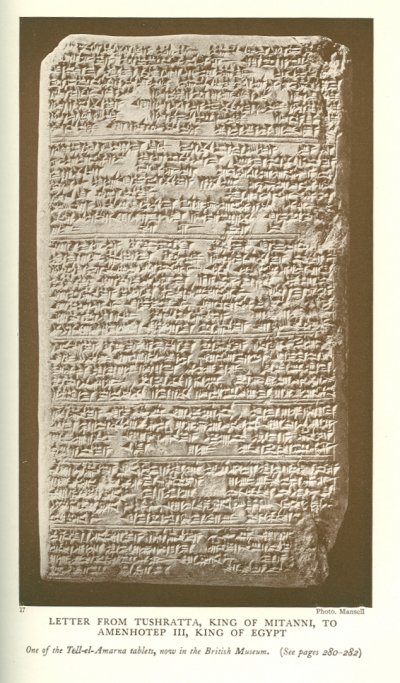
One of the Tell-el-Amarna tablets, now in the British Museum. Photo. Mansell
The Egyptian natives, ever so eager to sell antiquities so as to make a fortune
and retire for life, offered some specimens of the tablets for sale. One or
two were sent to Paris, where they were promptly declared to be forgeries, with the result
that for a time the inscribed bricks were not a marketable commodity. Ere their
value was discovered, the natives had packed them into sacks, with the result
that many were damaged and some completely destroyed. At length, however, the
majority of them reached the British Museum and the Berlin Museum, while others
drifted into the museums at Cairo, St. Petersburg, and Paris. When they were
deciphered, Mitanni was discovered, and a flood of light thrown on the internal
affairs of Egypt and its relations with various kingdoms in Asia, while glimpses
were also afforded of the life and manners of the times.
The letters covered the reigns of Amenhotep III, the great-grandson of Thothmes
III, and of his son Akhenaton, “the dreamer king”, and included communications
from the kings of Babylonia, Assyria, Mitanni, Cyprus, the Hittites, and the
princes of Phoenicia and Canaan. The copies of two letters from Amenhotep III
to Kallima-Sin, King of Babylonia, had also been preserved. One deals with statements
made by Babylonian ambassadors, whom the Pharaoh stigmatizes as liars. Kallima-Sin
had sent his daughter to the royal harem of Egypt, and desired to know if she
was alive and well. He also asked for “much gold” to enable him to carry on
the work of extending his temple. When twenty minas of gold was sent to him,
he complained in due course that the quantity received was not only short but
that the gold was not pure; it had been melted in the furnace, and less than
five minas came out. In return he sent to Akhenaton two minas of enamel, and
some jewels for his daughter, who was in the Egyptian royal harem.
Ashur-uballit, king of Ashur, once wrote intimating to Akhenaton that he
was gifting him horses and chariots and a jewel seal. He asked for gold to assist in building his palace. “In
your country”, he added, “gold is as plentiful as dust.” He also made an illuminating
statement to the effect that no ambassador had gone from Assyria to Egypt since
the days of his ancestor Ashur-nadin-akhe. It would therefore appear that Ashur-uballit
had freed part of Assyria from the yoke of Mitanni.
The contemporary king of Mitanni was Tushratta. He corresponded both with
his cousin Amenhotep III and his son-in-law Akhenaton. In his correspondence
with Amenhotep III Tushratta tells that his kingdom had been invaded by the
Hittites, but his god Teshup had delivered them into his hand, and he destroyed
them; “not one of them”, he declared, “returned to his own country”. Out of
the booty captured he sent Amenhotep several chariots and horses, and a boy
and a girl. To his sister Gilu-khipa, who was one of the Egyptian Pharaoh’s
wives, he gifted golden ornaments and a jar of oil. In another letter Tushratta
asked for a large quantity of gold “without measure”. He complained that he
did not receive enough on previous occasions, and hinted that some of the Egyptian
gold looked as if it were alloyed with copper. Like the Assyrian king, he hinted
that gold was as plentiful as dust in Egypt. His own presents to the Pharaoh
included precious stones, gold ornaments, chariots and horses, and women (probably
slaves). This may have been tribute. It was during the third Amenhotep’s illness
that Tushratta forwarded the Nineveh image of Ishtar to Egypt, and he made reference
to its having been previously sent thither by his father, Sutarna.
When Akhenaton came to the throne Tushratta wrote to him, desiring to continue
the friendship which had existed for two or three generations between the kings
of Mitanni and Egypt, and made complimentary references to “the distinguished Queen Tiy”, Akhenaton’s mother, who evidently exercised
considerable influence in shaping Egypt’s foreign policy. In the course of his
long correspondence with the Pharaohs, Tushratta made those statements regarding
his ancestors which have provided so much important data for modern historians
of his kingdom.
During the early part of the Tell-el-Amarna period, Mitanni was the most
powerful kingdom in Western Asia. It was chiefly on that account that the daughters
of its rulers were selected to be the wives and mothers of great Egyptian Pharaohs.
But its numerous enemies were ever plotting to accomplish its downfall. Among
these the foremost and most dangerous were the Hittites and the Assyrians.
The ascendancy of the Hittites was achieved in northern Syria with dramatic
suddenness. There arose in Asia Minor a great conqueror, named Subbi-luliuma,
the successor of Hattusil I, who established a strong Hittite empire which endured
for about two centuries. His capital was at Boghaz-K. Sweeping through Cappadocia,
at the head of a finely organized army, remarkable for its mobility, he attacked
the buffer states which owed allegiance to Mitanni and Egypt. City after city
fell before him, until at length he invaded Mitanni; but it is uncertain whether
or not Tushratta met him in battle. Large numbers of the Mitannians were, however,
evicted and transferred to the land of the Hittites, where the Greeks subsequently
found them, and where they are believed to be represented by the modern Kurds,
the hereditary enemies of the Armenians.
In the confusion which ensued, Tushratta was murdered by Sutarna II, who
was recognized by Subbi-luliuma. The crown prince, Mattiuza, fled to Babylon, where he found protection, but was unable to receive any assistance. Ultimately,
when the Hittite emperor had secured his sway over northern Syria, he deposed
Sutarna II and set Mattiuza as his vassal on the throne of the shrunken Mitanni
kingdom.
Meanwhile the Egyptian empire in Asia had gone to pieces. When Akhenaton,
the dreamer king, died in his palace at Tell-el-Amarna, the Khabiri were conquering
the Canaanite cities which had paid him tribute, and the Hittite ruler was the
acknowledged overlord of the Amorites.
The star of Assyria was also in the ascendant. Its king, Ashur-uballit, who
had corresponded with Akhenaton, was, like the Hittite king, Subbi-luliuma,
a distinguished statesman and general, and similarly laid the foundations of
a great empire. Before or after Subbi-luliuma invaded Tushratta’s domains, he
drove the Mitannians out of Nineveh, and afterwards overcame the Shubari tribes
of Mitanni on the north-west, with the result that he added a wide extent of
territory to his growing empire.
He had previously thrust southward the Assyro-Babylonian frontier. In fact,
he had become so formidable an opponent of Babylonia that his daughter had been
accepted as the wife of Karakhardash, the Kassite king of that country. In time
his grandson, Kadashman-Kharbe, ascended the Babylonian throne. This young monarch
co-operated with his grandfather in suppressing the Suti, who infested the trade
routes towards the west, and plundered the caravans of merchants and the messengers
of great monarchs with persistent impunity.
A reference to these bandits appears in one of the Tell-el-Amarna letters.
Writing to Akhenaton, Ashur-uballit said: “The lands (of Assyria and Egypt)
are remote, therefore let our messengers come and go. That your messengers were
late in reaching you, (the reason is that) if the Suti had waylaid them, they
would have been dead men. For if I had sent them, the Suti would have sent bands
to waylay them; therefore I have retained them. My messengers (however), may
they not (for this reason) be delayed.”1
Ashur-uballit’s grandson extended his Babylonian frontier into Amurru, where
he dug wells and erected forts to protect traders. The Kassite aristocracy,
however, appear to have entertained towards him a strong dislike, perhaps because
he was so closely associated with their hereditary enemies the Assyrians. He
had not reigned for long when the embers of rebellion burst into flame and he
was murdered in his palace. The Kassites then selected as their king a man of
humble origin, named Nazibugash, who was afterwards referred to as “the son
of nobody”. Ashur-uballit deemed the occasion a fitting one to interfere in
the affairs of Babylonia. He suddenly appeared at the capital with a strong
army, overawed the Kassites, and seized and slew Nazibugash. Then he set on
the throne his great grandson the infant Kurigalzu II, who lived to reign for
fifty-five years.
Ashur-uballit appears to have died soon after this event. He was succeeded
by his son Bel-nirari, who carried on the policy of strengthening and extending
the Assyrian empire. For many years he maintained excellent relations with his
kinsman Kurigalzu II, but ultimately they came into conflict apparently over
disputed territory. A sanguinary battle was fought, in which the Babylonians
suffered heavily and were put to rout. A treaty of peace was afterwards arranged,
which secured for the Assyrians a further extension of their frontier “from the borders of Mitanni as far as Babylonia”. The struggle of the future was
to be for the possession of Mesopotamia, so as to secure control over the trade
routes.
Thus Assyria rose from a petty state in a comparatively brief period to become
the rival of Babylonia, at a time when Egypt at the beginning of its Nineteenth
Dynasty was endeavouring to win back its lost empire in Syria, and the Hittite
empire was being consolidated in the north.
Footnotes
263:1 The Land of
the Hittites, John Garstang, pp. 312 et seq. and 315 et seq.
263:2 The Ancient
Egyptians, pp. 106 et seq.
264:1 The Ancient
Egyptians, p. 130.
264:2 Struggle of
the Nations(1896), p. 19.
265:1 Note contributed
to The Land of the Hittites, J. Garstang, p. 324.
266:1 Genesis,
xxvi, 34, 35.
266:2 Ezekiel,
xvi, 45.
266:3 Genesis,
xxvii, 46.
266:4 Genesis,
xxviii, 1, 2.
267:1 Genesis,
xxiv.
268:1 The Syrian Goddess,
John Garstang (London, 1913), pp. 17-8.
269:1 Vedic Index
of Names and Subjects, Macdonald & Keith, vol. i, pp. 64-5 (London, 1912).
270:1 The Wanderings
of Peoples, p. 21.
271:1 Breasted’s History
of Egypt, pp. 219-20.
275:1 A History of
Egypt, W. M. Flinders Petrie, vol. ii, p. 146 et seq. (1904 ed.).
276:1 A History of
Egypt, W. M. Flinders Petrie, vol. ii, p. 147 (1904 ed.).
277:1 The Old Testament
in the Light of the Historical Records and Legends of Assyria and Babylonia,
pp. 126 et seq.
278:1 His connection
with Anu is discussed in chapter xiv .
278:2 Ancient Assyria,
C. H. W. Johns, p. 11 (London, 1912).
285:1 The Tell-el-Amarna
Letters, Hugo Winckler, p. 31.
Next: Chapter XIII. Astrology and Astronomy

Leave A Comment