
CHAPTER XIII
Astrology and Astronomy
Culture and Superstition–Primitive Star Myths–Naturalism, Totemism, and
Animism–Stars as Ghosts of Men, Giants, and Wild Animals–Gods as Constellations
and Planets–Babylonian and Egyptian Mysticism–Osiris, Tammuz, and Merodach–Ishtar
and Isis as Bisexual Deities–The Babylonian Planetary Deities–Planets as Forms
of Tammuz and Ghosts of Gods–The Signs of the Zodiac–The “Four Quarters”–Cosmic
Periods in Babylonia, India, Greece, and Ireland–Babylonian System of Calculation–Traced
in Indian Yuga System–Astrology–Beliefs of the Masses–Rise of Astronomy–Conflicting
Views of Authorities–Greece and Babylonia–Eclipses Foretold–The Dial of Ahaz–Omens
of Heaven and Air–Biblical References to Constellations–The Past in the Present.
THE empire builders of old who enriched themselves with the spoils of war
and the tribute of subject States, not only satisfied personal ambition and
afforded protection for industrious traders and workers, but also incidentally
promoted culture and endowed research. When a conqueror returned to his capital
laden with treasure, he made generous gifts to the temples. He believed that
his successes were rewards for his piety, that his battles were won for him
by his god or goddess of war. It was necessary, therefore, that he should continue
to find favour in the eyes of the deity who had been proved to be more powerful
than the god of his enemies. Besides, he had to make provision during his absence
on long campaigns, or while absorbed in administrative work, for the constant
performance of religious rites, so that the various deities of water, earth,
weather, and corn might be sustained or propitiated with sacrificial offerings,
or held in magical control by the performance of ceremonial rites. Consequently
an endowed priesthood became a necessity in all powerful and well-organized
states.
Thus came into existence in Babylonia, as elsewhere, as a result of the accumulation
of wealth, a leisured official class, whose duties tended to promote intellectual
activity, although they were primarily directed to perpetuate gross superstitious
practices. Culture was really a by-product of temple activities; it flowed forth
like pure gold from furnaces of thought which were walled up by the crude ores
of magic and immemorial tradition.
No doubt in ancient Babylonia, as in Europe during the Middle Ages, the men
of refinement and intellect among the upper classes were attracted to the temples,
while the more robust types preferred the outdoor life, and especially the life
of the soldier.1 The permanent
triumphs of Babylonian civilization were achieved either by the priests, or
in consequence of the influence they exercised. They were the grammarians and
the scribes, the mathematicians and the philosophers of that ancient country,
the teachers of the young, and the patrons of the arts and crafts. It was because
the temples were centres of intellectual activity that the Sumerian language
remained the language of culture for long centuries after it ceased to be the
everyday speech of the people.
Reference has already been made to the growth of art, and the probability
that all the arts had their origin in magical practices, and to the growth of
popular education necessitated by the centralization of business in the temples.
It remains with us to deal now with priestly contributions to the more abstruse
sciences. In India the ritualists among the Brahmans, who concerned themselves
greatly regarding the exact construction and measurements of altars, gave the
world algebra; the pyramid builders of Egypt, who erected vast tombs to protect
royal mummies, had perforce to lay the groundwork of the science of geometry;
and the Babylonian priests who elaborated the study of astrology became great
astronomers because they found it necessary to observe and record accurately
the movements of the heavenly bodies.
From the earliest times of which we have knowledge, the religious beliefs
of the Sumerians had vague stellar associations. But it does not follow that
their myths were star myths to begin with. A people who called constellations
“the ram”, “the bull”, “the lion”, or “the scorpion”, did not do so because
astral groups suggested the forms of animals, but rather because the animals
had an earlier connection with their religious life.
At the same time it should be recognized that the mystery of the stars must
ever have haunted the minds of primitive men. Night with all its terrors appealed
more strongly to their imaginations than refulgent day when they felt more secure;
they were concerned most regarding what they feared most. Brooding in darkness
regarding their fate, they evidently associated the stars with the forces which
influenced their lives–the ghosts of ancestors, of totems, the spirits that
brought food or famine and controlled the seasons. As children see images in
a fire, so they saw human life reflected in the starry sky. To the simple minds
of early folks the great moon seemed to be the parent of the numerous twinkling
and moving orbs. In Babylon, indeed, the moon was regarded as the father not
only of the stars but of the sun also; there, as elsewhere, lunar worship was
older than solar worship.
Primitive beliefs regarding the stars were of similar character in various
parts of the world. But the importance which they assumed in local mythologies
depended in the first place on local phenomena. On the northern Eur-Asian steppes,
for instance, where stars vanished during summer’s blue nights, and were often
obscured by clouds in winter, they did not impress men’s minds so persistently
and deeply as in Babylonia, where for the greater part of the year they gleamed
in darkness through a dry transparent atmosphere with awesome intensity. The
development of an elaborate system of astral myths, besides, was only possible
in a country where the people had attained to a high degree of civilization,
and men enjoyed leisure and security to make observations and compile records.
It is not surprising, therefore, to find that Babylonia was the cradle of astronomy.
But before this science had destroyed the theory which it was fostered to prove,
it lay smothered for long ages in the debris of immemorial beliefs. It is necessary,
therefore, in dealing with Babylonian astral myths to endeavour to approach
within reasonable distance of the point of view, or points of view, of the people
who framed them.
Babylonian religious thought was of highly complex character. Its progress
was ever hampered by blended traditions. The earliest settlers in the Tigro-Euphrates
valley no doubt imported many crude beliefs which they had inherited from their
Pallithic ancestors–the modes of thought which were the moulds of new theories
arising from new experiences. When consideration is given to the existing religious
beliefs of various peoples throughout the world, in low stages of culture, it
is found that the highly developed creeds of Babylonia, Egypt, and other countries
where civilization flourished were never divested wholly of their primitive
traits.
Among savage peoples two grades of religious ideas have been identified,
and classified as Naturalism and Animism. In the plane of Naturalism the belief
obtains that a vague impersonal force, which may have more than one manifestation
and is yet manifested in everything, controls the world and the lives of human
beings. An illustration of this stage of religious consciousness is afforded
by Mr. Risley, who, in dealing with the religion of the jungle dwellers of Chota
Nagpur, India, says that “in most cases the indefinite something which they
fear and attempt to propitiate is not a person at all in any sense of the word;
if one must state the case in positive terms, I should say that the idea which
lies at the root of their religion is that of a power rather than many powers”.1
Traces of Naturalism appear to have survived in Sumeria in the belief that
“the spiritual, the Zi, was that which manifested life. . . . The test of the
manifestation of life was movement.”2 All things that moved, it was conceived in the plane of Naturalism, possessed
“self power”; the river was a living thing, as was also the fountain; a stone
that fell from a hill fell of its own accord; a tree groaned because the wind
caused it to suffer pain. This idea that inanimate objects had conscious existence
survived in the religion of the Aryo-Indians. In the Nala story of the Indian
epic, the Mahhata, the disconsolate wife Damayanti addresses a mountain
when searching for her lost husband:
This, the monarch of all mountains, ask I of the king
of men;
“O all-honoured Prince of Mountains, with thy heavenward soaring peaks . . .
Hast thou seen the kingly Nala in this dark and awful wood?. . .
Why repliest thou not, O Mountain?”
She similarly addresses the Asoka tree:
“Hast thou seen Nishadha’s monarch, hast thou seen my
only love? . . .
That I may depart ungrieving, fair Asoka, answer me. . . .”
Many a tree she stood and gazed on. . . .1
It will be recognized that when primitive men gave names to mountains, rivers,
or the ocean, these possessed for them a deeper significance than they do for
us at the present day. The earliest peoples of Indo-European speech who called
the sky “dyeus”, and those of Sumerian speech who called it “ana”, regarded
it not as the sky “and nothing more”, but as something which had conscious existence
and “self power”. Our remote ancestors resembled, in this respect, those imaginative
children who hold conversations with articles of furniture, and administer punishment
to stones which, they believe, have tripped them up voluntarily and with desire
to commit an offence.
In this early stage of development the widespread totemic beliefs appear
to have had origin. Families or tribes believed that they were descended from
mountains, trees, or wild animals.
op’s fable about the mountain which gave birth to a mouse may be a relic
of Totemism; so also may be the mountain symbols on the standards of Egyptian
ships which appear on pre-dynastic pottery; the black dwarfs of Teutonic mythology
were earth children.2
Adonis sprang from a tree; his mother may have, according to primitive belief,
been simply a tree; Dagda, the patriarchal Irish corn god, was an oak; indeed,
the idea of a “world tree”, which occurs in Sumerian, Vedic-Indian, Teutonic,
and other mythologies, was probably a product of Totemism.
Wild animals were considered to be other forms of human beings who could
marry princes and princesses as they do in so many fairy tales. Damayanti addressed
the tiger, as well as the mountain and tree, saying:
I approach him without fear.
“Of the beasts art thou the monarch, all this forest thy domain; . . .
Thou, O king of beasts, console me, if my Nala thou hast seen.”1
A tribal totem exercised sway over a tribal district. In Egypt, as Herodotus
recorded, the crocodile was worshipped in one district and hunted down in another.
Tribes fought against tribes when totemic animals were slain. The Babylonian
and Indian myths about the conflicts between eagles and serpents may have originated
as records of battles between eagle clans and serpent clans. Totemic animals
were tabooed. The Set pig of Egypt and the devil pig of Ireland, Scotland, and
Wales were not eaten except sacrificially. Families were supposed to be descended
from swans and were named Swans, or from seals and were named Seals, like the
Gaelic “Mac Codrums”, whose surname signifies “son of the seal”; the nickname
of the Campbells, “sons of the pig”, may refer to their totemic boar’s head
crest, which commemorated the slaying, perhaps the sacrificial slaying, of the
boar by their ancestor Diarmid. Mr. Garstang, in The Syrian Goddess,
thinks it possible that the boar which killed Adonis was of totemic origin.
So may have been the fish form of the Sumerian god Ea. When an animal totem
was sacrificed once a year, and eaten sacrificially so that the strength of
the clan might be maintained, the priest who wrapped himself in its skin was
supposed to have transmitted to him certain magical powers; he became identified
with the totem and prophesied and gave instruction as the totem. Ea was depicted
clad in the fish’s skin.
Animism, the other early stage of human development, also produced distinctive
modes of thought. Men conceived that the world swarmed with spirits, that a
spirit groaned in the wind-shaken tree, that the howling wind was an invisible
spirit, that there were spirits in fountains, rivers, valleys, hills, and in
ocean, and in all animals; and that a hostile spirit might possess an individual
and change his nature. The sun and the moon were the abodes of spirits, or the
vessels in which great spirits sailed over the sea of the sky; the stars were
all spirits, the “host of heaven”. These spirits existed in groups of seven,
or groups of three, and the multiple of three, or in pairs, or operated as single
individuals.
Although certain spirits might confer gifts upon mankind, they were at certain
seasons and in certain localities hostile and vengeful, like the grass-green
fairies in winter, or the earth-black elves when their gold was sought for in
forbidden and secret places. These spirits were the artisans of creation and
vegetation, like the Egyptian Khnumu and the Indian Rhibus; they fashioned the
grass blades and the stalks of corn, but at times of seasonal change they might
ride on their tempest steeds, or issue forth from flooding rivers and lakes.
Man was greatly concerned about striking bargains with them to secure their
services, and about propitiating them, or warding off their attacks with protective
charms, and by performing “ceremonies of riddance”. The ghosts of the dead,
being spirits, were similarly propitious or harmful on occasion; as emissaries
of Fate they could injure the living.
Ancestor worship, the worship of ghosts, had origin in the stage of Animism.
But ancestor worship was not developed in Babylonia as in China, for instance,
although traces of it survived in the worship of stars as ghosts, in the deification
of kings, and the worship of patriarchs, who might be exalted as gods or identified
with a supreme god. The Egyptian Pharaoh Unas became the sun god and the constellation
of Orion by devouring his predecessors.1 He ate his god as a tribe ate its animal totem; he became the “bull of heaven”.
There were star totems as well as mountain totems. A St. Andrew’s cross sign,
on one of the Egyptian ship standards referred to, may represent a star. The
Babylonian goddess Ishtar was symbolized as a star, and she was the “world mother”.
Many primitive currents of thought shaped the fretted rocks of ancient mythologies.
In various countries all round the globe the belief prevailed that the stars
were ghosts of the mighty dead–of giants, kings, or princes, or princesses,
or of pious people whom the gods loved, or of animals which were worshipped.
A few instances may be selected at random. When the Teutonic gods slew the giant
Thjasse, he appeared in the heavens as Sirius. In India the ghosts of the “seven
Rishis”, who were semi-divine Patriarchs, formed the constellation of the Great
Bear, which in Vedic times was called the “seven bears”. The wives of the seven
Rishis were the stars of the Pleiades. In Greece the Pleiades were the ghosts
of the seven daughters of Atlas and Pleione, and in Australia they were and
are a queen and six handmaidens. In these countries, as elsewhere, stories were
told to account for the “lost Pleiad”, a fact which suggests that primitive
men were more constant observers of the heavenly bodies than might otherwise
be supposed. The Arcadians believed that they were descended, as Hesiod recorded,
from a princess who was transformed by Zeus into a bear; in this form Artemis
slew her and she became the “Great Bear” of the sky. The Egyptian Isis was the
star Sirius, whose rising coincided with the beginning of the Nile inundation.
Her first tear for the dead Osiris fell into the river on “the night of the
drop”. The flood which ensued brought the food supply. Thus the star was not
only the Great Mother of all, but the sustainer of all.
The brightest stars were regarded as being the greatest and most influential.
In Babylonia all the planets were identified with great deities. Jupiter, for
instance, was Merodach, and one of the astral forms of Ishtar was Venus. Merodach
was also connected with “the fish of Ea” (Pisces), so that it is not improbable
that Ea worship had stellar associations. Constellations were given recognition
before the planets were identified.
A strange blending of primitive beliefs occurred when the deities were given
astral forms. As has been shown (Chapter III )
gods were supposed to die annually. The Egyptian priests pointed out to Herodotus
the grave of Osiris and also his star. There are “giants’ graves” also in those
countries in which the gods were simply ferocious giants. A god might assume
various forms; he might take the form of an insect, like Indra, and hide in
a plant, or become a mouse, or a serpent, like the gods of Erech in the Gilgamesh
epic. The further theory that a god could exist in various forms at one and
the same time suggests that it had its origin among a people who accepted the
idea of a personal god while yet in the stage of Naturalism. In Egypt Osiris,
for instance, was the moon, which came as a beautiful child each month and was
devoured as the wasting “old moon” by the demon Set; he was the young god who
was slain in his prime each year; he was at once the father, husband, and son
of Isis; he was the Patriarch who reigned over men and became the Judge of the
Dead; he was the earth spirit, he was the bisexual Nile spirit, he was the spring
sun; he was the Apis bull of Memphis, and the ram of Mendes; he was the reigning
Pharaoh. In his fusion with Ra, who was threefold–Khepera, Ra, and Tum–he
died each day as an old man; he appeared in heaven at night as the constellation
Orion, which was his ghost, or was, perhaps, rather the Sumerian Zi, the spiritual
essence of life. Osiris, who resembled Tammuz, a god of many forms also, was
addressed as follows in one of the Isis chants:
There proceedeth from thee the strong Orion in heaven
at evening, at the resting of every day!
Lo it is I (Isis), at the approach of the Sothis (Sirius) period, who doth watch
for him (the child Osiris),
Nor will I leave off watching for him; for that which proceedeth from thee (the
living Osiris) is revered.
An emanation from thee causeth life to gods and men, reptiles and animals, and
they live by means thereof.
Come thou to us from thy chamber, in the day when thy soul begetteth emanations,–
The day when offerings upon offerings are made to thy spirit, which causeth
the gods and men likewise to live.1
This extract emphasizes how unsafe it is to confine certain deities within
narrow limits by terming them simply “solar gods”, “lunar gods”, “astral gods”,
or “earth gods”. One deity may have been simultaneously a sun god and moon god,
an air god and an earth god, one who was dead and also alive, unborn and also
old. The priests of Babylonia and Egypt were less accustomed to concrete and
logical definitions than their critics and expositors of the twentieth century.
Simple explanations of ancient beliefs are often by reason of their very simplicity
highly improbable. Recognition must ever be given to the puzzling complexity
of religious thought in Babylonia and Egypt, and to the possibility that even
to the priests the doctrines of a particular cult, which embraced the accumulated
ideas of centuries, were invariably confusing and vague, and full of inconsistencies;
they were mystical in the sense that the understanding could not grasp them
although it permitted their acceptance. A god, for instance, might be addressed
at once in the singular and plural, perhaps because he had developed from an
animistic group of spirits, or, perhaps, for reasons we cannot discover. This
is shown clearly by the following pregnant extract from a Babylonian tablet:
“Powerful, O Sevenfold, one are ye”. Mr. L. W. King, the translator,
comments upon it as follows: “There is no doubt that the name was applied to
a group of gods who were so closely connected that, though addressed in the
plural, they could in the same sentence be regarded as forming a single personality”.1
Like the Egyptian Osiris, the Babylonian Merodach was a highly complex deity.
He was the son of Ea, god of the deep; he died to give origin to human life
when he commanded that his head should be cut off so that the first human beings
might be fashioned by mixing his blood with the earth; he was the wind god,
who gave “the air of life”; he was the deity of thunder and the sky; he was
the sun of spring in his Tammuz character; he was the daily sun, and the planets
Jupiter and Mercury as well as Sharru (Regulus); he had various astral associations
at various seasons. Ishtar, the goddess, was Iku (Capella), the water channel
star, in January–February, and Merodach was Iku in May–June. This strange
system of identifying the chief deity with different stars at different periods,
or simultaneously, must not be confused with the monotheistic identification
of him with other gods. Merodach changed his forms with Ishtar, and had similarly
many forms. This goddess, for instance, was, even when connected with one particular
heavenly body, liable to change. According to a tablet fragment she was, as
the planet Venus, “a female at sunset and a male at sunrise”1 –that
is, a bisexual deity like Nannar of Ur, the father and mother deity combined,
and Isis of Egypt. Nannar is addressed in a famous hymn:
Father Nannar, Lord, God Sin, ruler among the gods. .
. .
Mother body which produceth all things. . . .
Merciful, gracious Father, in whose hand the life of the whole land is contained.
One of the Isis chants of Egypt sets forth, addressing Osiris:
There cometh unto thee Isis, lady of the horizon, who
hath begotten herself alone in the image of the gods . . .
She hath taken vengeance before Horus, the woman who was made a male by her
father Osiris.2
Merodach, like Osiris-Sokar, was a “lord of many existences”, and likewise
“the mysterious one, he who is unknown to mankind”.3 It was impossible for the human mind “a greater than itself to know”.
Evidence has not yet been forthcoming to enable us to determine the period
at which the chief Babylonian deities were identified with the planets, but
it is clear that Merodach’s ascendancy in astral form could not have occurred
prior to the rise of that city god of Babylon as chief of the pantheon by displacing
Enlil. At the same time it must be recognized that long before the Hammurabi
age the star-gazers of the Tigro-Euphrates valley must have been acquainted
with the movements of the chief planets and stars, and, no doubt, they connected
them with seasonal changes as in Egypt, where Isis was identified with Sirius
long before the Ptolemaic age, when Babylonian astronomy was imported. Horus
was identified not only with the sun but also with Saturn, Jupiter, and Mars.1 Even the primitive Australians, as has been indicated, have their star myths;
they refer to the stars Castor and Pollux as two young men, like the ancient
Greeks, while the African Bushmen assert that these stars are two girls. It
would be a mistake, however, to assume that the prehistoric Sumerians were exact
astronomers. Probably they were, like the Aryo-Indians of the Vedic period,
“not very accurate observers”.2
It is of special interest to find that the stars were grouped by the Babylonians
at the earliest period in companies of seven. The importance of this magical
number is emphasized by the group of seven demons which rose from the deep to
rage over the land (p. 71 ). Perhaps the sanctity
of Seven was suggested by Orion, the Bears, and the Pleiad, one of which constellations
may have been the “Sevenfold” deity addressed as “one”. At any rate arbitrary
groupings of other stars into companies of seven took place, for references
are made to the seven Tikshi, the seven Lumashi, and the seven Mashi, which
are older than the signs of the Zodiac; so far as can be ascertained these groups
were selected from various constellations. When the five planets were identified,
they were associated with the sun and moon and connected with the chief gods
of the Hammurabi pantheon. A bilingual list in the British Museum arranges the
sevenfold planetary group in the following order:–
The moon, Sin.
The sun, Shamash.
Jupiter, Merodach.
Venus, Ishtar.
Saturn, Ninip (Nirig).
Mercury, Nebo.
Mars, Nergal.
An ancient name of the moon was Aa, or Ai, which recalls the Egyptian
A or Ah. The Sumerian moon was Aku, “the measurer”, like Thoth of Egypt, who
in his lunar character as a Fate measured out the lives of men, and was a god
of architects, mathematicians, and scribes. The moon was the parent of the sun
or its spouse; and might be male, or female, or both as a bi-sexual deity.
As the “bull of light” Jupiter had solar associations; he was also the shepherd
of the stars, a title shared by Tammuz as Orion; Nin-Girsu, a developed form
of Tammuz, was identified with both Orion and Jupiter.
Ishtar’s identification with Venus is of special interest. When that planet
was at its brightest phase, its rays were referred to as “the beard” of the
goddess; she was the “bearded Aphrodite”–a bisexual deity evidently. The astrologers
regarded the bright Venus as lucky and the rayless Venus as unlucky.
Saturn was Nirig, who is best known as Ninip, a deity who was displaced by
Enlil, the elder Bel, and afterwards regarded as his son. His story has not
been recovered, but from the references made to it there is little doubt that
it was a version of the widespread myth about the elder deity who was slain
by his son, as Saturn was by Jupiter and Dyaus by Indra. It may have resembled
the lost Egyptian myth which explained the existence of the two Horuses–Horus
the elder, and Horus, the posthumous son of Osiris. At any rate, it is of interest
to find in this connection that in Egypt the planet Saturn was Her-Ka, “Horus
the Bull”. Ninip was also identified with the bull. Both deities were also connected
with the spring sun, like Tammuz, and were terrible slayers of their enemies.
Ninip raged through Babylonia like a storm flood, and Horus swept down the Nile,
slaying the followers of Set. As the divine sower of seed, Ninip may have developed
from Tammuz as Horus did from Osiris. Each were at once the father and the son,
different forms of the same deity at various seasons of the year. The elder
god was displaced by the son (spring), and when the son grew old his son slew
him in turn. As the planet Saturn, Ninip was the ghost of the elder god, and
as the son of Bel he was the solar war god of spring, the great wild bull, the
god of fertility. He was also as Ber “lord of the wild boar”, an animal associated
with Rimmon.1
Nebo (Nabu), who was identified with Mercury, was a god of Borsippa. He was
a messenger and “announcer” of the gods, as the Egyptian Horus in his connection
with Jupiter was Her-ap-sheta, “Horus the opener of that which is secret”.2 Nebo’s original character is obscure.
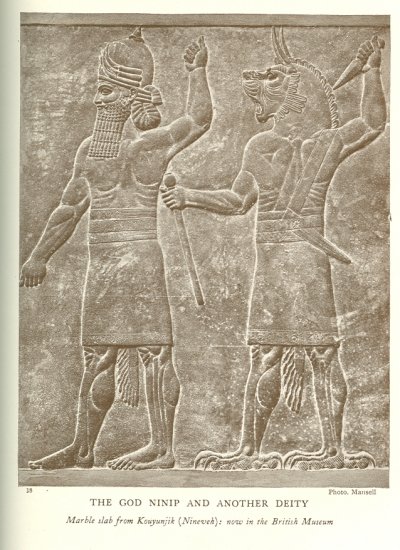
THE GOD NINIP AND ANOTHER DEITY
Marble slab from Kenyan jib (Nineveh): now in the British Museum.
Photo Mansell
He appears to have been a highly developed deity of a people well advanced
in civilization when he was exalted as the divine patron of Borsippa. Although
Hammurabi ignored him, he was subsequently invoked with Merodach, and had probably
much in common with Merodach. Indeed, Merodach was also identified with the
planet Mercury. Like the Greek Hermes, Nebo was a messenger of the gods and
an instructor of mankind. Jastrow regards him as “a counterpart of Ea”, and
says: “Like Ea, he is the embodiment and source of wisdom. The art of writing–and
therefore of all literature–is more particularly associated with him. A common
form of his name designates him as the ‘god of the stylus’.”1 He appears also to have been a developed form of Tammuz, who was an incarnation
of Ea. Professor Pinches shows that one of his names, Mermer, was also a non-Semitic
name of Ramman.2 Tammuz resembled
Ramman in his character as a spring god of war. It would seem that Merodach
as Jupiter displaced at Babylon Nebo as Saturn, the elder god, as Bel Enlil
displaced the elder Ninip at Nippur.
The god of Mars was Nergal, the patron deity of Cuthah,3 who descended into the Underworld and forced into submission Eresh-ki-gal (Persephone),
with whom he was afterwards associated. His “name”, says Professor Pinches,
“is supposed to mean ‘lord of the great habitation’, which would be a parallel
to that of his spouse, Eresh-ki-gal”.4 At Erech he symbolized the destroying influence of the sun, and was accompanied
by the demons of pestilence. Mars was a planet of evil, plague, and death; its
animal form was the wolf. In Egypt it was called Herdesher, “the Red Horus”,
and in Greece it was associated with Ares (the Roman Mars), the war god, who
assumed his boar form to slay Adonis (Tammuz).
Nergal was also a fire god like the Aryo-Indian Agni, who, as has been shown,
links with Tammuz as a demon slayer and a god of fertility. It may be that Nergal
was a specialized form of Tammuz, who, in a version of the myth, was reputed
to have entered the Underworld as a conqueror when claimed by Eresh-ki-gal,
and to have become, like Osiris, the lord of the dead. If so, Nergal was at
once the slayer and the slain.
The various Babylonian deities who were identified with the planets had their
characters sharply defined as members of an organized pantheon. But before this
development took place certain of the prominent heavenly bodies, perhaps all
the planets, were evidently regarded as manifestations of one deity, the primeval
Tammuz, who was a form of Ea, or of the twin deities Ea and Anu. Tammuz may
have been the “sevenfold one” of the hymns. At a still earlier period the stars
were manifestations of the Power whom the jungle dwellers of Chota Nagpur attempt
to propitiate–the “world soul” of the cultured Brahmans of the post-Vedic Indian
Age. As much is suggested by the resemblances which the conventionalized planetary
deities bear to Tammuz, whose attributes they symbolized, and by the Egyptian
conception that the sun, Jupiter, Saturn, and Mars were manifestations of Horus.
Tammuz and Horus may have been personifications of the Power or World Soul vaguely
recognized in the stage of Naturalism.
The influence of animistic modes of thought may be traced in the idea that
the planets and stars were the ghosts of gods who were superseded by their sons.
These sons were identical with their fathers; they became, as in Egypt, “husbands
of their mothers”. This idea was perpetuated in the Aryo-Indian Laws of Manu,
in which it is set forth that “the husband, after conception by his wife, becomes
an embryo and is born again of her”.1 The deities died every year, but death was simply change. Yet they remained
in the separate forms they assumed in their progress round “the wide circle
of necessity”. Horus was remembered as various planets–as the falcon, as the
elder sun god, and as the son of Osiris; and Tammuz was the spring sun, the
child, youth, warrior, the deity of fertility, and the lord of death (Orion-Nergal),
and, as has been suggested, all the planets.
The stars were also the ghosts of deities who died daily. When the sun perished
as an old man at evening, it rose in the heavens as Orion, or went out and in
among the stars as the shepherd of the flock, Jupiter, the planet of Merodach
in Babylonia, and Attis in Asia Minor. The flock was the group of heavenly spirits
invisible by day, the “host of heaven”–manifestations or ghosts of the emissaries
of the controlling power or powers.
The planets presided over various months of the year. Sin (the moon) was
associated with the third month; it also controlled the calendar; Ninip (Saturn)
was associated with the fourth month, Ishtar (Venus) with the sixth, Shamash
(the sun) with the seventh, Merodach (Jupiter) with the eighth, Nergal (Mars)
with the ninth, and a messenger of the gods, probably Nebo (Mercury), with the
tenth.
Each month was also controlled by a zodiacal constellation. In the Creation
myth of Babylon it is stated that when Merodach engaged in the work of setting
the Universe in order he “set all the great gods in their several stations”,
and “also created their images, the stars of the Zodiac,1 and fixed them all”.
Our signs of the Zodiac are of Babylonian origin. They were passed on to
the Greeks by the Phnicians and Hittites. “There was a time”, says Professor
Sayce, “when the Hittites were profoundly affected by Babylonian civilization,
religion, and art. . . .” They “carried the time-worn civilizations of Babylonia
and Egypt to the furthest boundary of Egypt, and there handed them over to the
West in the grey dawn of European history. . . . Greek traditions affirmed that
the rulers of Mykenhad come from Lydia, bringing with them the civilization
and treasures of Asia Minor. The tradition has been confirmed by modern research.
While certain elements belonging to the prehistoric culture of Greece, as revealed
at Mykenand elsewhere, were derived from Egypt and Phoenicia, there are others
which point to Asia Minor as their source. And the culture of Asia Minor was
Hittite.”2
The early Babylonian astronomers did not know, of course, that the earth
revolved round the sun. They believed that the sun travelled across the heavens
flying like a bird or sailing like a boat.3 In studying its movements they observed that it always travelled from west to
east along a broad path, swinging from side to side of it in the course of the
year. This path is the Zodiac–the celestial “circle of necessity”.
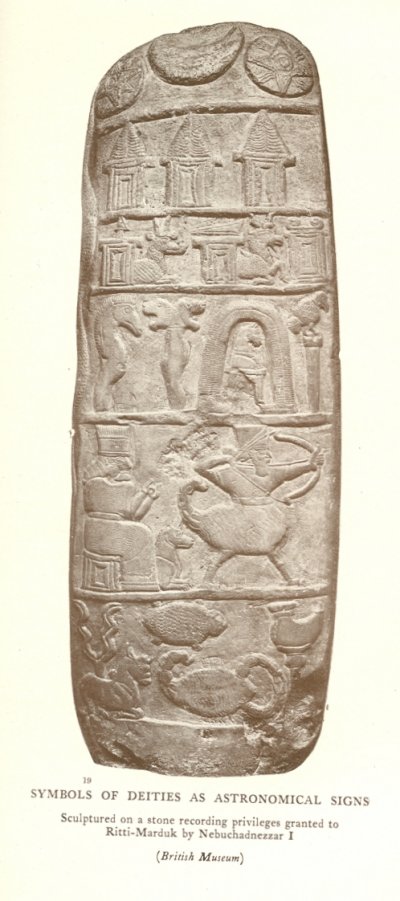
SYMBOLS OF DEITIES AS ASTRONOMICAL SIGNS
Sculptured on a stone recording privileges granted to Ritti-Marduk by Nebuchadnezzar
I
(British Museum)
The middle line of the sun’s path is the Ecliptic. The Babylonian scientists
divided the Ecliptic into twelve equal parts, and grouped in each part the stars
which formed their constellations; these are also called “Signs of the Zodiac”.
Each month had thus its sign or constellation.
The names borne at the present day by the signs of the Zodiac are easily
remembered even by children, who are encouraged to repeat the following familiar
lines:
The Ram, the Bull, the heavenly Twins,
And next the Crab, the Lionshines.
The Virginand the Scales;
The Scorpion, Archer, and Sea goat,
The man that holds the water pot,
And Fishwith glittring1 tails.
The table shows that our signs are derived from ancient Babylonia.
The celestial regions were also divided into three or more parts. Three “fields”
were allotted to the ancient triad formed by Ea, Anu, and Bel. The zodiacal
“path” ran through these “fields”. Ea’s field was in the west, and was associated
with Amurru, the land of the Amorites; Anu’s field was in the south, and was
associated with Elam; and Bel’s central “field” was associated with the land
of Akkad. When the rulers of Akkad called themselves “kings of the four quarters”,
the reference was to the countries associated with the three divine fields and
to Gutium2 (east = our north-east).
Was Gutium associated with demons, as in Scandinavia the north-east was associated
with the giants against whom Thor waged war?
The Babylonian Creation myth states that Merodach, having fixed the stars
of the Zodiac, made three stars for each month.
|
Constellations. |
Date of Sun’s Entry |
Babylonian Equivalent. |
|
Aries (the Ram). |
20th March |
The Labourer or Messenger. |
|
Taurus (the Bull). |
20th April |
A divine figure and the “bull of heaven”. |
|
Gemini (the Twins). |
21st May |
The Faithful Shepherd and Twins side by side, or head to head |
|
Cancer (the Crab). |
21st June (Tammuz = June-July). |
Crab or Scorpion. |
|
Leo (the Lion). |
22nd July |
The big dog (Lion). |
|
Virgo (the Virgin). |
23rd August |
Ishtar, the Virgin’s ear of corn. |
|
Libra (the Balance). |
23rd September |
The Balance. |
|
Scorpio (the Scorpion). |
23rd October |
Scorpion of darkness. |
|
Sagittarius (the Archer). |
22nd November |
Man or man-horse with bow, or an arrow symbol. |
|
Capricornus (the Goat). |
21st December |
Ea’s goat-fish. |
|
Aquarius (the Water Carrier). |
19th January |
God with water urn. |
|
Pisces (the Fishes). |
18th February |
Fish tails in canal. |
Mr. Robert Brown, jun., who has dealt as exhaustively with the astronomical
problems of Babylonia as the available data permitted him, is of opinion that
the leading stars of three constellations are referred to, viz.: (1) the central
or zodiacal constellations, (2) the northern constellations, and (3) the southern
constellations. We have thus a scheme of thirty-six constellations. The “twelve
zodiacal stars were flanked on either side by twelve non-zodiacal stars”. Mr.
Brown quotes Diodorus, who gave a rumof Babylonian astronomico-astrology,
in this connection. He said that “the five planets were called ‘Interpreters’;
and in subjection to these were marshalled ‘Thirty Stars’, which were styled
‘Divinities of the Council’. . . The chiefs of the Divinities are twelve in
number, to each of whom they assign a month and one of the twelve signs of the
Zodiac.” Through these twelve signs sun, moon, and planets run their courses.
“And with the zodiacal circle they mark out twenty-four stars, half of which
they say are arranged in the north and half in the south.”1 Mr. Brown shows that the thirty stars referred to “constituted the original
Euphratean Lunar Zodiac, the parent of the seven ancient lunar zodiacs which
have come down to us, namely, the Persian, Sogdian, Khorasmian, Chinese, Indian,
Arab, and Coptic schemes”.
The three constellations associated with each month had each a symbolic significance:
they reflected the characters of their months. At the height of the rainy season,
for instance, the month of Ramman, the thunder god, was presided over by the
zodiacal constellation of the water urn, the northern constellation “Fish of
the Canal”, and the southern “the Horse”. In India the black horse was sacrificed
at rain-getting and fertility ceremonies. The months of growth, pestilence,
and scorching sun heat were in turn symbolized. The “Great Bear” was the “chariot”
= “Charles’s Wain”, and the “Milky Way” the “river of the high cloud”, the Celestial
Euphrates, as in Egypt it was the Celestial Nile.
Of special interest among the many problems presented by Babylonian astronomical
lore is the theory of Cosmic periods or Ages of the Universe. In the Indian,
Greek, and Irish mythologies there are four Ages–the Silvern (white), Golden
(yellow), the Bronze (red), and the Iron (black). As has been already indicated,
Mr. R. Brown, jun., shows that “the Indian system of Yugas, or ages of the world,
presents many features which forcibly remind us of the Euphratean scheme”. The
Babylonians had ten antediluvian kings, who were reputed to have reigned for
vast periods, the total of which amounted to 120 saroi, or 432,000 years. These
figures at once recall the Indian Maha-yuga of 4,320,000 years = 432,000 X 10.
Apparently the Babylonian and Indian systems of calculation were of common origin.
In both countries the measurements of time and space were arrived at by utilizing
the numerals 10 and 6.
When primitive man began to count he adopted a method which comes naturally
to every schoolboy; he utilized his fingers. Twice five gave him ten, and from
ten he progressed to twenty, and then on to a hundred and beyond. In making
measurements his hands, arms, and feet were at his service. We are still measuring
by feet and yards (standardized strides) in this country, while those who engage
in the immemorial art of knitting, and, in doing so, repeat designs found on
neolithic pottery, continue to measure in finger breadths, finger lengths, and
hand breadths as did the ancient folks who called an arm length a cubit. Nor
has the span been forgotten, especially by boys in their games with marbles;
the space from the end of the thumb to the end of the little finger when the
hand is extended must have been an important measurement from the earliest times.
As he made progress in calculations, the primitive Babylonian appears to
have been struck by other details in his anatomy besides his sets of five fingers
and five toes. He observed, for instance, that his fingers were divided into
three parts and his thumb into two parts only;1 four fingers multiplied by three gave him twelve, and multiplying 12 by 3 he
reached 36. Apparently the figure 6 attracted him. His body was divided into
6 parts–2 arms, 2 legs, the head, and the trunk; his 2 ears, 2 eyes, and mouth,
and nose also gave him 6. The basal 6, multiplied by his la fingers, gave him
60, and 60 x 2 (for his 2 hands) gave him 120. In Babylonian arithmetic 6 and
60 are important numbers, and it is not surprising to find that in the system
of numerals the signs for 1 and 10 combined represent 60.
In fixing the length of a mythical period his first great calculation of
120 came naturally to the Babylonian, and when he undertook to measure the Zodiac
he equated time and space by fixing on 120 degrees. His first zodiac was the
Sumerian lunar zodiac, which contained thirty moon chambers associated with
the “Thirty Stars” of the tablets, and referred to by Diodorus as “Divinities
of the Council”. The chiefs of the Thirty numbered twelve. In this system the
year began in the winter solstice. Mr. Hewitt has shown that the chief annual
festival of the Indian Dravidians begins with the first full moon after the
winter festival, and Mr. Brown emphasizes the fact that the list of Tamil (Dravidian)
lunar and solar months are named like the Babylonian constellations.1 “Lunar chronology”, wrote Professor Max Mler, “seems everywhere to have preceded
solar chronology.”2 The later
Semitic Babylonian system had twelve solar chambers and the thirty-six constellations.
Each degree was divided into sixty minutes, and each minute into sixty seconds.
The hours of the day and night each numbered twelve.
Multiplying 6 by 10 (pur), the Babylonian arrived at 60 (soss); 60 x 10 gave
him 600 (ner), and 600 x 6, 3600 (sar), while 3600 x 10 gave him 36,000, and
36,000 x 12, 432,000 years, or 120 saroi, which is equal to the “sar” multiplied
by the “soss” x 2. “Pur” signifies “heap”–the ten fingers closed after being
counted; and “ner” signifies “foot”. Mr. George Bertin suggests that when 6
x 10 fingers gave 60 this number was multiplied by the ten toes, with the result
that 600 was afterwards associated with the feet (ner). The Babylonian sign
for 10 resembles the impression of two feet with heels closed and toes apart.
This suggests a primitive record of the first round of finger counting.
In India this Babylonian system of calculation was developed during the Brahmanical
period. The four Yugas or Ages, representing the four fingers used by the primitive
mathematicians, totalled 12,000 divine years, a period which was called a Maha-yuga;
it equalled the Babylonian 120 saroi, multiplied by 100. Ten times a hundred
of these periods gave a “Day of Brahma”. Each day of the gods, it was explained
by the Brahmans, was a year to mortals. Multiplied by 360 days, 12,000 divine
years equalled 4,320,000 human years. This Maha-yuga, multiplied by 1000, gave
the “Day of Brahma” as 4,320,000,000 human years.
The shortest Indian Yuga is the Babylonian 120 saroi multiplied by 10 = 1200
divine years for the Kali Yuga; twice that number gives the Dvapara Yuga of
2400 divine years; then the Treta Yuga is 2400 + 1200 = 3600 divine years, and
Krita Yuga 3600 + 1200=4800 divine years.
The influence of Babylonia is apparent in these calculations. During the
Vedic period “Yuga” usually signified a “generation”, and there are no certain
references to the four Ages as such. The names “Kali”, “Dvapara”, “Treta”, and
“Krita” “occur as the designations of throws of dice”.1 It was after the arrival of the “late corners”, the post-Vedic Aryans, that
the Yuga system was developed in India.2
In Indian Myth and Legend3 it is shown that the Indian and Irish Ages have the same colour sequence: (1)
White or Silvern, (2) Red or Bronze, (3) Yellow or Golden, and (4) Black or
Iron. The Greek order is: (1) Golden, (2) Silvern, (3) Bronze, and (4) Iron.
The Babylonians coloured the seven planets as follows: the moon, silvern;
the sun, golden; Mars, red; Saturn, black; Jupiter, orange; Venus, yellow; and
Mercury, blue.
As the ten antediluvian kings who reigned for 120 saroi had an astral significance,
their long reigns corresponding “with the distances separating certain of the
principal stars in or near the ecliptic”,4 it seems highly probable that the planets were similarly connected with mythical
ages which were equated with the “four quarters” of the celestial regions and
the four regions of the earth, which in Gaelic story are called “the four red
divisions of the world”.
Three of the planets may have been heralds of change. Venus, as “Dilbat”,
was the “Proclaimer”, and both Jupiter and Mercury were called “Face voices
of light”, and “Heroes of the rising sun” among other names. Jupiter may have
been the herald of the “Golden Age” as a morning star. This planet was also
associated with bronze, as “Kakkub Urud”, “the star of bronze”, while Mars was
“Kakkub Aban Kha-urud”, “the star of the bronze fish stone”. Mercury, the lapis
lazuli planet, may have been connected with the black Saturn, the ghost of the
dead sun, the demoniac elder god; in Egypt lapis lazuli was the hair colour
of Ra when he grew old, and Egyptologists translate it as black.1 The rare and regular appearances of Mercury may have suggested the planet’s
connection with a recurring Age. Venus as an evening star might be regarded
as the herald of the lunar or silver age; she was propitious as a bearded deity
and interchanged with Merodach as a seasonal herald.
Connecting Jupiter with the sun as a propitious planet, and with Mars as
a destroying planet, Venus with the moon, and Mercury with Saturn, we have left
four colour schemes which suggest the Golden, Silvern, Bronze, and Iron Ages.
The Greek order of mythical ages may have had a solar significance, beginning
as it does with the “golden” period. On the other hand the Indian and Irish
systems begin with the Silvern or white lunar period.
In India the White Age (Treta Yuga) was the age of perfect men, and in Greece
the Golden Age was the age of men who lived like gods. Thus the first ages in
both cases were “Perfect” Ages. The Bronze Age of Greece was the age of notorious
fighters and takers of life; in Babylonia the bronze planet Mars was the symbol
of the destroying Nergal, god of war and pestilence, while Jupiter was also
a destroyer as Merodach, the slayer of Tiamat. In India the Black Age is the
age of wickedness. The Babylonian Saturn, as we have seen, is black, and its
god, Ninip, was the destroying boar, which recalls the black boar of the Egyptian
demon (or elder god) Set. The Greek Cronos was a destroyer even of his own children.
All the elder gods had demoniac traits like the ghosts of human beings.
As the Babylonian lunar zodiac was imported into India before solar worship
and the solar zodiac were developed, so too may have been the germs of the Yuga
doctrine, which appears to have a long history. Greece, on the other hand, came
under the influence of Babylon at a much later period. In Egypt Ra, the sun
god, was an antediluvian king, and he was followed by Osiris. Osiris was slain
by Set, who was depicted sometimes red and sometimes black. There was also a
Horus Age.
The Irish system of ages suggests an early cultural drift into Europe, through
Asia Minor, and along the uplands occupied by the representatives of the Alpine
or Armenoid peoples who have been traced from Hindu Kush to Brittany. The culture
of Gaul resembles that of India in certain particulars; both the Gauls and the
post-Vedic Aryans, for instance, believed in the doctrine of Transmigration
of Souls, and practised “suttee”. After the Roman occupation of Gaul, Ireland
appears to have been the refuge of Gaulish scholars, who imported their beliefs
and traditions and laid the foundations of that brilliant culture which shed
lustre on the Green Isle in late Pagan and early Christian times.
The part played by the Mitanni people of Aryan speech in distributing Asiatic
culture throughout Europe may have been considerable, but we know little or
nothing regarding their movements and influence, nor has sufficient evidence
been forthcoming to connect them with the cremating invaders of the Bronze Age,
who penetrated as far as northern Scotland and Scandinavia. On the other hand
it is certain that the Hittites adopted the planetary system of Babylonia and
passed it on to Europeans, including the Greeks. The five planets Ninip, Merodach,
Nergal, Ishtar, and Nebo were called by the Greeks after their gods Kronos,
Zeus, Ares, Aphrodite, and Hermes, and by the Romans Saturnus, Jupiter, Mars,
Venus, and Mercurius. It must be recognized, however, that these equations were
somewhat arbitrary. Ninip resembled Kronos and Saturnus as a father, but he
was also at the same time a son; he was the Egyptian Horus the elder and Horus
the younger in one. Merodach was similarly of complex character–a combination
of Ea, Aim, Enlil, and Tammuz, who acquired, when exalted by the Amoritic Dynasty
of Babylon, the attributes of the thunder god Adad-Ramman in the form of Amurru,
“lord of the mountains”. During the Hammurabi Age Amurru was significantly popular
in personal names. It is as Amurru-Ramman that Merodach bears comparison with
Zeus. He also links with Hercules. Too much must not be made, therefore, of
the Greek and Roman identifications of alien deities with their own. Mulla,
the Gaulish mule god, may have resembled Mars somewhat, but it is a “far cry”
from Mars-Mulla to Mars-Nergal, as it is also from the Gaulish Moccus, the boar,
called “Mercury”, to Nebo, the god of culture, who was the “Mercury” of the
Tigro-Euphrates valley. Similarly the differences between “Jupiter-Amon” of
Egypt and “Jupiter-Merodach” of Babylon were more pronounced than the resemblances.
The basal idea in Babylonian astrology appears to be the recognition of the
astral bodies as spirits or fates, who exercised an influence over the gods,
the world, and mankind. These were worshipped in groups when they were yet nameless.
The group addressed, “Powerful, O sevenfold, one are ye”, may have been a constellation
consisting of seven stars.1 The worship of stars and planets, which were identified and named, “seems never
to have spread”, says Professor Sayce, “beyond the learned classes, and to have
remained to the last an artificial system. The mass of the people worshipped
the stars as a whole, but it was only as a whole and not individually.”2 The masses perpetuated ancient animistic beliefs, like the pre-Hellenic inhabitants
of Greece. “The Pelasgians, as I was informed at Dodona,” wrote Herodotus, “formerly
offered all things indiscriminately to the gods. They distinguished them by
no name or surname, for they were hitherto unacquainted with either; but they
called them gods, which by its etymology means disposers, from observing the
orderly disposition and distribution of the various parts of the universe.”3 The oldest deities are those which bore no individual names. They were simply
“Fates” or groups called “Sevenfold”. The crude giant gods of Scotland are “Fomhairean”
(Fomorians), and do not have individual names as in Ireland. Families and tribes
were controlled by the Fates or nameless gods, which might appear as beasts
or birds, or be heard knocking or screaming.
In the Babylonian astral hymns, the star spirits are associated with the
gods, and are revealers of the decrees of Fate. “Ye brilliant stars . . . ye
bright ones . . . to destroy evil did Anu create you. . . . At thy command mankind
was named (created)! Give thou the Word, and with thee let the great gods stand!
Give thou my judgment, make my decision!”1
The Indian evidence shows that the constellations, and especially the bright
stars, were identified before the planets. Indeed, in Vedic literature there
is no certain reference to a single planet, although constellations are named.
It seems highly probable that before the Babylonian gods were associated with
the astral bodies, the belief obtained that the stars exercised an influence
over human lives. In one of the Indian “Forest Books”, for instance, reference
is made to a man who was “born under the Nakshatra Rohini”.2 “Nakshatras” are stars in the Rigvedaand later, and “lunar mansions”
in Brahmanical compositions.3 “Rohini, ‘ruddy’, is the name of a conspicuously reddish star, α Tauri or Aldebaran,
and denotes the group of the Hyades.”4 This reference may be dated before 600 B.C., perhaps 800 B.C.
From Greece comes the evidence of Plutarch regarding the principles of Babylonian
astrology. “Respecting the planets, which they call the birth-ruling divinities,
the Chaldeans”, he wrote, “lay down that two (Venus and Jupiter) are propitious,
and two (Mars and Saturn) malign, and three (Sun, Moon, and Mercury) of a middle
nature, and one common.” “That is,” Mr. Brown comments, “an astrologer would
say, these three are propitious with the good, and may be malign with the bad.”1
Jastrow’s views in this connection seem highly controversial. He holds that
Babylonian astrology dealt simply with national affairs, and had no concern
with “the conditions under which the individual was born”; it did not predict
“the fate in store for him”. He believes that the Greeks transformed Babylonian
astrology and infused it with the spirit of individualism which is a characteristic
of their religion, and that they were the first to give astrology a personal
significance.
Jastrow also perpetuates the idea that astronomy began with the Greeks. “Several
centuries before the days of Alexander the Great,” he says, “the Greeks had
begun to cultivate the study of the heavens, not for purposes of divination,
but prompted by a scientific spirit as an intellectual discipline that might
help them to solve the mysteries of the universe.” It is possible, however,
to overrate the “scientific spirit” of the Greeks, who, like the Japanese in
our own day, were accomplished borrowers from other civilizations. That astronomy
had humble beginnings in Greece as elsewhere is highly probable. The late Mr.
Andrew Lang wrote in this connection: “The very oddest example of the survival
of the notion that the stars are men and women is found in the Paxof
Aristophanes. Trygs in that comedy has just made an expedition to heaven.
A slave meets him, and asks him: ‘Is not the story true, then, that we become
stars when we die?’ The answer is, ‘Certainly’; and Trygs points out the star
into which Ion of Chios has just been metamorphosed.” Mr. Lang added: “Aristophanes
is making fun of some popular Greek superstition”. The Eskimos, Persians, Aryo-Indians,
Germans, New Zealanders, and others had a similar superstition.1
Jastrow goes on to say that the Greeks “imparted their scientific view of
the Universe to the East. They became the teachers of the East in astronomy
as in medicine and other sciences, and the credit of having discovered the law
of the precession of the equinoxes belongs to Hipparchus, the Greek astronomer,
who announced this important theory about the year 130 B.C.”2 Undoubtedly the Greeks contributed to the advancement of the science of astronomy,
with which, as other authorities believe, they became acquainted after it had
become well developed as a science by the Assyrians and Babylonians.
“In return for improved methods of astronomical calculation which,” Jastrow
says, “it may be assumed(the italics are ours), contact with Greek science
gave to the Babylonian astronomers, the Greeks accepted from the Babylonians
the names of the constellations of the ecliptic.”3 This is a grudging admission; they evidently accepted more than the mere names.
Jastrow’s hypothesis is certainly interesting, especially as he is an Oriental
linguist of high repute. But it is not generally accepted. The sudden advance
made by the Tigro-Euphratean astronomers when Assyria was at the height of its
glory, may have been due to the discoveries made by great native scientists,
the Newtons and the Herschels of past ages, who had studied the data accumulated
by generations of astrologers, the earliest recorders of the movements of the
heavenly bodies. It is hard to believe that the Greeks made much progress as
scientists before they had identified the planets, and become familiar with
the Babylonian constellations through the medium of the Hittites or the Phnicians.
What is known for certain is that long centuries before the Greek science was
heard of, there were scientists in Babylonia. During the Sumerian period “the
forms and relations of geometry”, says Professor Goodspeed, “were employed for
purposes of augury. The heavens were mapped out, and the courses of the heavenly
bodies traced to determine the bearing of their movements upon human destinies.”1
Several centuries before Hipparchus was born, the Assyrian kings had in their
palaces official astronomers who were able to foretell, with varying degrees
of accuracy, when eclipses would take place. Instructions were sent to various
observatories, in the king’s name, to send in reports of forthcoming eclipses.
A translation of one of these official documents sent from the observatory of
Babylon to Nineveh, has been published by Professor Harper. The following are
extracts from it: “As for the eclipse of the moon about which the king my lord
has written to me, a watch was kept for it in the cities of Akkad, Borsippa,
and Nippur. We observed it ourselves in the city of Akkad. . . . And whereas
the king my lord ordered me to observe also the eclipse of the sun, I watched
to see whether it took place or not, and what passed before my eyes I now report
to the king my lord. It was an eclipse of the moon that took place. . . . It
was total over Syria, and the shadow fell on the land of the Amorites, the land
of the Hittites, and in part on the land of the Chaldees.” Professor Sayce comments:
“We gather from this letter that there were no less than three observatories
in Northern Babylonia: one at Akkad, near Sippara; one at Nippur, now Niffer;
and one at Borsippa, within sight of Babylon. As Borsippa possessed a university,
it was natural that one of the three observatories should be established there.”1
It is evident that before the astronomers at Nineveh could foretell eclipses,
they had achieved considerable progress as scientists. The data at their disposal
probably covered nearly two thousand years. Mr. Brown, junior, calculates that
the signs of the Zodiac were fixed in the year 2084 B.C.2 These star groups do not now occupy the positions in which they were observed
by the early astronomers, because the revolving earth is rocking like a top,
with the result that the pole does not always keep pointing at the same spot
in the heavens. Each year the meeting-place of the imaginary lines of the ecliptic
and equator is moving westward at the rate of about fifty seconds. In time–ages
hence–the pole will circle round to the point it spun at when the constellations
were named by the Babylonians. It is by calculating the period occupied by this
world-curve that the date 2084 B.C. has been arrived at.
As a result of the world-rocking process, the present-day “signs of the Zodiac”
do not correspond with the constellations. In March, for instance, when the
sun crosses the equator it enters the sign of the Ram (Aries), but does not
reach the constellation till the 20th.
When “the ecliptic was marked off into the twelve regions” and the signs
of the Zodiac were designated, “the year of three hundred sixty-five and one-fourth
days was known”, says Goodspeed, “though the common year was reckoned according
to twelve months of thirty days each,1 and equated with the solar year by intercalating a month at the proper times.
. . . The month was divided into weeks of seven days. . . . The clepsydra and
the sundial were Babylonian inventions for measuring time.”2
The sundial of Ahaz was probably of Babylonian design. When the shadow went
“ten degrees backward” (2 Kings, xx, 11) ambassadors were sent from Babylon
“to enquire of the wonder that was done in the land” (2 Chron., xxxii,
31). It was believed that the king’s illness was connected with the incident.
According to astronomical calculation there was a partial eclipse of the sun
which was visible at Jerusalem on 11th January, 689 B.C., about 11.30 a.m. When
the upper part of the solar disc was obscured, the shadow on the dial was strangely
affected.
The Babylonian astrologers in their official documents were more concerned
regarding international omens than those which affected individuals. They made
observations not only of the stars, but also the moon, which, as has been shown,
was one of their planets, and took note of the clouds and the wind likewise.
As portions of the heavens were assigned to various countries, so was the
moon divided into four quarters for the same purpose–the upper part for the
north, Gutium, the lower for the south, Akkad or Babylonia, the eastern part
for Elam, and the western for Amurru. The crescent was also divided in like
manner; looking southward the astrologers assigned the right horn to the west
and the left to the east. In addition, certain days and certain months were
connected with the different regions. Lunar astrology was therefore of complicated
character. When the moon was dim at the particular phase which was connected
with Amurru, it was believed that the fortunes of that region were in decline,
and if it happened to shine brightly in the Babylonian phase the time was considered
auspicious to wage war in the west. Great importance was attached to eclipses,
which were fortunately recorded, with the result that the ancient astronomers
were ultimately enabled to forecast them.
The destinies of the various states in the four quarters were similarly influenced
by the planets. When Venus, for instance, rose brightly in the field of Anu,
it was a “prosperor” for Elam; if it were dim it foretold misfortune. Much importance
was also attached to the positions occupied by the constellations when the planets
were propitious or otherwise; no king would venture forth on an expedition under
a “yoke of inauspicious stars”.
Biblical references to the stars make mention of well-known Babylonian constellations:
Canst thou bind the sweet influences of Pleiades, or
loose the bands of Orion? Canst thou bring forth Mazzaroth (?the Zodiac) in
his season? or canst thou guide Arcturus with his sons? Knowest thou the ordinances
of heaven? canst thou set the dominion thereof in the earth? Job, xxxviii,
31-33.
Which maketh Arcturus, Orion, and Pleiades, and the
chambers of the south. Job, ix, 9.
Seek him that maketh the seven stars and Orion, and
turneth the shadow of death into the morning, and maketh the day dark with night.
Amos, v, 8.
The so-called science of astrology, which had origin in ancient Babylonia
and spread eastward and west, is not yet extinct, and has its believers even
in our own country at the present day, although they are not nearly so numerous
as when Shakespeare made Malvolio read:
In my stars I am above thee; but be not afraid of greatness:
some are born great, some achieve greatness, and some have greatness thrust
upon em. Thy Fates open their hands. . . .1
or when Byron wrote:
Ye stars! which are the poetry of heaven!
If in your bright leaves we would read the fate
Of men and empires–‘t is to be forgiven
That in our aspirations to be great,
Our destinies oerleap their mortal state
And claim a kindred with you. . . .2
Our grave astronomers are no longer astrologers, but they still call certain
constellations by the names given them in Babylonia. Every time we look at our
watches we are reminded of the ancient mathematicians who counted on their fingers
and multiplied 10 by 6, to give us minutes and seconds, and divided the day
and the night into twelve hours by multiplying six by the two leaden feet of
Time. The past lives in the present.
Footnotes
288:1 “It may be worth
while to note again”, says Beddoe, “how often finely developed skulls are discovered
in the graveyards of old monasteries, and how likely seems Galton’s conjecture,
that progress was arrested in the Middle Ages, because the celibacy of the clergy
brought about the extinction of the best strains of blood.” The Anthropological
History of Europe, p. 161 (1912).
291:1 Census of India,
vol. i, part i, pp. 352 et seq.
291:2 Hibbert Lectures,
Professor Sayce, p. 328.
292:1 The Story of
Nala, Monier Williams, pp. 68-9 and 77.
292:2 “In Ymer’s flesh
(the earth) the dwarfs were engendered and began to move and live. . . . The
dwarfs had been bred in the mould of the earth, just as worms are in a dead
body.” The Prose Edda.
“The gods . . . took counsel whom they should make the lord of dwarfs out
of Ymer’s
blood (the sea) and his swarthy limbs (the earth).” The Elder Edda(Voluspa,
stanza 9).
293:1 The Story of
Nala, Monier Williams, p. 67.
295:1 Egyptian Myth
and Legend, pp. 168 et seq.
297:1 The Burden of
Isis, Dennis, p. 24.
298:1 Babylonian Magic
and Sorcery, p. 117.
299:1 Babylonian and
Assyrian Religion, T. G. Pinches, p. 100.
299:2 The Burden of
Isis, J. T. Dennis, p. 49.
299:3 Ibid., p.
52.
300:1 Religion of
the Ancient Egyptians, A. Wiedemann, p. 30.
300:2 Vedic Index,
Macdonell & Keith, vol. i, pp. 423 et seq.
302:1 Religion of
the Ancient Babylonians, Sayce, p. 153, n. 6.
302:2 Religion of
the Ancient Egyptians, A. Wiedemann, p. 30.
303:1 Aspects of Religious
Belief and Practice in Babylonia and Assyria, p. 95.
303:2 Babylonian and
Assyrian Religion, pp. 63 and 83.
303:3 When the King of
Assyria transported the Babylonians, &c., to Samaria “the men of Cuth made Nergal”,
2 Kings, xvii, 30.
303:4 Babylonian and
Assyrian Religion, p. 80.
305:1 Indian Myth
and Legend, p. 13.
306:1 Derived from the
Greek zōon, an animal.
306:2 The Hittites,
pp. 116, 119, 120, 272.
306:3 “The sun . . .
is as a bridegroom coming out of his chamber, and rejoiceth as a strong man
to run a race.” (Psalmxix, . et seq.) The marriage of the sun
bridegroom with the moon bride appears to occur in Hittite mythology. In Aryo-Indian
Vedic mythology the bride of the sun (Surya) is Ushas, the Dawn. The sun maiden
also married the moon god. The Vedic gods ran a race and Indra and Agni were
the winners. The sun was “of the nature of Agni”. Indian Myth and Legend,
pp. 14, 36, 37.
307:1 Or golden.
307:2 The later reference
is to Assyria. There was no Assyrian kingdom when these early beliefs were developed.
309:1 Primitive Constellations,
R. Brown, jun., vol. ii, p. 1 et seq.
311:1 In India “finger
counting” (Kaur guna) is associated with prayer or the repeating of mantras.
The counting is performed by the thumb, which, when the hand is drawn up, touches
the upper part of the third finger. The two upper “chambers” of the third finger
are counted, then the two upper “chambers” of the little finger; the thumb then
touches the tip of each finger from the little finger to the first; when it
comes down into the upper chamber of the first finger 9 is counted. By a similar
process each round of 9 on the right hand is recorded by the left up to 12;
12 X 9 = 108 repetitions of a mantra. The upper “chambers” of the fingers are
the “best” or “highest” (uttama), the lower (adhama) chambers are not utilized
in the prayer-counting process. When Hindus sit cross-legged at prayers, with
closed eyes, the right hand is raised from the elbow in front of the body, and
the thumb moves each time a mantra is repeated; the left hand lies palm upward
on the left knee, and the thumb moves each time nine mantras have been counted.
312:1 Primitive Constellations,
R. Brown, jun., vol. ii, p. 61; and Early History of Northern India,
J. F. Hewitt, pp. 551-2.
312:2 Rigveda-Samhita,
vol. iv (1892), p. 67.
313:1 Vedic Index,
Macdonell & Keith, vol. ii, pp. 192 et seq.
313:2 Indian Myth
and Legend.
313:3 Pp. 107 et seq.
313:4 Primitive Constellations,
R. Brown, jun., vol. i, 1. 333. A table is given showing how 120 saroi equals
360 degrees, each king being identified with a star.
314:1 “Behold, his majesty
the god Ra is grown old; his bones are become silver, his limbs gold, and his
hair pure lapis lazuli.” Religion of the Ancient Egyptians, A. Wiedemann,
p. 58. Ra became a destroyer after completing his reign as an earthly king.
317:1 As Nin-Girsu, Tammuz
was associated with “sevenfold” Orion.
317:2 Babylonian and
Assyrian Life, pp. 61, 62.
317:3 Herodotus(ii, 52) as quoted in Egypt and Scythia(London, 1886), p. 49.
318:1 Babylonian Magic
and Sorcery, L. W. King (London, 1896), pp. 43 and 115.
318:2 Vedic Index,
Macdonell & Keith, vol. ii, p. 229.
318:3 Ibid., vol.
i, pp. 409, 410.
318:4 Ibid., vol.
i, p. 415.
319:1 Primitive Constellations,
vol. i, p. 343.
320:1 Custom and Myth,
pp. 133 et seq.
320:2 Dr. Alfred Jeremias
gives very forcible reasons for believing that the ancient Babylonians were
acquainted with the precession of the equinoxes. Das Alter der Babylonischen
Astronomie(Hinrichs, Leipzig, 1908), pp. 47 et seq.
320:3 Aspects of Religious
Belief and Practice in Babylonia and Assyria, pp. 207 et seq.
321:1 A History of
the Babylonians and Assyrians, p. 93.
322:1 Babylonians
and Assyrians: Life and Customs, pp. 219, 220.
322:2 Primitive Constellations,
vol. ii, pp. 147 et seq.
323:1 The Aryo-Indians
had a lunar year of 360 days (Vedic Index, ii, 158).
323:2 A History of
the Babylonians and Assyrians, p. 94.
325:1 Twelfth Night,
act ii, scene 5.
325:2 Childe Harold,
canto iii, v, 88.

Leave A Comment